Tag: Technology

Review: Ghost Fleet: A Novel of the Next World War

Review: Ghost Fleet: A Novel of the Next World War

It’s back to world war again. Last month I reviewed 2034: A Novel of the Next World War. Now I’ll review Ghost Fleet: A Novel of the Next World War. What’s that, you ask? Both books have the same subtitle? Yup. Apparently world wars sell books. Since Ghost Fleet came first, it would be the 2034 authors and publisher poaching the subtitle. Originality, anyone?

Anyway, the same Foreign Service buddy who suggested I read 2034 suggested that I read Ghost Fleet, too. It’s one more of those books that is reputedly all the buzz inside the Beltway. This is because, as mentioned in my other review, every war-game simulation run shows the ChiComs winning and handing us our ass. This is basically the premise of Ghost Fleet, that we’re at a disadvantage in a confrontation with China, and the book takes us through the ensuing conflict.

Foreign Policy had this to say about the place the book held in the Pentagon in 2016:

“It’s on the desks of four-star generals and junior naval officers, and it has found its way on to the recommended reading lists for every branch of the American military . . . At a time when commanders and intelligence officials are worried about retaining America’s technological edge against resurgent great power rivals — crystallized in Friday’s of the Defense Department’s annual report on China — the book has captured imaginations and sparked debate inside the Pentagon. Ghost Fleet has landed at an auspicious time: After 15 years of grinding ground wars against elusive insurgents armed with homemade bombs, the U.S. military is both yearning to get back to its roots in high-end conflict and wondering how to counter old adversaries with new hi-tech tools.”

I guess that was a time when our military — for lack of a better word — leadership was more concerned with defending the U.S. against real threats than superfluous things like promoting Critical Race Theory, gender equity, climate change, and combating alleged white supremacy. It’s pretty startling the changes that have taken place just in the past nine months in that regard, though I think the seeds of those changes were planted long ago. And now, with the debacle of our shameful Afghanistan surrender and withdrawal, the threat to this country has never been greater in many decades, and yet it is more clear, to friend and foe alike, that we are less psychologically prepared to counter any threats than perhaps at any time in our history. So whether one accepts the premise of the book or not, it is clear that through our exhibited fecklessness and weakness the temptation to our enemies has been magnified exponentially and entirely through our own unforced errors.

The Future as Seen from 2014

Ghost Fleet was written in 2014 and came out in 2015, so there are some clear anachronisms in it. One thing that jumped out was the widespread use in the book of smart glasses that are based on Google Glass, and we all know what happened to that idea. Technology plays a big part in the book and in the war, as one might expect. But one has to question some of that technology. For instance, a Chinese teenage girl is depicted just flicking her fingers to manipulate smart rings on her digital joints and create dire situations half way around the world. Call me a skeptic, but I don’t see where finger flicks could be deployed with sufficient precision to accomplish their goals. I mean, I have a hard enough time getting my tablet to do anything with my fingers on the screen. These things might make for colorful visuals, but I don’t see them working in real life.

Some things, like our dependence on computer chips used in sophisticated military aircraft and machines that are made in China, enabling the planting of spyware and tracking capability in them, is plausible, though others more knowledgeable of such things than I am have pointed out how shielding and other safeguards would largely make such things ineffectual. Peoples’ movements are tracked in great detail by a network of surveillance cameras, to the point where one can hardly take a dump without being observed, and then deadly drones, called quadcopters, come in to take out perceived enemies. Not totally inconceivable, but stretched to a point that challenges credulity. These scenes frequently reminded me of the 2016 – 2018 TV series Colony, which featured an alien invasion of Los Angeles.

As in 2034, technological advantages held by our adversaries help tip the balance toward them. But the question has to be raised whether the answer is simply more technology, more dependence on technology, or whether being smarter about how that technology is developed, built, deployed, and hardened against infiltration is the better approach. Ghost Fleet is almost like a clarion call for those at the top to pour more trillions into high-end technology while it’s also a dire warning against such an approach. The money game is at the heart of Washington politics, but how much does it further expose us to our enemies? And what role should more low-tech approaches play, undercutting our adversaries’ dependence on technology?

One disturbing element of the book is how virtually everyone, on both sides, has become essentially drug addicts. They rely on “stims” and implanted “pumps” to enhance their performance, do their jobs, even stay awake. This seemed superfluous to the overall story line, but it’s far from the only superfluous element.

The Ghost Fleet

The book’s title, and much of its action, centers on the mothballed fleet of ships — the Ghost Fleet — that have been taken out of service and are moldering at various places around the country. Once the war has started, China (actually, an updated version of China, something called “the Directorate,” made up of a mix of business moguls and military brass who overthrew the former Chinese Communist Party following the collapse of Indonesia) and Russia have disabled U.S. communications and surveillance capabilities. The Directorate also invaded, in a sneak blitz attack, and holds the state of Hawaii, where much of the action goes on.

With most of the U.S. Navy destroyed, the Pentagon resorts to putting the Ghost Fleet into action. Especially a high-tech, but mothballed, destroyer known as the U.S.S. Zumwalt — an actual vessel, seen in the image above in its sea trials. Mounted with a new and powerful weapon called a rail gun, this is going to be our answer to the mighty Chinese fleet. And like the lead characters in a TV crime drama running between the bullets but never getting hit, somehow the Chinese don’t see what is going on with its refurbishment and refitting, and then the Zumwalt manages to survive every attack launched against it once sent out on the prowl.

While serving up much of the dramatic and personal action in the book, these two elements — that we’d ever tolerate occupation of a U.S. state without massive retaliation, and how so much reliance was put on a single obsolete naval vessel — further stretched credulity. Throw in an eccentric billionaire who manages to take over a previously impermeable Chinese space station, after the Russians had taken over the International Space Station by locking out the sole U.S. astronaut aboard, and a sexy serial killer whose cleverly murderous ways are directed at the Chinese occupiers in Hawaii while feeding her own homicidal desires, and you have a mix more colorful than plausible.

Additionally, as a former intel analyst, I have to question how the Chinese and Russians could gear up for their attacks without us seeing what they were up to. We can identify specific cargoes being loaded on ships from our satellite surveillance and humint capabilities (assuming someone was watching, which they would be, before our satellites were incapacitated), and that just didn’t compute to me. Or how the Chinese wouldn’t see what we were up to refitting the Zumwalt at Mare Island.

The book has been criticized on literary terms, and I have to say I frequently found the book annoying. There are so many locations, subplots, and characters to keep track of — switching between them every one, two, or three pages throughout the book — there were times I was tempted to throw the book down. Rather than building my suspense, that got to be too much and just irritated me. I wound up spending an inordinate amount of time flipping back in the book to see who a specific character was or what was going on in a given subplot. Also, the book comes to a screeching halt in the middle of the most critical action, implying somehow we had prevailed without filling in the details how we did, and that also annoyed me.

While the book is a novel — at 404 pages, a rather long one — it also has 374 end notes meant to document every detail in the book and intended to lend credibility to it.

I won’t argue that Ghost Fleet doesn’t raise some questions worth evaluating, or that it isn’t entertaining enough in numerous places. But I wouldn’t get my ideas on how a future war might start, be fought, won, or lost, from the book. Or any work of fiction. I’d suggest that our military and political leadership get their heads out of their reading lists and get back to looking in a hard-headed way at world realities. Not that I have much faith that they will.

>>Click this link to buy the book on Amazon<<

Ghost Fleet: A Novel of the Next World War is by P.W. Singer and August Cole, an Eamon Dolan Book, published by Mariner Books, an imprint of Houghton Mifflin Harcourt. Copyright © 2015 by P.W. Singer and August Cole.

P.W. Singer is a strategist at New America, a Professor of Practice at Arizona State University, and Principal at Useful Fiction LLC. He has been named by the Smithsonian as one of the nation’s 100 leading innovators by Defense News, as one of the 100 most influential people in defense issues by Foreign Policy to their Top 100 Global Thinkers List, and as an official “Mad Scientist” for the U.S. Army’s Training and Doctrine Command. Singer is the author of multiple best-selling, award winning books in both fiction and nonfiction, ranging from Wired for War to Ghost Fleet. Described in the Wall Street Journal as “the premier futurist in the national-security environment,” Singer is considered one of the world’s leading experts on changes in 21st Century warfare, with more books on the military professional reading lists than any other author, living or dead.

August Cole is a nonresident senior fellow at the Brent Scowcroft Center on International Security at the Atlantic Council. He is the director of the Art of Future War project, which explores narrative fiction and visual media for insight into the future of conflict. His fiction writing tackles themes at the core of American foreign policy and national security in the twenty-first century, including the privatization of military and intelligence operations and the future of American power in the Pacific. He is also writer-in-residence at Avascent, an independent strategy and management-consulting firm focused on the defense and aerospace sectors. From 2007 to 2010, Cole reported on the defense industry for the Wall Street Journal.

Photo of U.S.S. Zumwalt by U.S. Navy and General Dynamics Bath Iron Works, via Getty Images. Used under Fair Use.

This piece also is posted on my fiction blog, Stoned Cherry, and on Substack in my community there, Issues That Matter. Follow me here, and there. And if you like the piece, please share it. Links below.

Review: 2034: A Novel of the Next World War

Review: 2034: A Novel of the Next World War

An old Foreign Service buddy of mine recently turned me on to the book 2034: A Novel of the Next World War. Co-authored by writer Elliott Ackerman and retired Admiral James Stavridis, my friend tells me the novel is all the buzz inside the Beltway these days. In no small measure, this is because in every war game simulation run in recent years, the ChiComs wind up handing the U.S. its ass on a platter. A sobering thought, it was enough to make me want to read this book.

It’s no coincidence that I’m posting this review on August 6, on the 76th anniversary of the day the U.S. dropped the atomic bomb on Hiroshima. While it takes more than a book to remind us, the specter of nuclear war has not receded into the realm of the totally implausible despite all the changes that have occurred in the world in those intervening years since the Enola Gay (which I’ve actually seen and stood next to) released its payload over the Japanese city of Hiroshima. If anything, an increasingly multi-polar world may be making the world ever more dangerous.

First, from a literary point of view, the book is well written. At times the action is gripping, and it becomes difficult to put the book down (a tendency I confess to have resisted and wound up reading the book in several tranches). There is a fair amount of personal back story of various characters, which got me a bit impatient, though such things usually do when my focus is on the action.

The general premise of the book is that China coordinates with the Iranians and the Russians to goad the U.S. into a conflict in which the U.S. is from the outset at a technological disadvantage. A series of miscalculations and missteps set the world’s two leading powers into a pattern that winds up in a tit-for-tat nuclear exchange, one that, just barely, falls short of being an all-out nuclear blow out. In the end, the world balance of power has shifted, and somehow India winds up emerging as the world’s king maker. There are elements of nuclear porn, for those who seek such things, but the book doesn’t wind up being Apocryphal. If anything, I found the ending rather unsatisfactory, but we’ll get to that.

One of the premises of the book is that the Chinese have developed a technology that renders entire fleets of their ships invisible to detection. Clearly this gives them a huge strategic advantage, but I had to wonder how plausible this is. We have satellites circling the globe with visual surveillance capability, and it just didn’t make sense to me that actual ships on the waters could be hidden from that kind of visual identification.

As it turns out, I recently came across an article where this very issue is raised. Apparently GPS technology already is being intercepted and manipulated by unknown actors to show ships and fleets in locations where they are not. Obviously, this can lead to serious consequences if, for instance, a nation thinks it is about to be attacked by a phantom fleet, which it believes to be real, and retaliates. But, much as I suspected in reading the scenario painted in 2034, visual satellite imagery is used to confirm the actual location of the ships detected and to compare that location with the phantom location to demonstrate the reality. So until someone shows me some technology that completely obscures a vessel’s visual presence (as well as the role played by human intelligence), I have to conclude that this is a stretch too far.

There were other things in the book that didn’t compute to me. Early in the book an entire U.S. naval fleet is destroyed by the Chinese, and yet our retaliation is restrained and the course of events is stretched over several months. If China (or anyone) wipes out an entire fleet of our ships, would we slow-walk our response, as happens in the book? I seriously doubt it. In fact, the whole war seems like it is in slow motion. I understand we’re on entirely new ground here and we have never engaged in a full-scale war with a nuclear power before. We may or may not make a first nuclear strike, but would a nuclear China be as restrained if faced with a massive conventional response? I can’t answer that question, with what I know, but the pace of events just didn’t seem realistic, though it did help fill pages.

Another thing I didn’t understand was a key part where the Russians take out underwater Internet cables passing under the Arctic Sea, completely disrupting domestic U.S. communication. I had to wonder why Internet cables running under the Arctic Sea would be connecting domestic U.S. Internet nodes, and why destroying them would disrupt our internal Internet connectivity. I also looked up current undersea cables and there don’t appear to be any running under the Arctic Sea. But even if there were, I can see where they might disrupt connections to Europe or maybe Asia, but not between the East and West coasts of the U.S. This seemed to be an unanswered question even though it was a critical event in the book.

The cable thing also raised the question why one side or the other wouldn’t have used an Electro-Magnetic Pulse (EMP) attack on the other, which would have had far more widespread effects without the need to resort to nuclear ground attacks and frying whole cities.

I understand a certain degree of literary liberty, but when logic seems not to apply to major elements of the plot, without any explanation, I find it troubling as a reader and it makes me question how much I can suspend disbelief. Perhaps we’ve gotten to the point where we believe that all things are possible with technology, but until pigs fly without benefit of technology, I’m going to retain a level of skepticism.

There are some interesting themes that run through the book. One of them seemed to be, low tech meets high tech and low tech wins (usually, anyway). This has long been a kind of life principle of mine. Are we too dependent (and would be even more so in 13 years which, by the way, doesn’t seem that far off) on technology? Probably. Especially if proper safeguards and backstops aren’t built into it. But meanwhile we are engaged in a technological competition with the Chinese. To believe 2034, they may well be winning that competition. And there is reason to believe they are, aside from the book.

One lesson, early on and which sets the whole story in motion, is how not following proper procedure and going off on deviations can be a very bad idea. A U.S. naval commodore, heading a patrol in the South China Sea, decides to deviate from SOPs to go check out a Chinese merchant vessel that appears to be in trouble. In doing so, she walks right into a trap that had been set by the Chinese. It might not be as heroic or dramatic, but sometimes it’s better to stay with the program and not follow one’s gut feelings or curiosities.

I have long believed that if we get into a nuclear war it would most likely be by accident or miscalculation. We have come pretty close a couple of few times. In the book, a series of mishaps and miscalculations allows a U.S. Navy pilot to get through to nuke Shanghai despite attempts by his commander to call off the attack. And things just continue to snowball.

Parts of the book turned out to be nothingburgers. There is a whole section devoted to a battle for the Strait of Hormuz between the Iranians and the Russians which seemed superfluous and much to-do about not much. I was expecting more involvement by Russia leading to the U.S. being forced to fight a two-front war, and that just never developed.

While, as I said, much of the book is gripping, I found the ending unsatisfactory. It is made to seem that the U.S. had been reduced to some sort of second- or third-rate power, while India, of all countries, had risen to be the major world power. Both the reality and the logic of that eluded me. In the course of the book the Chinese nuke Galveston and San Diego, but in the end the country seems demoralized and a shadow of its former self. Somehow I don’t see how loss of those two cities would have such a major impact on the country as it does in the book. There are even people living in refugee camps, which also seemed superfluous and unlikely.

We’ve faced crises before, whether it was grouping and striking back after Pearl Harbor, or following 9-11. And a major hurricane, like Katrina, certainly devastated a big part of the country, and we dealt with it, if imperfectly. Maybe if New York and Los Angeles were taken out it might be more likely. But with Galveston and San Diego being the targets, I don’t see it. Of course, at the rate and in the direction the country currently is headed, we might be so wimped out and divided and chaotic by then, that we just slip into being a third-rate power.

We also never do find out how things are in China after the war (except they don’t mind putting a bullet in the back of the head of someone who is perceived to have screwed up), and we are left wondering the final disposition of Taiwan, which China has invaded in the course of the war.

My friend who turned me on to the book disagrees with me on the ending. He thinks it would be quite realistic to believe that the country could be so demoralized if even relatively minor cities were nuked that it might actually break up, and the country would face an existential crisis the likes of which we only experienced during the Civil War. In his view, states with extreme politics, like California and Oregon, might opt out of the Union and attempt to become independent entities. There also would be lots of openings, he says, for malicious external actors to support some people’s worst inclinations. I’m not prepared to say his analysis is wrong, again, especially with the current negative trends we’re seeing in the country. I do think it would not be unrealistic to think both the country and the world would be profoundly altered by a war between the superpowers, especially one with nuclear exchanges.

As I proceeded through the book, I was reminded of an argument I had with a friend 40-some years ago. I argued at the time that logic would militate against a nuclear confrontation, and the other party argued that it would in fact be logic that would lead to such a conflict. Reading this book and seeing the progression of events, I actually could see the validity of that argument and how that very logical progression of events led to the conflagration that ensues.

The Washington scenes frequently reminded me of the things I didn’t like about being in the Foreign Service and the reasons that caused me eventually to leave it: The boneheads running the show, the clash of egos, the internal politics, the too many chefs in the kitchen, the hubris, the suits and ties running the ship of state aground. There were little giveaways to when the book was written and the authors’ perspectives, such as a reference to the one-term presidency of Mike Pence, but those didn’t much matter in the overall scheme of things.

Of course I felt bad about all the millions of incinerated people, on both sides. I even felt bad for the ex-wife of one of the main characters who got nuked in Galveston (and I felt bad for the neat little B&B there at which I once stayed). But, think what you will, I felt worst about this squirrel that the main Iranian character squeezes to death in his hand, and for its mate as she watches him do it. That just seemed gratuitously cruel and it bothered me all through the rest of the book.

Perhaps the main value of 2034 is that it draws our attention to the biggest external threat facing the country and the world. China has made no secret of its designs for domination both regionally and on the larger world stage. Its impact has been felt in the past year and a half through a devastating virus that it allowed to be released across the globe and, to date, has faced virtually no consequences for what, at best, was its negligence. Neither has it faced consequences for its repressive internal policies, the genocide it is conducting against the Uighurs, its crushing of Hong Kong’s democracy, or its open threats against Taiwan and even Japan. While our focus and national resolve drift, China’s has intensified.

There are a range of issues the book brings attention to, from the role of technology, to war strategy, to civil preparedness, to hardening our communications, to effective diplomacy. And they are all worthy of attention. But what it fails to address, what fall outside its purview, are the internal divisions that tear at our national fabric, the diversion of both our civilian and military leadership from the big issues of national security to some sort of “woke” agenda that only further weakens us, and our growing loss of educational acuity as China surges ahead. It is the internal threat that, in the end, may pose the greater danger than the external one. The import of that threat is not lost on China nor our other adversaries.

Bottom line: Read 2034, pay more attention to what China is up to, and what is — or isn’t — going on in Washington, too.

>>Click this link to buy the book on Amazon<<

2034: A Novel of the Next World War is by Elliot Ackerman and Admiral James Stavridis, published by Penguin Press, an imprint of Penguin Publishing Group, a division of Penguin Random House LLC. Copyright © 2021 by Elliot Ackerman and Admiral James Stavridis.

Elliot Ackerman is the author of the novels “Red Dress in Black and White,” “Waiting for Eden,” “Dark at the Crossing,” and “Green on Blue,” as well as the memoir “Places and Names: On War, Revolution, and Returning.” His books have been nominated for the National Book Award and the Dayton Literary Peace Prize. He is both a former White House Fellow and Marine, and served five tours of duty in Iraq and Afghanistan, where he received the Silver Star, the Bronze Star for Valor, and the Purple Heart.

Retired Adm. Jim Stavridis spent more than 30 years in the U.S. Navy, rising to the rank of four-star admiral. He was Supreme Allied Commander at NATO and previously commanded U.S. Southern Command, overseeing military operations through Latin America. At sea, he commanded a Navy destroyer, a destroyer squadron, and an aircraft carrier battle group in combat. He holds a Ph.D from the Fletcher School of Law and Diplomacy at Tufts University, where he recently served five years as dean. He has published eight previous books and hundreds of articles. Admiral Stavridis is chief international security and diplomacy analyst for NBC News, and a columnist at both Time magazine and Bloomberg Opinion. Based in Washington, D.C., he is an operating executive of the Carlyle Group, an international private equity firm, and chair of the board of counselors of McLarty Associates, an international consulting firm.

This piece also is posted on my fiction blog, Stoned Cherry, and on Substack in my community there, Issues That Matter. Follow me here, and there.

Going Off the Rails With No Way Back

Going Off the Rails With No Way Back

At the risk of sounding like a curmudgeon once again, there are some things that need to be said. If I’m a curmudgeon — I don’t think I am — so be it.

What brought this sudden bout of curmudeonness on, you ask? It began Saturday morning with telephone conversations with two different bankers in Maryland. I’d written two checks to a friend of mine visiting from Albania, repayment of an old debt. She took the checks to a local branch of Wells Fargo Bank (I’m naming names this time), the bank on which the checks were drawn, and someone from the branch called me to verify the checks’ legitimacy. Okay, I can see the point of that, though I wonder if they would have done the same if my friend was American or had, say, a British or Canadian passport and not an Albanian one. I also have questions about the need for a call given that Wells Fargo seems to have policies in place that deliberately make it as difficult as possible for customers to access their own funds. But that is a whole other story.

In any case, one of the checks was for $2,000.00, and the other one was for $9,000.06. I put the numerical amount as I always do, $2,000.00/100 for the first check, and $9,000.06/100 for the second one. And then I wrote out the amount in the proper format, the one I’ve been using for some 50 years virtually without incident: Two Thousand and No Hundreths Dollars, and Nine Thousand and Six Hundreths Dollars. Okay, granted, the proper spelling is hundredths, but close enough for government work since the words spell out what the numerals already show, and in my haste I dropped the “d.” But that wasn’t the issue.

Now, I don’t know, but I think anyone from about the age of 5 should know that a hundredth of a dollar is a cent. A penny. One hundredth of a dollar is one cent, six hundredths of a dollar is six cents. Even misspelled, I’d bet most 5 year olds can figure that out. But apparently this fine point is lost on Wells Fargo bankers, and I had to explain to two different genius bankers that Nine Thousand and Six Hundreths (sic) Dollars was not $9,600, but $9,000.06. The first banker said their branch policy was not to accept checks with the cents expressed that way. That made no sense to me, but finally he conceded and said they’d cash the checks. All good, right?

Not quite. A few minutes later another banker, the first one’s manager, called me, and after a few unnecessary and unwanted pleasantries, she repeated that the branch didn’t normally accept checks where the cents were expressed as they were on my check. She had me read off the amount of the check, and confirm the intended amount. I was rapidly losing my patience with this whole thing, and I told her I’d been writing checks like this for 50 years, it was the proper way to write a check, and what exactly didn’t she understand? She then feigned a brief reconsideration of the matter, and finally confirmed that they would accept the check. Hurrah. I got to tell a banker what should have been obvious to her by reading the check as it had been written. Duh.

Now I have better ways of spending my Saturday mornings than explaining the obvious to bankers, but this whole affair served to remind me the extent to which this country is going to hell in a hand basket. The signs are increasingly everywhere, how far off the rails we’re going, this just being the most recent one. It seems people, and the country as a whole, just get stupider and stupider by the day.

I’ve railed against the madness in the direction we’re headed before, but it’s time to do it again, drilling down a bit this time.

In the course of a typical day, I get messages – obviously written on a phone with a run-away spell corrector – that are virtually incomprehensible. I’m asked questions that I already answered, sometimes multiple times. And I get abbreviated messages that fail to respond to issues I raised. In short, I can almost always tell when someone is writing me from a phone, and the communication is seriously impaired as a result. This is a significant matter, since communication should be primary, not to mention I don’t understand how people don’t go crazy typing and reading on a small screen. Well, maybe they do, and we just don’t have a name yet for this mental illness.

If you’re a parent in this country, it probably doesn’t come as a surprise to you that your little darlings are no longer expected to learn cursive writing. At one point, some 45 states and the District of Columbia had dropped the requirement to teach cursive writing, and the dreaded Common Core was at least in large part responsible for that since Common Core doesn’t require cursive as part of the curriculum. Now blaming Common Cause for stupidity is a bit like blaming phones for errors. It’s the people behind Common Core who are exhibiting their ignorance, and the curriculum is just the symptomatic outcome of that.

There has been some retrenchment in a handful of states that realized the folly of dropping cursive writing from the curriculum, but overall this country is on the verge of entering a new Dark Ages where kids can’t even sign their own names. The idea is that they can do everything on a keyboard, but somehow that seems equivalent to saying they don’t need to learn to walk since they can get driven around everywhere by their parents.

Additionally, as studies confirm, the ability to write, and not just type, promotes some cognitive and motor skills that typing does not. Writing is not the same as typing, and while both skills might be worthwhile, school districts and states don’t want to spend the money teaching both. So out goes cursive writing, and with it one of the traits of an educated person. And people wonder why I’d never put any child of mine in a public, and probably most private, schools.

While this has been going on in more recent years, another long term trend – grade inflation in the nation’s colleges and universities – has been underway for more than half a century. It’s true that a degree of grade inflation began during the Vietnam War years, Recent GPA Trendswhen I was in college. Some attribute this to the desire on the part of many professors to keep students out of the draft, which worked for awhile, but based on my own experience it also probably had to do with the proliferation of pass-fail grading during the turmoil of years of sit-ins, walk-outs, and student strikes that closed some institutions, including the one I attended, for nearly entire semesters. But the grade inflation of that period pales to what has been going on since the 1980s, when grade-point averages have been rising an average of 0.1 points a decade, and the percentage of A grades given has gone up 5 to 6 percentage points a decade.
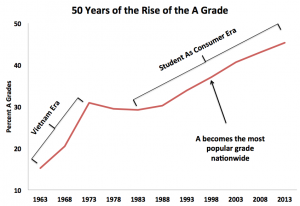
Since the 1990s, the A grade is the most common grade given in four-year colleges, and As are now three times more common than they were in 1960. At that time Cs were most common, and in my own era, Bs were most common. Now if they don’t get an A, students are at the professor’s throat as if the failing rests with the prof and not with their own performance. If you believe that is because college students have gotten that much smarter since 1960, I have a nice athletic building on a fine campus I’d like to sell you. Very good price. Just sign right here. Oh, wait, you can’t sign, because you never learned cursive. Okay, put your “X” on the line there.

Having been a college professor, I can tell you there is a strong tendency toward treating what are supposed to be young (and sometimes not so young) adults as 50 Years Rise of A Gradechildren. There is a stress on not offending the students, sandwiching any critical remarks in between praise, not being unduly harsh in comments even in the face of abject and repeated refusal on the part of the student to follow guidance. This is called the Student as Consumer Era, and it is indicative of schools that need to cultivate their students to stay enrolled and to pay the exorbitant tuitions and fees charged them and their parents. And instead of challenging their minds and belief systems, these educational institutions allow students to retreat to so-called “safe spaces” and to drive speakers with views divergent from their own off campus, allowing a new form of Fascism and sheltered closed-mindedness to run rampant on college campuses.

Moving from the swamp of so-called education, we have cars that stop themselves or keep themselves in their own lanes, ostensibly so their owners (“drivers” is too strong a word for them) can text and talk on the phone. Things seem increasingly geared toward the lazy and the ignorant. My own car turns its own lights on and off, doesn’t have a key, and tells me how many miles I can go before I run out of fuel. Thank goodness it doesn’t stop itself or do that lane thing, which would be way beyond what I would tolerate of my car. It does open its own trunk, though, for unknown reasons and at very inconvenient times, sometimes multiple times in a row. I guess taunting its owner is part of the deal. I can almost hear it laugh when it does this.

In the course of all these trends, we continue to lose human contact at an almost alarming rate. My most recent two forays into paying entry fees – one at a movie theater, the other at a major conference I attended – were done at terminals. Gone were the friendly ticket girl and the helpful conference gatekeeper, replaced by screens and credit card readers and keyboards. That may all be more efficient, but it’s a bit disconcerting, too. My local Walmart has installed all sorts of self-check-out equipment, but I have never found self-check-out to be faster or more efficient than dealing with a human cashier, and it’s also a tad insulting, I think. If the store wants my money, it should at least have a sufficient number of humans on hand to take it. So, unless I have just one or two items and am in a major hurry, I won’t use the self-check-out.

Meanwhile, the medical profession – one area that might benefit from more, rather than less, technology in enabling improved communication between physicians and patients – remains mired back a century or two. If anyone is able to email their doctor, or even their doctor’s office, I’d love to hear about it. And our prescription drug system seems designed to breed frustration and inefficiency, and we wonder why healthcare costs continue to escalate. I’ve written on these things before, and on the inherent inequities and inefficiencies of the medical system, and the most I’ve gotten in response from doctors is a smile and a laugh, as if I were proposing absurdities.

Call me a curmudgeon if you like, but somehow this all feels like we’re headed off the rails with no way back. Maybe, as the illustration says, you’ll get it eventually, but by then it might be — probably will be — too late. I could be wrong, but I don’t think I am. Am I the only one who feels this way? I’d love to hear your thoughts on all this, regardless which side of things you come down on.

Charts from http://www.gradeinflation.com 

Stop the Madness

Stop the Madness

I don’t mean to sound like a curmudgeon, since I’m not, really, but there are some things that just need to be said about how things clearly are headed in this technological world we inhabit.

News of interactive appliances, self-driving cars, bots and algorithms that determine what gets fed to us over the Internet has gotten to be pretty much old hat. Those things would be enough to give us pause, but no, nothing is about to stop there, it seems.

It’s bad enough that we have to fear our washing machine or refrigerator turning us in for some transgression, or feeding our habits to an advertising program that will just try to sell us more stuff we probably don’t need. And if I can’t open the door of the fridge to see how much milk or eggs or cream cheese is left, someone really needs to put me out of my misery, and soon. But things have already reached that stage.

There is a way of looking at things that seems to have gotten lost in the quest to come up with the next technological advance. It’s pretty simple, really: Just because it’s possible to do something doesn’t mean it’s a good idea to do it. That’s where we’re at, maybe already well past it, and the lesson seems to be lost on those who are planning our “brave” new world of technological wonders. It’s time to stop the madness, though I’m not encouraged by what I see and hear about almost on a daily basis now.

Take cars, for example. Now there’s a subject. Some of us actually don’t want our car making decisions for us. Cars that stop on their own, keep us from wandering into the next lane, open and close their own doors, and which park themselves already go further than some of us, those who were taught to drive properly and enjoy being in charge of the process of guiding a machine down the road, want. Now we’re looking at cars, and even trucks, that drive themselves. They’re already out there, sharing the roads with us. But apparently that is not enough for those who think up these things. The next step – I am not making this up – are cars that will carry on a conversation with us while they drive us around.

Am I some sort of raving radical when I say I don’t really want to have a conversation with my car? I don’t even like riding in taxis since I’d rather not converse with the driver. How much less will I want to speak with a machine? Just guessing here, but I’d say a lot. A really lot. A lot a lot. What could my car even have to say that would interest me? At least with cab drivers I can learn about other cultures and the kinds of things that brought them here. I really don’t need to hear from my car how things were in Korea or Mexico or Canada or wherever before they came here, or how they’re running hot and they just don’t feel up to par these days. And suppose their hearing or grasp of the language isn’t so good? One can only imagine the misunderstandings that might ensue.

Now we’re hearing about pills that send out little signals so that our doctors can spy on us and see whether we’re taking the bloody things as they’ve instructed. I can’t get my doctors on the phone or even send them an email, but now they’re going to be listening in on what’s going on inside my stomach? Sorry, I don’t think so. The manufacturers of these spybot pills say they’re perfectly safe. Well, I’m less concerned about that then I am about what other purposes they might be put to, like programming our refrigerators not to let us touch the bacon or the ice cream that dwells within them. Or someone hacking into those interactive pills to find out more about us, things our insurance company or Russian scammers might want to know.

We’ve become so hungry to consume that having packages delivered to our doorstep isn’t enough anymore. Now Amazon is offering “in home” delivery – literally, their delivery people will come inside our home to drop off our latest gizmo. But do I want strangers coming into my home? Hell, no. It’s bad enough they know where I live. I certainly don’t want them crossing the threshold and coming inside. And I don’t care if some hidden camera or Alexa, Amazon’s other way of getting into our house and life – and two more things I don’t want in my home — is there to observe them.

Increasingly bots and algorithms determine what we read, what ads are fed us, what vids pop up on our computer screens. Google thinks its algorithms are so smart they can tell where we are and feed us local ads. Ha, Google. FYI, I don’t live in Chicago, nowhere within a thousand miles of it, even if my ISP is located there, so you can stop sending me all those ads for vendors in the Windy City. We’re still a long way from when these things will be fool-proof, if ever, but meanwhile they’ve been unleashed on us. For instance, now we read that with the YouTube Kids application – Google owns YouTube, too, if you didn’t know – the algorithms are feeding the little darlings cartoons in which the characters drink bleach, appear as gore-covered zombies, or get it on with other characters. With parents increasingly substituting screens for actual parenting, who couldn’t see this coming? Nothing like a bot to handle the babysitting, right?

When I was a kid, my dad would take me outside on cold nights to look through a telescope at the moon and the planets. I wonder how many parents and kids do that today, and I’d be willing to wager that the only way most kids today see celestial bodies, if at all, is on a screen.

More and more we’re seeing machines and electronics and robots taking over ever-more things that used to be the province of people, of actual human beings, to do. We’re told that many manufacturing jobs will never come back because technology and robots have replaced the workers that used to be in them. And while the machines, for all their faults, get smarter and smarter, it seems people are getting dumber and dumber, with no end in sight for either trend.

There has been a question on my mind for a very long time, long before the popular future vision began to become a reality. And that is, if machines and technology can do all this stuff, what will people do? Or more precisely, what will people do to earn a living to pay for all these luxuries, all these gadgets, all these robots and technological advances? The vision of the future was a place where people could live lives of total leisure, never having to lift a finger. It seems that’s what the people developing these technologies have in mind, but is anyone thinking about the economics and the politics of it all?

I can just imagine sitting at home drinking mint juleps, prepared by Alexa, and watching on a screen as my self-driving car heads out on a scenic road that I get to enjoy vicariously from my living room. Drones are dropping off packages I’ve ordered online and bots carry them inside, while my robot vacuum cleaner does the den and my refrigerator orders up restocks of the bananas and hot dogs. My imaginary kids are playing video games and learning about life from cartoons, and all the while ads and click-bait stories about celebrities pop up on screens all over the house.

If that’s my life, who is paying for it? I can easily see a society – we’re almost there now — where a permanent underclass is forced to support the more privileged among us. Proles who support members of the Inner and Outer Party (thank you, George Orwell, for painting such a vivid picture of this notional future in the perhaps prophetic Nineteen Eighty-Four, the year in the title maybe just four decades early).

At one time we used to worry about big corporations taking on too much power and controlling our lives too much. Yet, these new corporations of technology have become bigger, more powerful, and with more influence on our lives than any ITT, GM, IBM, or AT&T of the past. Somehow we’ve come to see the Googles and Apples and Microsofts of the world as benign, looking after our well being and making our lives better and easier, and not as the profit-making, market-share-grabbing machines that they are. Maybe a comparison could be drawn with the Omni Consumer Products (OCP) corporation of 1987’s RoboCop film.

I also have to wonder what politics all this will lead to, with the political order mirroring and supporting the economic one. Already we’ve become polarized and divided almost as never before, and I can only see this trend growing as our societal dialogue becomes increasingly fractured, splintered, and Balkanized, with each individual picking and choosing what version of reality he or she prefers. And with the decline of the national dialogue and the dumbing-down of the population, it will become easier and easier for Big Brother (who also comes to us from Nineteen Eighty-Four) to simply manipulate and control a society whose creature comforts and diet of electronic pap fed them will take precedence over more traditional political values, like dissent and the freedoms of speech and association.

Already otherwise intelligent people appear to have a hard time writing anything that exceeds 140 (or 280, for the truly verbose) characters, and what at one time would be intelligent correspondence and debate has been reduced to gibberish, repetition, and name-slinging. A large proportion of the population sees the world through the medium of a phone, and the quality of their communication reflects this.

I’m not going to claim that technology is inherently bad – after all, I’m writing this on a laptop computer, and the thought of doing so on a typewriter is a chilling one – but we need to think about how far things can be carried before the beneficial becomes detrimental. Like I said near the outset, just because it’s possible to do something doesn’t mean it should be done.

It’s time to stop the madness.

From Water to Water

From Water to Water

. . . for water thou art, and unto water shalt thou return.”

Taking a little poetic license here with the wording of Genesis 3:19 to illustrate the intrinsic nature of hydrogen technology.

We’ll get to how that works, but first a little background, about me, and about hydrogen and its use in electricity-producing devices known as fuel cells.

I covered the space program as a science writer back in the 1980s, including daily interaction with NASA’s Space Shuttle program. That’s when I first started getting really interested in hydrogen as a potential fuel source for the future, including replacing fossil fuels for use in our cars, trucks, buses, and possibly even aircraft. At the time, I considered various possible fuel sources, and the one that made the greatest sense to me was hydrogen, the most abundant element in the Universe. Not to burn hydrogen as we burn gasoline or diesel, or as the Space Shuttle burned it for lift-off, but rather as a source to produce electrical energy through a fuel cell that would then drive electric motors.

NASA has been putting fuel cells aboard spacecraft since the early 1960s, and they are what generate electricity aboard many spacecraft, including the Space Shuttle when it was operational. Fuel cell technology is actually a very old one, the principle first demonstrated in 1801 – yes, 1801, that’s not a typo – by Humphry Davy. Sir William Grove, who came to be known as the “Father of the Fuel Cell,” then invented the first fuel cell, which he called an “electric battery,” in 1839. Two researchers, Charles Langer and Ludwig Mond, were the ones, in 1889, to coin the term “fuel cell,” as they attempted to produce a device that would convert coal or carbon to electricity. What is considered the first successful fuel cell, using hydrogen and oxygen with alkaline electrolytes and nickel electrodes, was developed by Francis Bacon in 1932.

It wasn’t until 1959 that Bacon was able to produce the first practical fuel cell, one that could be put to use driving equipment. Also during the 1950s, General Electric invented the proton-exchange membrane fuel cell, and in the subsequent decade NASA started putting fuel cells aboard spacecraft. The technology since then has continued to develop, evolve, and gain in efficiency, which puts us where we are today.

My conclusion 30 years ago that hydrogen, used to generate electricity through fuel cells, would be the wave of future automotive technology was not the first bit of technical or scientific prognostication I had come up with. Ever since I was a kid I saw concept after concept that I first postulated subsequently adopted by manufacturers and appear on cars as well as on ships. It’s taken nearly three decades, and it probably will take another decade to be fully realized, but I finally am seeing my conclusion about hydrogen and fuel cells coming into reality. I don’t suppose I am the only one who saw this development, but I feel increasingly vindicated that it was an accurate prediction.

Now, getting back to the water-to-water thing. If you remember anything about your early schooling, beyond perhaps your first teacher’s name or the name of your best friend, it is the formula for water: H2O. The “O,” of course, stands for oxygen, the third most abundant element in the Universe. And the “H” stands for hydrogen. Two atoms of hydrogen, combined with one atom of oxygen, give us that liquid, water, essential to life as we know it.

Now here’s the really neat thing about hydrogen. It can be produced by separating it from oxygen in water, yielding both key elements to produce energy in a fuel cell – hydrogen and oxygen – and then when they are rejoined at the end of the process, voila, you get back water, and only water. It starts as water and ends as water. Water-to-water. Neat, huh?

Compared with a standard internal combustion engine burning gasoline or diesel, which produces poisonous carbon monoxide, nitrogen oxide, sulfur dioxide, particulate matter, and other nasty stuff, it’s kind of a no-brainer. But what about pure electric cars with motors powered by batteries, you ask? Aren’t they even cleaner, producing no pollution? Well, that’s only if you look at the motors themselves. But where does the electricity needed to charge the batteries to drive the motors come from? Right. Power plants which, depending on the plant, might burn fuel oil, coal, nuclear fuel, or natural gas (the latter perhaps being the cleanest source of mass power production, save for hydroelectric plants which have their own issues associated with them).

Former Fox News commentator Bill O’Reilly once waxed eloquent about how all the nation’s cars should be electric and how much cleaner that would make the environment. I pointed out to him something called the Law of Conservation of Energy, which means it would take the same amount of energy to move all those cars regardless the source of the energy, and if the source of the electricity was central power plants, as it would be, there still would be a significant amount of pollution associated with all those electric cars. Alas, O’Reilly, clearly not a physicist, chose to ignore my message.

There are other problems with electric vehicles, too, including significant environmental issues with both the manufacture of the big batteries used in cars – building an electric car produces more greenhouse gases than does building a conventional car – and their disposal when they’ve reached the end of their useful life. And while the best pure-electric vehicle today might go over 300 miles on a charge, most still are limited to a range of 100 – 200 miles. Not very far, especially when it can then take anywhere from 30 minutes for a quick charge up to around 80 percent of battery capacity to as long as 12 hours to re-charge the batteries. If you’re not in much of a hurry or not going very far, an electric car might meet your need. Otherwise, not so much.

There is another huge problem with electric cars that was highlighted in recent months by the three major hurricanes to hit U.S. shores this year: Harvey, Irma, and Maria. When power is knocked out for large swaths of territory for hours, days, weeks, and, in some cases, months, an electric vehicle becomes a very large paper weight. Lacking a source of power to recharge its batteries, an electric vehicle isn’t going anywhere once its batteries are depleted. While there usually are conventional fuel shortages around big storms, people can fill their tanks ahead of time and often there are limited sources for gasoline and diesel available before, during, and after big storms. A conventionally powered vehicle might keep going while an electric one might not.

Looking now at hydrogen cars, the cars being produced and sold that are called “hydrogen-powered” actually employ fuel cells to drive the electric motors that drive the cars. While lagging far behind electric and hybrid-electric cars in terms of sheer numbers on the roads, the biggest problem retarding their more widespread use is a chicken-and-egg conundrum centered around the availability of hydrogen fuel stations. With low numbers of hydrogen vehicles there is low incentive to provide hydrogen fuel stations, and the low number of hydrogen fuel stations deters more widespread marketing and purchasing of hydrogen vehicles. But there might be changes on the way as, I would argue, there should be.

It’s estimated that by the end of this year there will be just 50 hydrogen filling stations in the U.S., most of them in California. There also are fleet stations and those used for research vehicles, but there is a huge gap in the number of places where one can fill up a hydrogen vehicle. Consider, however, that it only takes 3 – 5 minutes to refuel a hydrogen car, comparable to filling up a gasoline or diesel car, versus the hours needed to charge an electric vehicle, and the fact that hydrogen cars have ranges in excess of 300 miles and acceleration often equivalent to a conventional car.

Besides the paucity of places to fill up, the other problem with hydrogen is how to generate it in clean and economical ways. While it’s the most abundant element, it loves to join with oxygen to make water and other atoms to form other substances, and breaking it free to run it through a fuel cell is both a technical and an economic challenge. While there is enough oxygen in the air to use in a fuel cell, it’s a more difficult proposition with hydrogen.

There are all sorts of ways used to generate hydrogen, ranging from throwing iron filings into vats of sulfuric acid, to cracking hydrocarbon molecules in natural gas to, a more recent proposal, using geothermal heat at great ocean depths to generate large quantities of hydrogen. While the first method produces toxic waste, the second produces carbon dioxide, a greenhouse gas, and the third is still under development, there is a simple, tried-and-true method, alluded to at the outset of this piece, that starts and ends with water.

That method uses electrolysis to separate water into its constituent atoms, and then after passing them through a fuel cell, reunites them as water at the end of the process. In fact, it’s relatively simple to construct a hydrogen generator of this sort – I’ve done it myself with readily available materials costing somewhere around $100 – and there are commercially available hydrogen generators for prices equivalent, or less, than making one’s own, and there even is a portable hydrogen reactor and fuel cell available for $105.99.

The basic problem with generating hydrogen through electrolysis is that it uses electricity to produce the hydrogen to be used in a fuel cell to, you guessed it, make electricity. But it’s not hard to envisage using solar or wind energy to provide the electricity used in the electrolysis. In fact, I think it doesn’t take a huge amount of imagination to picture each household with a hydrogen vehicle generating its own hydrogen. And maybe it’s a bit of a stretch today, but why can’t we see each hydrogen vehicle with its own on-board hydrogen generator, powered with rooftop solar panels, producing its own fuel from water that then returns to water and is recycled back through the hydrogen generator and, employing a little hyperbole, becomes its own perpetual motion machine?

We’ve heard of the supposed possibility of running cars on water, but with hydrogen cars this is a possibility, and it’s all based on science, not science fiction or a scam, if the technical issues can be worked out.

Elon Musk, who has put all his eggs in the electric car basket with Tesla Motors and the Tesla Gigafactory battery-production facilities, calls hydrogen technology “incredibly dumb.” He thinks it’s inefficient. But the major automobile manufacturers against which Musk and Tesla are pitted might disagree, and there are no fewer than eight hydrogen cars either currently available or under development for the marketplace in the next few years. These include the Toyota Mirai and Honda Clarity, two hydrogen cars already on the market, and hydrogen cars planned for release in the next few years by Lexus, Mercedes-Benz, Audi, BMW, Ford, General Motors, and Nissan. A small Welsh startup, Riversimple, is making its subcompact hydrogen car available in the UK this year, Ford expects to have its hydrogen car out this year, and startup truck maker Nikola Moto Company unveiled a prototype hydrogen truck late last year that it expects to offer by 2020, with a range of between 800 and 1,200 miles. Nikola also plans to open 364 hydrogen filling stations by 2019.

Meanwhile, the French firm Alstom ran its first hydrogen fuel cell train, the Coradia iLint, in Germany in March, reaching 80 kph, and 140 kph in tests run in the Czech Republic, and orders for the train are already pouring in. Its sole emissions are steam and water.

“It’s so clean you can breathe it in,” says Stefan Schrank, Alstom’s project manager of the train’s emissions. And it is 60 percent less noisy than a diesel-powered train.

Whether the various plans for hydrogen cars and other vehicles reach fruition remains to be seen. It’s still not clear whether hydrogen is the fuel of the future and always will be – as Charles de Gaulle once said of Brazil, which he called “the country of the future, and always will be” – or if it becomes the primary fuel to replace fossil fuels. The question may be decided in the next 10 – 15 years, or even sooner. It was my pick 30 years ago, and so far I’m still betting on it.

Water-to-water, baby. I think that’s a winning formula.