“Here men from the planet Earth first set foot upon the moon, July 1969 A.D. We came in peace for all mankind.” – Words on the plaque left on the moon by the crew of Apollo 11
There have and will be many words written and numerous commemorations broadcast this week to mark the fiftieth anniversary of the first time humans set foot on the moon. For that reason, and others of a more personal nature, this will be an account of my own journey leading up to that momentous event, and since, and not any kind of historic or scientific record of the flight of Apollo 11 or the first moon landing. Yes, it’s long. But it’s been a long trip.
 What happened on July 20 and 21, 1969, to me was the culmination not just of my own interest in space and space exploration that I had pursued since I was a child, but the result of many centuries of human scientific development and evolution, and also the climax of the eons that preceded them when primitive humans looked up at the moon with wonder, yearning, and maybe even fear. That phrase on the Apollo 11 plaque, “We came in peace for all mankind,” best summed up my feelings on that historic night.
The Early Years
I can’t say specifically what triggered my early interest in space, except perhaps a general interest in science, but I do know that by the age of 9 I was writing novellas about future space explorers engaged in both dramatic and mundane tasks in the far reaches of the solar system. Starring protagonist Fairleigh Starr and his intrepid crew aboard the space freighter Euphrates, I still have those little string-bound books and their illustrative covers, hand-drawn in crayon on cardboard, somewhere in my archives. I also still have some of my early astronomy books.
I don’t remember the exact year or my age, but at some point my father got me an actual, real, reflecting telescope, and this opened up new vistas beyond our planet to me. Many were the nights he and I would brave the cold out in our driveway pointing the telescope toward the moon and beyond. Under the red skies of Northeastern New Jersey, illuminated as they were by the myriad lights of the New York Metro area, it was hard, if not impossible, to see much beyond the biggest and brightest celestial objects, the moon being paramount among them. All these decades later I can still picture in my mind’s eye the distinct craters and the bright silvery surface of earth’s sole natural satellite as seen vividly through that telescope.
The late 1950s and early 1960s were heady times for anyone interested in space exploration. In fact, they were heady times even for those not so interested. As the United States faltered through one failed launch after another, the Soviets – known more generally to us as the Russians – were succeeding in their advance into space. The thing that got our attention more than anything was the successful launch of Sputnik, the world’s first artificial satellite, in October 1957. More than attention, it struck fear into the hearts of many, including my own mother, who tucked her 7-year-old son, being me, into bed one post-Sputnik night, saying as she did, “I don’t think we’re going to live to see Christmas this year.” Thanks for that, Mom.
As it turned out, we did survive to see that Christmas, and many since. But again it was the Russians who were first to send a man not just into space, but into orbit, when cosmonaut Yuri Gargarin circled the earth one time on April 15, 1961. Less than a month later, on May 5, 1961, the U.S. finally succeeded in launching the first American into space, astronaut Alan Shephard, on a 15-minute sub-orbital flight launched atop a Mercury-Redstone rocket from Cape Canaveral. Watching the launch and recovery of the Freedom 7 Mercury capsule on TV still remains in my memory, as do the other Mercury launches and recoveries to follow. And then, nine months later on February 20, 1962, John Glenn became the first American to orbit the earth, three times, aboard the capsule Friendship 7, and the U.S. took the lead in what was clearly a space race. By then I was hooked on space, and there was no looking back.
What led us on the path to the moon was a speech President John Kennedy gave to Congress on May 25, 1961, when he said that the U.S. “. . . should commit itself to achieving the goal, before this decade is out, of landing a man on the moon and returning him safely to the earth.” Kennedy repeated the same objective in a now-famous speech he delivered to 40,000 people in the stadium at Rice University in Houston on September 12, 1962, saying, “We choose to go to the Moon in this decade and do the other things, not because they are easy, but because they are hard; because that goal will serve to organize and measure the best of our energies and skills, because that challenge is one that we are willing to accept, one we are unwilling to postpone, and one we intend to win, and the others, too.”
The course was set to the moon, and despite a chorus of naysayers, the objective was reached, Kennedy’s challenge fulfilled, on July 20, 1969.
The mission of Apollo 11 had lifted off four days earlier, on July 16, 1969, at 9:32 a.m. EDT (13:32 UTC), from Launch Pad 39A at Cape Canaveral – known at the time as Cape Kennedy in JFK’s honor – carrying Neil Armstrong, Buzz Aldrin, and Michael Collins toward the moon.  A product of the work of Wernher von Braun and his team of German rocket engineers brought to the U.S. following World War II, the Saturn V rocket that bore them aloft was, and remains, the biggest and most powerful rocket ever built, so loud on launch its sound waves broke windows in Titusville, 12 miles away. Armstrong later described the initial ascent as a very bumpy ride, at least until first-stage separation, when he said things became smooth and totally silent. At that point, the world waited, and watched.
“The Eagle Has Landed”
July 1969, exactly a half century ago, was a personally tumultuous time for me. At 19 ½, in the summer between my sophomore and junior years at Rutgers University, I was in the midst of my first real affair, and that in itself was proving more challenging than I had bargained for (Sheila was an artist, she didn’t look back – thank you Bob Dylan for summing things up so well). I had a summer job mowing grass and picking up litter on the New Jersey Turnpike, out of the Secaucus yard in the most congested and polluted sector of the Pike in its final miles between Newark Airport and Exit 18, the northern terminus and gateway to the George Washington Bridge. I was living back at home for the summer and in a state of ongoing conflict with both my parents. Worse was how I sensed my father often didn’t have the heart for the conflict, but my mother goaded him into it and to appease or please her, he’d rise to the occasion.
It also was perhaps the most creative time of my life. On the many and prolonged breaks my maintenance team on the Turnpike would take, once Moe, our supervisor, had driven off and left us to our own devices, we would drop our mowers and tools and retreat to the shade under an overpass, or occasionally wander off the Pike to some nearby diner for a late breakfast. While the other guys sat around and shot the shit for hours, I would sequester myself to write and draw in my own imagined, but productive, world. Along with my writing, I was able to draw in ways I had never before, nor since, been capable of. If you can imagine completely changing the gears in your head, that was what it was like that summer.
I don’t remember all the details or reasons, but the small group of friends of which Sheila and I were a part could not be together the night of the moon landing. It was a Sunday night, July 20, and I had work the next morning, moon landing or no moon landing. As I recall, my high school friend John Horohan was with his girlfriend Jane, who had introduced me to Sheila, and I don’t remember whether Sheila was with them or somewhere else. She wasn’t with me, though, nor I with her, which was the main thing.
The lunar lander had touched down on the moon’s surface earlier that afternoon, almost out of fuel and in a different location – the Sea of Tranquility – than initially planned, at 4:17 p.m. EDT (20:17 UTC). As it turned out, Armstrong had to take over the controls of the lander following a computer overload and finding too many bus-sized boulders at the initial West Crater landing site. It was with relief when Mission Control, along with the rest of the world, heard Armstrong’s words, “Houston, Tranquility Base here. The Eagle has landed.”
The actual moon walk was planned for later that night, and that to us was the big event. I had been sleeping out on our enclosed back porch, as I was wont to do in the summers spent at home, and that night I was watching there in the dark, on the small TV we kept on the porch, the events unfolding 240,000 miles away on the moon. On the moon! My parents were upstairs in their room also watching on their TV, and we could have been on separate planets for the divide between us on that historic night. Other than some forays my mother would make down to check on me – mostly to harass me for staying up past my alleged bedtime, as I recall – we had little or no contact that night.
 The telephone provided the link between me and my friends, a kind of lifeline as it were, and we stayed in touch intermittently via it as the time approached for Neil Armstrong and Buzz Aldrin to step out of the lunar lander and descend the craft’s ladder to the surface of the moon. As we and 600 million other people around the globe watched, that came at 10:56 p.m. EDT (02:56 UTC on July 21), when Armstrong stepped down onto the lunar surface, uttering the famous words, “That’s one small step for man, one giant leap for mankind” (controversy has dogged those words ever since, and it’s pretty well believed that a blip in the radio transmission changed the intended and spoken “one small step for a man” to what is commonly attributed to Armstrong). Aldrin followed Armstrong down the ladder, and together, as we watched in fascination and through bleary eyes and blurry black and white video images, the pair bounced around on the lunar surface, collecting moon rocks as they did, for the next two and a quarter hours. Meanwhile, Collins, in the command module, named Columbia, orbited the moon, keeping an eye on things from 69 miles above the lunar surface.
Little did I realize at the time what connections I would have with Armstrong, and especially Aldrin, and other men who set foot on the moon, a decade and a half later.
The Aftermath
What I saw in the lunar mission and the success of Apollo 11 was not just a victory and amazing achievement for America, but the culmination of centuries of discoveries and achievements of many people of many nationalities. There was Copernicus, a Pole, who in the Sixteenth Century, postulated a universe with the sun, not the earth, at its center. He was preceded in the heliocentric theory by Aristarchus of Samos, a Greek, eighteen centuries earlier, and followed in the next century by Galileo, an Italian, who was declared a heretic for his beliefs by the Catholic Church in 1633. It took the Church three more centuries to finally concede that it’s supposedly infallible belief was, well, wrong. Galileo’s theories of gravity also proved to be correct, not bad for a heretic.
There was Newton, an Englishman, and his discoveries of the laws of physics. And Lippershey, a Dutchman, who invented the telescope. And da Vinci, another Italian, who had invented an actual flying machine – the helicopter – and the parachute, and who also had postulated a heliocentric universe. The Chinese in the Ninth Century invented the rocket, but Goddard, an American, invented the first liquid-fueled rocket in 1926. And von Braun and the other German rocket engineers brought it all together, with American support and funding, with the Saturn V. I don’t mean this list to be inclusive, but simply illustrative of the worldwide, global contributions over the centuries that finally resulted in Apollo 11 and the moon landing.
Indeed, as the plaque said, “We came in peace for all mankind.” And at the moment of mankind’s first steps on the moon and the days that followed, the world was largely united in hailing a feat that previously existed only in the realm of dreams and the imagination. Of course, there are still those on the fringe who continue to imagine that the whole moon landing was staged, that the astronauts descended to some hidden chamber under the launch pad or went to Hollywood, where there was a set made to look like a moonscape and the whole thing was an elaborate deception. And when I was posted as a diplomat to Albania in the 1990s, people there said they had been told by the previous Communist regime that it was the Russians, not the Americans, who had landed men on the moon.
A week after the lunar landing and walk, on July 27, 1969, my father died, unexpectedly, in front of me, in the midst of one more of our low-level conflicts. He had gotten to witness people walking on the moon, something almost unimaginable at the time of his birth in 1913, and then he was gone. And thus, with his death, began the rest of my life, the half century that followed.
After Apollo 11, there were just six more lunar missions – five lunar landings, one short of what was planned when Apollo 13 ran into serious problems en route to the moon and had to return to earth without reaching its destination. Later, as a journalist covering the space program, I lost count of the number of times when engineers and managers who had been involved with the Apollo program told me that getting men to the moon was not the big challenge of the Apollo program. It was getting the crew of Apollo 13 back alive. In any event,  with the splashdown of Apollo 17 on December 19, 1972, the moon program was over, less than three and a half years after the launch of Apollo 11. The country, embroiled in the Vietnam War and deeply divided, was withdrawing into itself, and Congress cut NASA’s funding. What was left of funding for manned space flight was directed toward the Apollo-Soyuz joint mission with the Soviet Union and three missions of Skylab, the world’s first space station. After all the years of striving to reach the moon, and meeting the challenge President Kennedy laid down, we reverted to missions in low earth orbit. To this day, that is where we have remained.
What struck me then, and continues to trouble me, is how for eons people looked to the heavens and wondered and dreamed of what it would be like to walk on the moon. And now billions of people, billions of children, and adults, were born and lived since the last human left the moon, and again are left to look toward the heavens, toward the moon, and wonder and dream, just as primitive humans did millennia ago.
As America and the space program drifted through the 1970s, I looked inward, too, and essentially cut myself off from what was going on in the world, and what remained of the space program. I had this peculiar idea that if I cut off the news of the world and its problems those problems would go away and leave me alone. It didn’t take more than several years to realize that’s not how things work.
A Return to Space
My return to space came in 1982. After detours through Woodstock and Key West and grad school at the University of Florida, I wound up taking up a reporting job in Cocoa, Fla., at the doorstep to Cape Canaveral and Kennedy Space Center. While I was with the weekly paper, The Tribune, I struck up a friendship with the lead reporter, Peter Adams, at our sister daily, TODAY (now FLORIDA TODAY). Perhaps it could only happen in Brevard County, Fla., but the lead reporter was the Science Writer, formerly known as the Aerospace Writer, whose primary duty entailed covering the space program.
The Space Shuttle program was under way, with the launch of the orbiter Columbia and STS-1 in April of 1981. Peter invited me to accompany him to witness a launch of the Shuttle at KSC, the launch of Columbia and STS-5 on November 11, 1982. It was one of the most exciting things I’d ever witnessed, and again, I was hooked. I later finagled my first assignment actually covering a space launch, as a freelancer for The Globe and Mail of Toronto, reporting on the launch of a Delta rocket from Cape Canaveral carrying a Canadian satellite that subsequently failed to go into orbit and was lost. Peter and I continued to remain in close contact, and when he left the paper to go to The Orlando Sentinel, our main competition, he recommended me for the choice position of Science Writer. I not only moved to my first position on a daily, but to the premier reporting position, with the charge to report daily on the space program and other science topics.
The first launch I was to cover as primary reporter was the maiden launch of the new orbiter, Challenger. But before it could launch I received a phone call from a confidential informant late one night in the newsroom. The word was that a problem with the Shuttle’s main engines had been discovered and the launch would be delayed, possibly for months. I was able to chase down other sources to confirm the report, and we were first to break the story of Challenger’s impending lengthy delay, which turned out to be totally correct. I had already managed to win the confidence of those closest to the Shuttle program and to break my first big story.
Challenger finally did launch on April 4, 1983, carrying a tracking and relay satellite into orbit. The flight, the first of many Space Shuttle missions I would cover, also featured the first EVA – Extra-Vehicular Activity, or space walk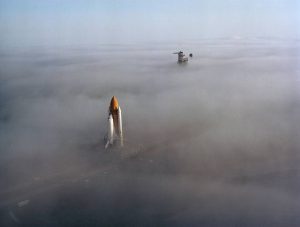 – of the Shuttle program. In my time as Science Writer, I got to cover many other firsts: The first flight of Spacelab. The first American woman in space. The first flight of two women in space, and the first space walk by an American woman. The first African-American in space. The first Shuttle night launch. The first launch of the orbiter Discovery. The first Shuttle landing at KSC. The first recovery and return to earth of orbiting satellites. The first classified Department of Defense Shuttle mission. The first in-space repair of an orbiting satellite. The first flight of a politician in space. Many of my stories got national play via the Gannett News Service and appearance in USA TODAY, for which TODAY served as the model.
I approached my work as a Science Writer the same way I approached other reporting positions I had filled, which was to build in as much diversity and have as much fun with it as I could, all while doing a competent and credible job of reporting. I felt my specialty was taking highly complex scientific and technical details and issues and translating them in a way that just about any reader could understand, without dumbing them down. In the course of my term, I managed to score a wonderful stint at Space Camp in Huntsville, Ala., got to visit the WET-F – the huge water tank where astronauts practice doing EVAs in simulated weightlessness – in Houston, launched my own weather rocket, the Yacenda-1, from Cape Canaveral, flew aboard a NOAA hurricane tracker plane through a tropical storm, rode on the huge transporter that carried the Shuttle to the launch pad, and sat at desks of scientists with actual moon rocks on them. I came up with the term “astroworker” – a word my editors hated and took out at every chance they could, which is why you’ve never seen it – to encapsulate the kind of manual activity many astronauts and mission specialists engage in while in space.
More than anything was the thrill of meeting, interviewing, and in some cases spending time with people who had helped establish America’s place in space, people that had just been names bordering on mythological to me, and now I had the opportunity to be face-to-face with them. I got to interview and know half the men who had walked on the moon. It was said even then that Neil Armstrong rarely granted interviews. I had a telephone interview with him while he was a professor in Ohio, and he was indeed the humble, quiet, non-self-aggrandizing person I had been told he was. And I got to pal around for several days with Buzz Aldrin, who was and is every bit the character he was ascribed to being, though also knowledgeable and serious about America’s space pursuits. He told me of what was to be his next mission, setting up a space science program at the University of North Dakota. I love that the President featured Aldrin at the most recent State of the Union address.
I got to visit Edgar Mitchell and meet his family aboard Mitchell’s yacht when it was docked in Brevard County. I had the opportunity to interview Alan Bean about his art and Alan Shephard about his beer business. I had a number of encounters with Fred Haise, of Apollo 13 fame, both as a reporter and later as someone bidding for business from the company with which he became an executive, Grumman Aerospace. As then chief of the astronaut corps, John Young was someone I got to see and quote in numerous news conferences. I was able to meet Tom Stafford at an evening event. Though he wasn’t an astronaut, I got to interview Chuck Yeager, the first man to fly faster than the speed of sound and live to tell about it. And, a high point, I got to hang out with Walt Cunningham of Apollo 7 fame during some very entertaining days at Cape Canaveral when I had invited him to speak at a conference I helped organize, and then some time later have lunch with him at Brennan’s in Houston. I still remember the moment when we were waiting to board a tour bus at KSC and Cunningham was sitting on top of a waste basket, just as a place to rest. The bus driver informed us we needed to get tickets to take the tour, and then, realizing who the unassuming guy sitting on the trash can was, came bounding back off the bus, practically giddy and shaking, blurting out, “I’m sorry, Mr. Cunningham! I didn’t recognize you at first! Of course you don’t need a ticket! Anything you want, Mr. Cunningham!”
Along with all the other names and personalities, I got to interview Judy Resnik, one of my most memorable interviews. I still have the tape of that interview in which Resnik said she didn’t fear going up on the Shuttle since NASA took such care looking after the astronauts’ safety. When Challenger blew up on the bitterly cold morning of January 28, 1986, taking the lives of Resnik and her six crew mates with it, NASA wasn’t looking out for the astronauts’ safety, and neither was it when Columbia disintegrated on reentry on February 1, 2003. Both were avoidable disasters.
Looking Forward
I was no longer covering the space program at the time of the Challenger disaster — in fact, earlier the very morning it occurred I had looked toward the space center and said to myself, “One day that thing is going to blow up and I won’t be there when it does” — but I still was involved with space through my public relations firm, ITech International, which specialized in aerospace and high technology, among other areas. To me, the Challenger disaster was personal, both on account of the needless death of Judy Resnik and the other astronauts and specialists and the civilian school teacher, Christa McAuliffe, aboard, all of whom I had seen in news conferences and reported on, but because I helped bring Challenger into the world, covering its first launch, and the issues that had delayed that launch.
Following the Challenger disaster my old paper, TODAY, invited me to write an op-ed piece about the disaster and my views on where the country should go in its wake. In it I wrote how the Space Shuttle was equivalent to the early iterations of airliners that eventually led up to the DC-3, the first commercially successful airliner, and rather than expending money on another Shuttle orbiter, the nation should dedicate itself to new iterations of space transportation systems and go on to further space exploration. Obviously, Congress and NASA felt otherwise, and the space agency went on to build the orbiter Endeavour, which launched for the first time on May 7, 1992. And then, with the landing at KSC of the orbiter Atlantis on July 21, 2011, the Space Shuttle program came to an end.
And now, 50 years after the triumph of Apollo 11, we remain confined to low earth orbit. The International Space Station, development of which began when I was still involved with the space program, is the sole embodiment of humans in space. Since the end of the Shuttle program, the U.S. doesn’t even have the means of bringing our own astronauts to and from the ISS, depending on Russian rockets to do so. There are commercial rockets in the late development stage that are expected to be able to carry people to and from the ISS, but they’re not certified for this purpose yet. In fact, much of what holds promise for the future of space exploration rests with private companies, such as SpaceX and Boeing and several others.
I’m sure there is a lot of important work that goes on aboard the ISS, but I would venture that few people outside the program can name even one or two projects, specifically, that the ISS crews are working on. There is even credible argument that space is an expensive and not terribly great place for doing science. Regardless, whatever they are doing, it doesn’t provide the kind of excitement and global attention that deep-space exploration, most notably the Apollo lunar voyages, provided, and can provide. I am not denigrating the tremendously exciting and important and truly amazing unmanned space missions we’ve conducted. Our knowledge of the solar system and the universe beyond has been expanded enormously by these missions, and they should be continued. But somehow they lack the appeal and drama of manned missions of exploration to new destinations.
NASA and the space program reached its nadir in 2010 when its then-Adminstrator, Charles Bolden – himself a former astronaut – told Al Jazeera television that he had been charged by President Barack Obama with three primary tasks: Encourage children to learn about math and science, improve relations with foreign nations, and, Bolden said, “perhaps foremost, he wanted me to find a way to reach out to the Muslim world and engage much more with dominantly Muslim nations to help them feel good about their historic contribution to science … and math and engineering.”
Compare that with President Kennedy’s challenge, that the nation should commit itself to achieving the goal, before the decade was out, of landing a man on the moon and returning him safely to the earth. Not because it was easy, but because it was hard. In the intervening decades, it seems we have come down not just from the moon, but from rising to the kind of challenge the nation responded to in the 1960s.
Now there is talk of going to Mars. I’m happy to see that. While recognizing the costs and dangers involved in such missions, I think it is inevitable that the human spirit is always going to drive us on to bigger and more daring ventures, whether on earth or in space. I think it makes a lot of sense for us to go back first to the moon, and establish a base there. It takes a whole lot less energy to launch a rocket from a place where the gravity is one-sixth what it is on earth. There may be other justifications for a base on the moon, but that one alone provides justification if, in fact, we are intent on going to Mars and elsewhere in the solar system.
Most of my space interest these days is constrained to looking at the full moon, when it appears and the skies are clear, and watching for night launches from Cape Canaveral. I’m living 120 miles from the launch site, but in the dark of night I can get pretty clear views of the launches, which continue to excite me. Recently, during the latest SpaceX launch of its Falcon Heavy rocket from Pad 39A on June 25, the same launch pad from which Apollo 11 launched, I actually got to see the return to earth of the two first-stage boosters that came back to land at KSC. I think that was even more exciting than the launch, all the more so since I wasn’t expecting to be able to see that, just as watching the first Shuttle landing at KSC from the grandstand beside the runway was so exciting 35 years ago. I’m sure that one of these days I’m going to need to go back down to the space center and watch a launch from closer up.
And now, fifty years after that first footstep on the moon, I and the other 7.7-whatever billion people on this planet can only look up at the moon, and wonder: Will mankind ever again set foot on that celestial body? Will my children get to go there? Some might even wonder if they, themselves, will get a chance to go to the moon.
It is of such wonderment that giant leaps are born.
Watch the actual ignition and liftoff of Apollo 11 shot by a NASA camera at the launch pad
All images by NASA except the last image which is by SpaceX
This is a joint posting with my fiction site. It also appears on Medium.


