Tag: Liberals

Back to the Plantation

Back to the Plantation

One of the vestiges of the plantation system which depended on slavery for its existence was the racial divisiveness perpetrated by economic elites to maintain their power and control over both blacks and whites. In simplest terms, this translates to “divide and rule.”

“You are kept apart that you may be separately fleeced of your earnings,” Georgia populist leader Tom Watson told a gathering of white and black laborers in 1892. ““You are made to hate each other because upon that hatred is rested the keystone of the arch of financial despotism which enslaves you both.”

Lyndon Baines Johnson, who rose through the ranks of Texas racist politics to become the president who, after decades of helping block civil rights legislation in the House and the Senate, fostered passage of the Civil Rights Act of 1964, once related essentially the same theory to Bill Moyers. In classic LBJ style, Johnson told Moyers, a Johnson staffer before he became White House Press Secretary and, later, a journalist, “If you can convince the lowest white man he’s better than the best colored man, he won’t notice you’re picking his pocket. Hell, give him somebody to look down on, and he’ll empty his pockets for you.”
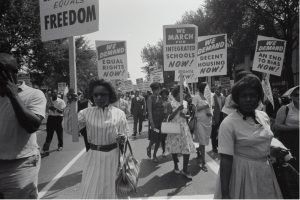
Women March on Washington
Women March on Washington, August 28, 1963. Library of Congress.

This was a theory I first learned in the aftermath of the civil rights movement of the 1960s. It made sense to me then, and it still makes sense to me, though the nature of those elites have changed during the intervening half century, as have their tools. And it wasn’t just white populists who laid out the theory, plain as day for anyone who cared to look.

The white liberal and the new plantation

The white liberal is the worst enemy to America and the worse enemy to the black man.”

That’s not a quote from Sean Hannity or Rush Limbaugh. It’s a quote from Malcolm X, the black liberation theology leader and firebrand, who said it about the same time LBJ was getting the civil rights theology and launching his War on Poverty, and not long before Malcolm X’s assassination on February 21, 1965.

The white liberal aren’t white people who are for independence, who are moral and ethical in their thinking. They are just a faction of white people that are jockeying for power,” he said. “The same as the white conservative is a faction of white people that are jockeying for power. They are fighting each other for power and prestige, and the one that is the football in the game is the Negro, 20 million black people. A political football, a political pawn, an economic football, and economic pawn. A social football, a social pawn.”

Malcolm X
Malcolm X. Source unknown. Used under Fair Use.

Malcolm X’s message – it’s worth reading the full quote, which is quite long – was that blacks need to solve their own problems and not depend on whites of either persuasion, liberal or conservative, Democrat or Republican, since for either of them it’s just a game of power and control.

The worst enemy that the Negro have is this white man that runs around here drooling at the mouth professing to love Negros, and calling himself a liberal, and it is following these white liberals that has perpetuated problems that Negros have. If the Negro wasn’t taken, tricked, or deceived by the white liberal then Negros would get together and solve our own problems.”

Now, 55 years later, Malcolm X’s message still hasn’t gotten through to many African Americans, much less to both white and black people who continue to pursue and support policies that effectively keep blacks, and all people of the underclass, down on the new plantation. I’m reminded of his message watching the multi-millionaire Nancy Pelosi and her hypocritical House Democrats kneeling in Kente cloths draped around their necks, and as trendy young white people proclaim on social media that they “stand against racism,” as if any right-thinking person doesn’t stand against racism, any less than someone might stand against kicking puppies or drowning babies. Or as politicians, lacking as much in balls as brains, call for disbanding the police, when it is black people who will be the main victims of the lawlessness, violence, and vigilantism that inevitably would ensue.

Look at what people do, not what they say

By way of disclosure, I’ve never considered myself a liberal, even during my radical phase (aspects of which persist). Like Malcolm X, I’ve never trusted self-proclaimed liberals who always have struck me as having ulterior motives or who operate under some sort of misplaced guilt or, at best, a Pollyannish view of the world. I tend to discount what people say in favor of what they do and, even more, the results they obtain through their actions and policies. This is highly relevant if you want to see the principle of “divide and rule” at work in contemporary liberal politics.

Consider this crucially important fact: While the U.S. has spent somewhere north of $22 trillionthat’s trillion, as in a thousand billion or a million million dollars, 22 times over (by some estimates, depending on how you count it, it’s closer to $27 trillion) – since LBJ declared the War on Poverty in his 1964 State of the Union address, the percentage of the population living in poverty has hardly changed at all in the past half century. Given that in the most recent normal year total U.S. GDP was just over $21 trillion, that’s a powerful lot of money to garner zero real reduction in the poverty rate. How can this be, you ask?

Look at the charts, below, to get a visual picture of the reality. What we see is that poverty was in major decline beginning in 1959, five years before Johnson’s declaration of his war on it. That decline continued for another five years, running through 1969. Beginning in 1970, a full 50 years ago, there has been essentially no long-term change in the poverty rate even as the country threw trillions of dollars of the national treasure at it.

As is visible, there have been blips up and down through both Democratic and Republican administrations and congresses, but the same overall reality persists across the span of a half century. As the third chart demonstrates, the African-American poverty rate has shown, marginally, the most improvement, especially when compared with the Hispanic and general poverty rates. But an interesting and undeniable reality emerges when you look at the first and third charts: The highest recent poverty levels in all three key categories – African-American, Hispanic, and the general population – peaked during the Obama administration, and all three reached historic lows during the Trump administration. How can this be, you might ask, given that Obama is painted as a friend of the poor and minorities and Trump is portrayed not only as their enemy, but as an out-and-out racist?

Like I said, get below the rhetoric and the reality emerges. Clearly taking the brakes off the economy and creating jobs that lower the unemployment rate and empower individuals and families, as Trump did in stark contrast to the effect his predecessor’s policies had on the economy, provides a road map for reducing poverty. Jobs are a key factor, if not the only one, in poverty reduction. There are other factors at work, too, and we’ll look at them toward the end of this piece.

Follow the money

Follow the money” is a phrase that we learned from Deep Throat during the Watergate scandal of the early 1970s. It’s salient to our discussion here.

I had a sociology professor when I was an undergrad at Rutgers University sometime in the late 1960s. I don’t recall his name, but he was a black man, and I always looked forward to his classes. One thing about him was that he was straightforward and honest in his discussion of social issues and didn’t try to promote any ideology, something that seems to have become a hallmark of more recent sociological education (I can say this having since been a professor of sociology myself and seeing the ideological blather in the text books, and ostensibly believed by other professors, that is fed to students in the field).

In any case, my professor had previously worked with an anti-poverty agency on Long Island in New York. He told us how this agency had spun its wheels “studying” how to provide low-income housing to people, how much money passed through it, how it debated one approach and another approach, and in the end, not a single unit of housing was built. My professor said that, had the money the agency spent been given to the people it ostensibly had been set up to help, every one of those families could have gone out and bought their own house.

Sadly, my professor’s example is far from a unique case, given the trillions of dollars spent on “helping” poor people over the intervening five decades without any real effect (a similar calculation was made for FEMA’s spending after Hurricane Katrina when it was determined that the money the agency spent bureaucratically could have paid for a new house and two new cars for everyone who lost their home in the storm, and that, too, is far from unique).

If you still have any doubt that the vast bulk of the money spent fighting poverty doesn’t go to the people in poverty, the chart below should dispel that doubt. As per-person spending has climbed inexorably over the past six decades, it certainly hasn’t gotten to those in need of the funds. As per-person spending approaches $20,000, the poverty level this year for a family of four is set at $26,200. If the preponderance of the money went to that same theoretical family, they’d be receiving nearly $80,000, a long, long way from the poverty level. Needless to say, that’s not where most of the money goes.

When you look at the sheer volume of money involved, is it any wonder that those into whose hands, and pockets, it passes want to be sure to keep their constituents in poverty? In this context, what is said about one party in particular, the Democratic Party, that it depends on the existence of a permanent underclass for its very existence, begins to make sense and takes on credibility. Looking strictly at the numbers, the existence of poverty, maintaining as many people as possible dependent on the largesse of what passes for anti-poverty spending, bolsters its electoral power and, more, furthers the interests of its power brokers while favoring their influence and their wealth. They are the new plantation masters.

Down on the urban plantation

It’s a clever ploy, a revival of “divide and rule” for more than half a century, and the Democratic Party continues to rely on this strategy, keeping its black constituents down on the urban plantation, well into the 21st Century. Consider for a moment these facts:

  • Democrats run 35 of the nation’s 50 largest cities (37 if you count the “Independent” mayors of San Antonio and Las Vegas, both of whom ran with Democratic support).
  • Democrats run 15 of the 16 cities ranked the worst-run cities in America in 2019 by WalletHub, including Washington, D.C., which came in 150th out of 150 cities ranked. Other cities in the bottom 16 include Los Angeles (ranked 135th) , Philadelphia (137th), St. Louis (139th), Chicago (140th), Cleveland (141st), Oakland (144th), Detroit (145th), New York (146th), Chattanooga (147th), and San Francisco (148th). Gulfport, Miss., ranked 149th, is the only one of the worst-run cities with a Republican mayor. The only big city to rank in the top 10 of best-run cities was Oklahoma City, also with a Republican mayor.

    Detroit decay
    Detroit decay. Pixabay.
  • All of the top 10 most dangerous cities in the country, including Detroit, St. Louis, Oakland, Memphis, Birmingham, Atlanta, Baltimore, Stockton, Cleveland, and Buffalo, have Democratic mayors. Of the top 25 most dangerous cities, most are controlled by Dems, and have poverty rates between 18 and 39 percent, compared with a 2019 national average of 12.3 percent. As gun violence runs rampant in these cities, most have strict gun control laws, giving meaning to the phrase, when guns are outlawed only outlaws will have guns.
  • All but two of the 10 cities rated “least healthy” on two different lists are run by Democrats.
  • All 10 cities with the highest numbers of homeless residents, led by Los Angeles with an estimated 58,000 homeless people, are Democratic-run sanctuary cities which provide refuge to illegal immigrants, disadvantaging lower-income legal residents of those cities and creating unsafe and unhealthy conditions for all residents.
  • The Democratic virtual one-party state of California, with one of the largest and most prosperous economies in the world, has the highest poverty rate of any state in the union, according to the U.S. Census Bureau’s Supplemental Poverty Measure.
  • Six of the 10 least educated cities in America are in the same Democratic one-party state of California. In Democratic stronghold Baltimore, which ranks fourth in per-student educational spending in the nation, not a single student in 13 public high schools is proficient at math, and nine of 10 black boys in the city’s schools can’t read at grade level. Meanwhile, thousands of consultants, contractors, and administrators are paid salaries in excess of $100,000 a year by the city’s school system.
  • Many of the cities run by Democrats haven’t elected a Republican mayor in more than 100 years. That’s the case in Newark, N.J., ranked the fifth worst city in the nation to live in. Detroit, once the wealthiest city in America and the one LBJ planned to be the “Model City” of his Great Society, and which today is ranked the country’s worst city, hasn’t elected a Republican mayor since 1957, about the
    Detroit decay
    Decay of Detroit, the “Model City.” Daniel Lincoln/Unsplash.

    time its golden era began its swan song. Chicago, one of the country’s most segregated and violent cities, elected its last Republican mayor in 1927. St. Louis, one of the nation’s most dangerous and poverty-stricken cities, has been electing Democrats as mayor for 71 years. Philadelphia, for 68 years. Baltimore and Oakland for more than half a century. In Flint, Mich., Dems have been mayors for 88 years. In New Orleans, mayors have been Democrats since 1872 – 148 years, longer than most countries have been in existence. What do all these cities have in common, besides being Democratic fiefdoms? They’re all wracked by poverty, crime, corruption, and urban decay. If anyone cares to argue that the Democratic Party, the party that in its history supported slavery and Jim Crow, has changed over all those decades, if anything the change has been for the worse where these cities’ residents are concerned and as their condition has continued to deteriorate over the decades.

So where have all those trillions of anti-poverty dollars gone? That would be a good question to ask these mayors, city councils, state governments, their Congressional backers, and those running the various anti-poverty agencies and failed school systems, spread from coast to coast to coast. And maybe their bankers and investment brokers and real estate agents, too.

And don’t buy into the argument that other developed countries spend more on anti-poverty programs than the U.S. (for the most part, they don’t), or on healthcare (they don’t), or education (they don’t). Money, at least not its lack, isn’t the problem. Misguided programs, corrupt officials and politicians, and just plain bad policies are. Given the dismal results of those policies over such a long period of time, one has to assume that malice of intent more than just bad judgment lies at the heart of their failure. Divide and rule: Keep those poor folk down on the plantation and rake in the big bucks. Follow the money.

Martin Luther King Jr. march on Washington
Martin Luther King, Jr., leads the march on Washington, August 28, 1963. Library of Congress.

What things work and how the plantation masters work against them

There are some things that are known, at least empirically, to help people get out of poverty. The plantation masters know this, and they work against them methodically, often under cover of some sort of politico-babble. We’ll look, briefly, at them here.

Education

Getting a decent education and at least a high school diploma – and, better, a college degree — is one of the known routes out of poverty. Educational choice, through vouchers and charter schools, in many cases have been shown to offer low-income people a better education than often available in the normal public school system. Even Barack Obama said “The best anti-poverty program is a world-class education.” So why do he and so many of the urban plantation masters oppose both vouchers and charter schools (while putting their own kids in private schools)?

Two-parent families

Two-parent families are another antidote to poverty. The overall child poverty rate is 17.5 percent. For children in homes headed by a single mother, it’s 50 percent. In 2015, 77.3 percent of non-immigrant black births were to unmarried mothers. For Hispanic immigrants, it was 48.9 percent. For whites, it was 30 percent. In 1965, the rate was 24 percent for black babies and 3.1 percent for white babies. There are many factors involved in this differential, the role of welfare rules that favor single mothers, households without a man or father, being just one of them. Whatever the reasons, the economic impact is significant.

Helping black men improve their situation

A better educational environment, improved employment opportunities, and staying out of trouble with the law help black men improve their situation, which overall has a positive impact on reducing poverty among African-Americans. Trump’s answers have been improving employment prospects, economic opportunity zones in under-privileged communities, and criminal justice reform. The answer of at least one Democratic candidate, Bernie Sanders, is to help African American, Latino, and Native American communities “start businesses selling legal marijuana.” Yup, keep those poor folks in the drug culture. After all, it’s been such a big help to their communities over many years.

Full-time employment

Finding and keeping full-time employment Is another of those elements that are basic to getting out of poverty. Rather than depending on public assistance, becoming self-sufficient is a critical step in upward mobility, and its efficacy is evidenced by the relation between a declining unemployment rate and declining poverty rate. But the new plantation masters would rather depress employment, shutter whole industries and send jobs to China, thus increasing dependency on them.

These are not the only things that impact on poverty, but they are some of the bigger ones. By now, 56 years on, it’s time to declare America’s longest war – the War on Poverty – a lost cause, and to begin to empower all people in poverty, and most especially African-Americans, as Malcolm X said, to solve their own problems, and to send the new plantation masters packing. All the signs are that they won’t go easily, and they’re already figuring out new ways of fleecing the populace and keeping folks down on the plantation. Divide and rule is as relevant today as it was in 1892, and as long as people buy into it, its impact will be as pernicious and long-lasting.

Featured image: Sugar Cane Plantation. North Wind Picture Archives/Alamy Stock. Used under Fair Use.

Illiberal Liberals

Illiberal Liberals

I’m increasingly reminded how very illiberal many liberals are. This used to be a relatively rare occurrence, but in the age of Trump, and with the liberal affliction of Trump Derangement Syndrome, or TDS, reaching epidemic proportions, it’s happening pretty much all the time now.

There are unmistakable signs of this illiberal bent in all sorts of places, but every so often it takes on a personal dimension. Yesterday was one of those occasions. As many of you know, I regularly post my pieces on Medium, a site that supposedly promotes propagation and discussion of all different viewpoints. I say “supposedly,” because like most of social media, like Facebook and Twitter, if your views are liberal they get pushed, and if they’re not, they get buried, banned, shadow banned, or just ignored. I’ve read utter drivel on a variety of subjects, but with a liberal perspective, on Medium that get lauded (approvals are registered by “claps” by readers) with thousands and thousands of claps. Other posters and pieces – and I know this sounds like sour milk, but I do my best to base my postings on actual facts and not just figments of my paranoia or imagination – such as myself and my postings, not of a liberal tilt, are lucky to even get any readers. In general, if Medium promotes a piece, it gets exposure. If it doesn’t get promoted, one might as well throw a piece down a well, and it doesn’t matter how much sense it makes or how well informed it is.

Which takes me back to my story about the personal dimension of liberal illiberality I encountered yesterday. One of Medium’s promo emails, which list several postings site editors view as especially worthy of promotion, included a link that tied back to some piece of (I use the term loosely) poetry that, in less than subtle terms, accused the President of treason for some connection with Putin, which it seems the poster took as fact. It was, I don’t know, about five lines long, and wasn’t even good poetry. Never mind that it contained no evidence or even theory for what would normally qualify as a slanderous allegation, it was enough that this “poet” believed it. And, of course, in true Medium form, he had all sorts of sycophantic clappers. Yea! Great work! Right. Well, not being terribly judicious, I had to say something, so I posted a very simple response, which I think was in keeping with the style and depth of the original posting. What I said was, “Seriously? I mean, seriously???”

Well, next thing I know the poster did what liberals often do when confronted with something they don’t like. He blocked me. He didn’t argue against me. He didn’t ask my reason for posting what I did. He didn’t call me a nasty name, which at least would have been an honest thing to do. He just did the cowardly thing and blocked me, like I was some sort of stalker (believe me, I’m not) or threat to his life or safety (as many so called “liberals” actually are with those with whom they disagree). I’ve been online since the early days of the Internet, and even being the direct and sometimes controversial person I tend to be, I make a point of being reasoned and not engage in ad hominum attacks, and I can count on one hand the number of times I’ve been blocked. And even most of those few times have been by disgruntled former girlfriends. But there you have it – this über-liberal and would-be poet couldn’t handle just four words of dissent with his ill-founded views.

I mean, me, I welcome disagreement. Of course, I love it when someone agrees with me, but I’d rather have someone disagree and say why then just ignore what I say, or do something gutless like blocking me. I’m not afraid of argument or dissent, and I have the facts to back up my positions. I’m even willing to admit when I’m wrong, which happens on rare occasions. Which I guess is part of liberals’ cowardice, because they often don’t base their positions on fact and simply can’t admit when they are wrong.

What happened yesterday isn’t an aberration, either. I have found almost universally it is so-called liberals who are quick to cut off contact when one utters something that diverges from their orthodoxy. This all began for me a few years ago when my oldest friend in the world, a besty since high school in the 1960s, decided I wasn’t liberal enough for him and he cut off contact after more than a half-century of friendship, 50-plus years of putting up with each other’s idiosyncrasies. In doing so, he accused me of having “changed“ in my views over the years. Funny that, which doesn’t seem like a crime to me, but funnier because it was said to someone who doesn’t really believe most people can or do change, not much. But not being afraid of dialogue, I wrote back and recounted all the key beliefs I held in high school – how I valued the individual and individual freedom, being paramount among them – and how I still was true to them. I also pointed out to him, inter alia, how he supported bombing the North Vietnamese back to the Stone Age, a not terribly liberal view, in those days. That aside, the point I was trying to make was, while we might disagree in our views, our values, I thought, were pretty similar.

Notice the distinction that I made between “views” and “values.” Views come and go. Values endure. That’s how I see it, anyway. Well, there were two values I guess we didn’t share – engaging in reasoned argument, and the value of friendship – because he never responded. Not then. Not since. After all, he’s a liberal, right, and I’m some sort of lesser person because I’m not. Speak of a holier-than-thou attitude, the hallmark of a hypocrite.

If truth be told, even during the many years when I was sympathetic to supposedly liberal causes and beliefs, I’ve always detested the word liberal. The reason was that it seemed to be a cop out, and people who claimed to be liberals were usually half-assed and didn’t really live by liberal values. I’d rather an honest radical – in some respects, I’m closer to that, radical, than liberal – than a wishy-washy liberal.

So now we’re seeing these self-styled liberals showing their true colors. If the facts don’t comport with their world view, they just change them, or make them up. If they don’t like someone, it’s easier to call them a name than look at their own hatreds and prejudices. The inconsistencies and downright fraud perpetrated on them by their appointed heroes doesn’t seem to phase them, but if someone they don’t like, or are told not to like, is the least bit inconsistent or less than honest, they’re all over him or her like a rash.

This tendency, of course, is most evident when it comes to the President and TDS. These so-called liberals, led by the liberal stoolies in the mass media, are like a pack of rabid jackals. It’s gotten to the point where school kids are bullied for just having the name Trump, so much that they’re driven to want to change their name. And what do they get back? A bunch of ineffectual (though undoubtedly liberal) coping techniques from someone who, if thinly disguised, clearly shares the same view of the President that has led to this hapless kid being bullied (I’m somewhat qualified to comment on what does or doesn’t work with bullies, by the way, having been bullied relentlessly in grade school and even after).

I actually heard someone in the media today say that not only is Trump bad, but anyone who voted for him is equally bad. This is the kind of intolerance, not to mention ignorance, that is gaining traction in so-called liberal quarters.

I’m not so doctrinaire or limited in my view to accuse all liberals of this illiberal behavior, and I do recognize there still are some reasonable liberals with whom one can have a civil disagreement or discussion. That said, in my experience and observation, they are increasingly in the minority. They certainly are not the ones who are in a position to control either social or mass media. And they are not at all on the ascendancy.

If this were an earlier century, I have no doubt that many of these illiberal liberals would be happy to put anyone who disagreed with them into the village stocks and have the general populous hurl rotten vegetables at them. Or worse. Much worse. Now, we get ridiculed or bullied or blocked, as I was by that would-be poet on Medium, or by my erstwhile friend. But as is said, power corrupts and absolute power corrupts absolutely. I do wonder what these illiberal liberals would do if they were to get absolute power. Given all the signs, it’s not encouraging.

Shouting Past Each Other

Shouting Past Each Other

For several years now, I have been in the habit of listening to the liberals in the morning and the conservatives in the afternoon. My rationale for this is that I want to hear both sides of various current arguments and issues. Not being an adherent to either political persuasion – I consider myself both a libertarian and independent – I find lots of cause for annoyance across the political spectrum, though in truth I find lots more grounds for annoyance originating from the left than from the right. It has been this way for some time, but the trend seems to be accelerating lately.

What has increasingly occurred to me is that there not only seem to be at least two entirely different conversations going on, with some sub-sets within each, but those conversations are based on entirely different sets of facts and, without doubt, vastly different world views. And as this trend continues and deepens, the conversations – again, especially on the liberal side – seem to be degrading into shouting matches.

I’ve always believed that we all can disagree, but that disagreement is based on the same sets of facts. Now, listening in to these two camps, one increasingly begins to wonder if there are even such things as facts any more, and what facts there might be seem to be mutable, with each side holding and citing two almost completely different sets of them. And that’s ostensibly on the news and news analysis side of things. In the realm of entertainment, the divisions appear to be even greater, and sub-sets of divisions, between the coasts and what is called fly-over country, between white and black, between younger and older, between cities and rural areas, and even schisms between and among residents of the same cities and the same states become ever more evident.

While I listen to these things daily, becoming somewhat inured to them, someone coasting in from out there somewhere and catching these battling views for the first time might be justified to conclude that we are going through a kind of societal crack up.

Without a basis in common facts, the arguments become self-justifying. Each side builds its logic like competing jenga towers teetering atop bases of illusory blocks, seemingly ignoring the laws of physics and the pull of reality. When things become too difficult to justify based on factuality, the next step is simply to raise the volume. Speech rises to shouting and shouting to screaming, as if decibels are a stand-in for rationality. See me, the shouters seem to say, I can yell louder than you so I must be right and you must be wrong.

We’ve seen this in street demonstrations, where one almost comes to expect such behavior. We’ve seen it on cable TV, with panelists shouting at each other to the point no one, least of all the viewers, can make out what is being said. And now we see it in Congressional hearings, where raising one’s voice and speaking over the subject of one’s disdain appears to be a substitute for actually seeking answers to questions. We saw this during Tuesday’s hearing of the Senate Intelligence Committee, with Democrats like California’s Sen. Kamala Harris insistently speaking over Attorney General Jeff Sessions, her grandstanding meant to block out whatever Sessions might actually have to say and, ostensibly, to discredit him. And then Sessions is later heckled by the liberal media for becoming flustered and stymied by such obviously pre-planned tirades and Harris painted as some sort of victim because she’s a woman and black.

This dismissal of inconvenient facts seems to be a hallmark of the 21st Century in this country. If we come to realize that the Iraq War was a folly, we dismiss the fact that Hillary Clinton and other Democrats voted in support of it. If the IRS abuses its power in going after conservative groups, we look the other way and ignore it as if it never happened. If the Obama Administration failed to protect or attempt to rescue Americans under attack in Benghazi, we say there is no there there and don’t question why the Administration found it necessary to concoct and promulgate a lie about what actually happened. And if Hillary Clinton violated federal law and jeopardized the country’s security, we ignore it and her non-prosecution and justify voting for her anyway. And when facts turn out differently than we have been told they are, such as that there is no chance Donald Trump can ever be elected President, we throw a tantrum and question his legitimacy and hold his bloody head in our hands. How dare reality intrude on our manufactured view of how things should turn out?

Like I said, I find lots more to annoy me on the left than on the right, but the right is not without its own sets of facts and fictions. I think at this point there is little question but that Trump can be his own worst enemy, despite the efforts of many on the right to defend his every misstep, and even many of his supporters hope someone will take away his phone and throw it in the toilet. And while he gets no credit on the left for what he does right, there is little criticism from the right of what he does wrong. And let’s not forget that, despite years of bellyaching about the ills of Obamacare, the Republicans showed themselves utterly bereft of a viable alternative plan.

While I can understand the urge to overcompensate on the right to counter the venom spewing like a volcano from the left and the anti-Trump crowd, there is truth in what many of us were taught as children, which is that two wrongs do not a right make.

But my assertion remains, which is that we’re not arguing over the same facts and realities, but over completely different sets of facts, completely different realities. And therein lies much of the problem.

How did this state come to be? I think there are a number of factors in play, some of which are the result of changes in technology and how we communicate, and some of which go back much further and are rooted in the same sources that have led to the general alienation and disconnectedness we have come to take for granted in our society, and to the coarsening and degradation of dialogue.

In past decades, as recently as the 1990s but going back well before that, we had a basis for a common dialogue. Not that everyone agreed, which they didn’t, but at least there was a common set of facts we could and would debate over. We had three primary television networks, three primary sets of national news reporting, and, in effect, three focal points for a national audience. Locally, we might have had one or two or three newspapers which, while they might have diverged somewhat in viewpoint, made an effort to at least deal in common facts. And one could make one’s views known through a letter to the editor which had a decent chance of showing up on the editorial page.

All that has changed in the past 20 years. While the three TV networks prevail, there is now cable television with new sources and new, and often radically divergent, views on the news. There is social media, like Facebook and Twitter. And there are hundreds and thousands of online so-called news sites and blogs (full disclosure: including this one), where there is no prevailing view or even any prevailing agreement on the facts. Daily newspaper readership has dwindled to the point that it’s not clear how long newspapers will even remain viable. Our news sources have become fractured almost beyond description, as has our national dialogue. Anyone can spout any sort of nonsense one wants, any sort of venom, any set of facts, real or fabricated, and there is a place for it on the Internet. Try to express one’s views, like one could before with a letter to the editor or even in some online forums, and there is a high likelihood it will be lost in a flood of conflicting and often nutty comments, and diluted by multiple places to even post one’s views. What if one doesn’t use Twitter? One’s views might never see light. And have you read much on Twitter? The same 140-character vision of reality (whatever that might be) repeated 100 times.

With all this fracturing of communication, there also is a tendency toward recycling. When I was trained as a journalist 30-some years ago, it was considered tacky, if not downright improper, for journalists to interview other journalists. It was expected that one would go out and find original sources for stories, or even commentary, and that one would at least make an effort at balancing one’s stories. Now journalists interview other journalists incessantly, with little or no effort at balance, and this incestuous relationship just builds on and furthers this tendency toward competing and non-overlapping conversations. So-and-so at the New York Times or the Washington Post reported this, so it must be correct, and I’ll base my reporting and blathering on those reports (which more often than not are based on anonymous sources readers or viewers or listeners have no means of vetting for themselves).

Going back further, we see how things like air conditioning in our homes and the rise of the automobile moved people indoors and off public transport, breeding the kind of alienation and social separation that has been with us and growing for many decades. Now we have people with their noses buried in their devices – it’s common to see even friends and lovers incommunicado with one another as they focus on their smart phones – and our interpersonal distance simply grows exponentially and, along with it, any sense of a common dialogue. The Culture of the Id seems to prevail over all.

While all this was going on, our dialogue also seems to have become coarsened. We no longer seem capable of conducting civil discussions with those with whom we disagree. Whether in Congress, or in the media, or in our personal interactions, it’s become acceptable to spout all sorts of untruths and distortions, to issue threats, and to cut off communication, simply because we might disagree. This seems to be mostly, if not exclusively, a tendency on the left, and I have had supposedly “liberal” friends going back half a century break off contact with me simply since I didn’t agree with everything that came out of their mouths or off their keyboards, no matter how logically flawed or factually incorrect it might be.

I like to see the bright side of things and a way out of dark places and times, but I confess I’m at a bit of a loss on this one. In some ways we appear to be on the verge of a Vietnam Era breakdown, and I guess the one bright side might be that our discourse has become so fragmented that even that kind of two-sided split may no longer be possible. But I think that is false optimism. We see battling demonstrations, people being gunned down for their perceived views, looting and lawlessness, widespread dissent across the political spectrum and, along with all these things, competing realities that make any common effort at resolution virtually impossible. Given current trends, I’m afraid I just see more of what we have, and that’s not positive.

I’ll probably continue to listen to the liberals in the morning and the conservatives in the afternoon, knowing that ultimately we all need to form our own judgments and, to the extent we can, protect ourselves from whatever the latest new cause either side might concoct that will come raining down on our heads.

I’d love to hear dissenting views and maybe some insights on ways forward. I’m open to having my mind changed, as challenging as that might be. But that’s how I see things from here.


This piece also appears on Medium. Follow me there and here.