Tag: China

Russia and China: The Nightmare Scenario

Russia and China: The Nightmare Scenario

Imagine this scene: A week or so after the closing ceremony of the 2022 Beijing Winter Olympics, Russia invades Ukraine, its forces quickly rolling across the country, taking its capital city. At the same time, China launches a full-scale attack against Taiwan, intent on taking back what it views as a renegade province. The U.S. is then faced with three unsatisfactory choices: Engage in a two-front war, on opposite sides of the world, to counter Russian and Chinese aggression; pick one theater or the other, Eastern Europe to prevent Russia from moving past Ukraine and threatening its NATO allies, or the South China Sea to honor its commitments to protect Taiwan; or do nothing except bluster without effect in the U.N. and other fora as China and Russia reveal an ineffectual America to the world.

It’s what I call the Nightmare Scenario, and it’s not entirely implausible. I envisaged it independently, but a cursory review of informed opinion reveals it’s far from a unique view of what might ensue in coming days or weeks. And there really is no waking up from this nightmare, should it unfold. Regardless which of those unsatisfactory choices the U.S. makes, the world becomes a much more dangerous place, the threat of wider war, including the threat of nuclear war, grows exponentially, and a new power axis combining two of the world nuclear super powers, China and Russia, possibly augmented by Iran, emerges as a monster threat to the rest of the world.

While the U.S. re-positions a small number of troops, 3,000 compared with the 100,000-plus Russia has put in place, virtually encircling Ukraine, and China brazenly flies hundreds of sorties into Taiwan’s air defense identification zone, the real problem is that it has already lost, strategically. Beginning with the Biden administration’s catastrophic surrender and evacuation from Afghanistan, and continuing with its focus on such demoralizing distractions as vaccine mandates and gender and race training within the ranks of the military, the country’s enemies have methodically evaluated Washington’s weakness.

Checkers v. Chess

Both Vladimir Putin and Xi Jinping are masters at assessing and sizing up their opponents. Both know that Biden isn’t quite there, doesn’t have a clue of his own what to do when faced with a crisis, has a back field of losers carried over from the Obama days, who for eight years oversaw American power being inexorably pushed back, and is seriously compromised in both Kyiv and Beijing. While Biden plays a feckless game of checkers, Putin and Xi are playing a high-level game of chess.

It’s been said so many times by so many observers that a weak America spells a dangerous world, and seldom has this been more apparent than at present. Any realistic assessment of the former Trump administration showed a real and determined show of American power that no one, least of all Putin and Xi, could easily dismiss. That all changed with the change of administration, and any doubts that might have remained in the minds of America’s enemies evaporated with the fall of Kabul last August. The events currently unfolding in the snows of Eastern Europe and over the waters of the Taiwan Strait, while in both cases anchored in decades of history, can be traced in the instant directly to America’s massive fail in Afghanistan and its feckless leaderless wandering since.

A relevant question, not one that can easily be dismissed, is why Biden is more concerned about Ukraine’s border than America’s own border. While every ilk of border jumper, including known terrorists, drug runners, sex traffickers, and a range of other criminals, is allowed across a virtually undefended Southwest Border and then sent, at taxpayer expense, all over the country, Biden emptily trumpets his commitment to the sanctity of Ukraine’s border, even to the point of alarming the country’s president, raising fear that Biden’s rhetoric might in fact invite a Russian attack.

Not the First Time

With Russian tanks and troops virtually encircling Ukraine, not just in Russia itself on Ukraine’s eastern border, but also to the north in Belarus, the south in Russian-annexed Crimea, and the west, in Moldova, it’s hard to imagine that it isn’t Putin’s plan to invade and crush the country. I don’t adhere to the idea that history repeats itself, but there are some lessons that can be learned from history.

Many of us remember the Hungarian Revolution of 1956 and how Soviet tanks (the Russian war vehicle of choice) and 200,000 Soviet troops crushed Hungary’s push for independence from the Soviet sphere. After encouraging Hungarians to seek their liberation through incessant broadcasts on America’s Radio Free Europe, then-President Dwight Eisenhower, no dithering fool like the current occupant of the White House, fresh off the Korean War, decided it was fruitless to do anything to help the Hungarians and risk a nuclear confrontation, leading the freedom-seeking Hungarians to feel betrayed by America. Lyndon Johnson, already on his way out of office after his Vietnam fiasco, made a similar calculation in 1968 when the Soviets again used tanks and 200,000 troops, including those from several other Warsaw Pact countries, to crush the Prague Spring uprising in then-Czechoslovakia. And here we are again.

The Bigger Threat

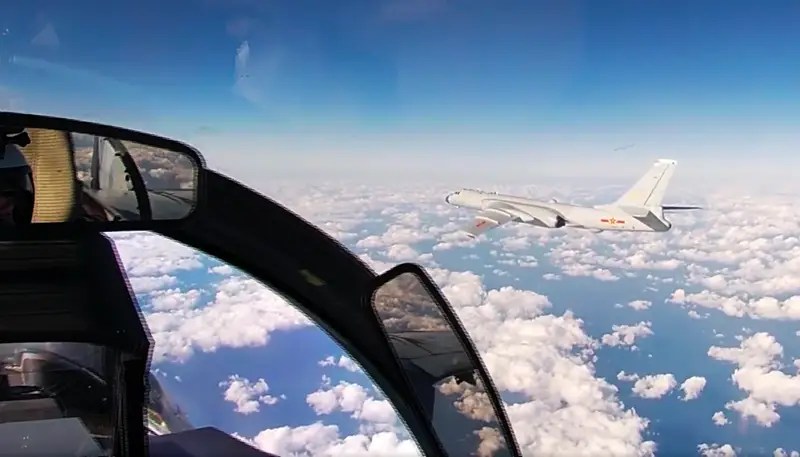
With so much attention directed at Ukraine, the much bigger strategic threat posed by China has largely flown under the radar. China has increasingly made it clear its intent to take back Taiwan. Along with ratcheting up its rhetoric, it has taken increasingly provocative overt actions, including holding naval war games not far from the island and flying hundreds of military sorties over the course of recent months, including by fighter jets, H-6 strategic bombers, intelligence-gathering aircraft, and air freighters, into Taiwan’s air defense identification zone. And just last Friday, Jan. 28, China’s ambassador to the U.S. warned that Taiwan’s continued push for independence would “most likely” lead to military conflict between the U.S. and China.

“If the Taiwanese authorities, emboldened by the United States, keep going down the road to independence, it most likely will involve China and the United States, the two big countries, in a military conflict,” Ambassador Qin Gang told National Public Radio.

Keep in mind, as I’ve discussed in this space before in my reviews of the novels 2034 and Ghost Fleet, every simulation of conflict between those two “big countries” run in recent years shows China handing the U.S. its ass on a platter. This is not encouraging, even less so if the U.S. is pulled into a global two-front war, for which it is not prepared.

Especially given the controversy swirling around the Olympics, now under way, with Putin and XI shoulder to shoulder in Beijing, I tend to believe that any conflict, either in Ukraine or Taiwan, is unlikely to begin until after the Olympics. Of course the Olympics didn’t stop Putin from invading Georgia on the very eve of the 2008 Beijing Summer Olympics or taking Crimea from Ukraine shortly after the 2014 winter games, held in Sochi, Russia, or planning cyber attacks to disrupt the postponed 2020 Tokyo Olympics. China has denied U.S. claims that Xi asked Putin in December not to invade Ukraine during the current Beijing Olympics, and given the growing affinity between the former rivals Putin may not wish to take any glory away from Xi. But that doesn’t preclude action immediately after the games.

A Dangerous New Reality

Regardless whether the Nightmare Scenario I postulated plays out or not, it is clear we’ve entered into a new and dangerous reality. We can expect to see growing coordination between China and Russia, and especially expanding Chinese economic and political influence and presence on a global scale. We’re already seeing its stifling influence on American corporations, universities, sports leagues, and other institutions, the culmination of a process more than three decades in the making.

Meanwhile, Biden’s green lighting of the Nord Stream 2 pipeline, to carry Russian gas to Germany under the Baltic Sea, makes Germany dependent on Russia for a major source of energy, enabling Putin’s threat in Eastern Europe to drive a wedge between NATO allies. And, if all that is not worrisome enough, we have a world-class grifter in the White House thoroughly bought off and compromised to China.

It is hard to imagine a more dangerous and precarious time than the one into which we’ve entered.

Featured image: A Chinese H-6K bomber is seen from a Russian aircraft during a joint patrol over the Western Pacific, Dec. 22, 2020. Russian Defense Ministry Press Service via Associated Press. Used under Fair Use.

Russian tanks on the move in Belarus. Copyright Russian Defense Ministry Press Service via Associated Press. Photo taken from video and released by the Russian Defense Ministry Press Service on Wednesday, Feb. 2, 2022. Used under Fair Use.

Chinese Navy conducts live-fire exercises in waters near Zhoushan Islands north of Taiwan, August 2020. Associated Press. Used under Fair Use.

This piece also appears on my Substack, Issues That Matter. Subscribe here, and there, and share the piece.

Review: Ghost Fleet: A Novel of the Next World War

Review: Ghost Fleet: A Novel of the Next World War

It’s back to world war again. Last month I reviewed 2034: A Novel of the Next World War. Now I’ll review Ghost Fleet: A Novel of the Next World War. What’s that, you ask? Both books have the same subtitle? Yup. Apparently world wars sell books. Since Ghost Fleet came first, it would be the 2034 authors and publisher poaching the subtitle. Originality, anyone?

Anyway, the same Foreign Service buddy who suggested I read 2034 suggested that I read Ghost Fleet, too. It’s one more of those books that is reputedly all the buzz inside the Beltway. This is because, as mentioned in my other review, every war-game simulation run shows the ChiComs winning and handing us our ass. This is basically the premise of Ghost Fleet, that we’re at a disadvantage in a confrontation with China, and the book takes us through the ensuing conflict.

Foreign Policy had this to say about the place the book held in the Pentagon in 2016:

“It’s on the desks of four-star generals and junior naval officers, and it has found its way on to the recommended reading lists for every branch of the American military . . . At a time when commanders and intelligence officials are worried about retaining America’s technological edge against resurgent great power rivals — crystallized in Friday’s of the Defense Department’s annual report on China — the book has captured imaginations and sparked debate inside the Pentagon. Ghost Fleet has landed at an auspicious time: After 15 years of grinding ground wars against elusive insurgents armed with homemade bombs, the U.S. military is both yearning to get back to its roots in high-end conflict and wondering how to counter old adversaries with new hi-tech tools.”

I guess that was a time when our military — for lack of a better word — leadership was more concerned with defending the U.S. against real threats than superfluous things like promoting Critical Race Theory, gender equity, climate change, and combating alleged white supremacy. It’s pretty startling the changes that have taken place just in the past nine months in that regard, though I think the seeds of those changes were planted long ago. And now, with the debacle of our shameful Afghanistan surrender and withdrawal, the threat to this country has never been greater in many decades, and yet it is more clear, to friend and foe alike, that we are less psychologically prepared to counter any threats than perhaps at any time in our history. So whether one accepts the premise of the book or not, it is clear that through our exhibited fecklessness and weakness the temptation to our enemies has been magnified exponentially and entirely through our own unforced errors.

The Future as Seen from 2014

Ghost Fleet was written in 2014 and came out in 2015, so there are some clear anachronisms in it. One thing that jumped out was the widespread use in the book of smart glasses that are based on Google Glass, and we all know what happened to that idea. Technology plays a big part in the book and in the war, as one might expect. But one has to question some of that technology. For instance, a Chinese teenage girl is depicted just flicking her fingers to manipulate smart rings on her digital joints and create dire situations half way around the world. Call me a skeptic, but I don’t see where finger flicks could be deployed with sufficient precision to accomplish their goals. I mean, I have a hard enough time getting my tablet to do anything with my fingers on the screen. These things might make for colorful visuals, but I don’t see them working in real life.

Some things, like our dependence on computer chips used in sophisticated military aircraft and machines that are made in China, enabling the planting of spyware and tracking capability in them, is plausible, though others more knowledgeable of such things than I am have pointed out how shielding and other safeguards would largely make such things ineffectual. Peoples’ movements are tracked in great detail by a network of surveillance cameras, to the point where one can hardly take a dump without being observed, and then deadly drones, called quadcopters, come in to take out perceived enemies. Not totally inconceivable, but stretched to a point that challenges credulity. These scenes frequently reminded me of the 2016 – 2018 TV series Colony, which featured an alien invasion of Los Angeles.

As in 2034, technological advantages held by our adversaries help tip the balance toward them. But the question has to be raised whether the answer is simply more technology, more dependence on technology, or whether being smarter about how that technology is developed, built, deployed, and hardened against infiltration is the better approach. Ghost Fleet is almost like a clarion call for those at the top to pour more trillions into high-end technology while it’s also a dire warning against such an approach. The money game is at the heart of Washington politics, but how much does it further expose us to our enemies? And what role should more low-tech approaches play, undercutting our adversaries’ dependence on technology?

One disturbing element of the book is how virtually everyone, on both sides, has become essentially drug addicts. They rely on “stims” and implanted “pumps” to enhance their performance, do their jobs, even stay awake. This seemed superfluous to the overall story line, but it’s far from the only superfluous element.

The Ghost Fleet

The book’s title, and much of its action, centers on the mothballed fleet of ships — the Ghost Fleet — that have been taken out of service and are moldering at various places around the country. Once the war has started, China (actually, an updated version of China, something called “the Directorate,” made up of a mix of business moguls and military brass who overthrew the former Chinese Communist Party following the collapse of Indonesia) and Russia have disabled U.S. communications and surveillance capabilities. The Directorate also invaded, in a sneak blitz attack, and holds the state of Hawaii, where much of the action goes on.

With most of the U.S. Navy destroyed, the Pentagon resorts to putting the Ghost Fleet into action. Especially a high-tech, but mothballed, destroyer known as the U.S.S. Zumwalt — an actual vessel, seen in the image above in its sea trials. Mounted with a new and powerful weapon called a rail gun, this is going to be our answer to the mighty Chinese fleet. And like the lead characters in a TV crime drama running between the bullets but never getting hit, somehow the Chinese don’t see what is going on with its refurbishment and refitting, and then the Zumwalt manages to survive every attack launched against it once sent out on the prowl.

While serving up much of the dramatic and personal action in the book, these two elements — that we’d ever tolerate occupation of a U.S. state without massive retaliation, and how so much reliance was put on a single obsolete naval vessel — further stretched credulity. Throw in an eccentric billionaire who manages to take over a previously impermeable Chinese space station, after the Russians had taken over the International Space Station by locking out the sole U.S. astronaut aboard, and a sexy serial killer whose cleverly murderous ways are directed at the Chinese occupiers in Hawaii while feeding her own homicidal desires, and you have a mix more colorful than plausible.

Additionally, as a former intel analyst, I have to question how the Chinese and Russians could gear up for their attacks without us seeing what they were up to. We can identify specific cargoes being loaded on ships from our satellite surveillance and humint capabilities (assuming someone was watching, which they would be, before our satellites were incapacitated), and that just didn’t compute to me. Or how the Chinese wouldn’t see what we were up to refitting the Zumwalt at Mare Island.

The book has been criticized on literary terms, and I have to say I frequently found the book annoying. There are so many locations, subplots, and characters to keep track of — switching between them every one, two, or three pages throughout the book — there were times I was tempted to throw the book down. Rather than building my suspense, that got to be too much and just irritated me. I wound up spending an inordinate amount of time flipping back in the book to see who a specific character was or what was going on in a given subplot. Also, the book comes to a screeching halt in the middle of the most critical action, implying somehow we had prevailed without filling in the details how we did, and that also annoyed me.

While the book is a novel — at 404 pages, a rather long one — it also has 374 end notes meant to document every detail in the book and intended to lend credibility to it.

I won’t argue that Ghost Fleet doesn’t raise some questions worth evaluating, or that it isn’t entertaining enough in numerous places. But I wouldn’t get my ideas on how a future war might start, be fought, won, or lost, from the book. Or any work of fiction. I’d suggest that our military and political leadership get their heads out of their reading lists and get back to looking in a hard-headed way at world realities. Not that I have much faith that they will.

>>Click this link to buy the book on Amazon<<

Ghost Fleet: A Novel of the Next World War is by P.W. Singer and August Cole, an Eamon Dolan Book, published by Mariner Books, an imprint of Houghton Mifflin Harcourt. Copyright © 2015 by P.W. Singer and August Cole.

P.W. Singer is a strategist at New America, a Professor of Practice at Arizona State University, and Principal at Useful Fiction LLC. He has been named by the Smithsonian as one of the nation’s 100 leading innovators by Defense News, as one of the 100 most influential people in defense issues by Foreign Policy to their Top 100 Global Thinkers List, and as an official “Mad Scientist” for the U.S. Army’s Training and Doctrine Command. Singer is the author of multiple best-selling, award winning books in both fiction and nonfiction, ranging from Wired for War to Ghost Fleet. Described in the Wall Street Journal as “the premier futurist in the national-security environment,” Singer is considered one of the world’s leading experts on changes in 21st Century warfare, with more books on the military professional reading lists than any other author, living or dead.

August Cole is a nonresident senior fellow at the Brent Scowcroft Center on International Security at the Atlantic Council. He is the director of the Art of Future War project, which explores narrative fiction and visual media for insight into the future of conflict. His fiction writing tackles themes at the core of American foreign policy and national security in the twenty-first century, including the privatization of military and intelligence operations and the future of American power in the Pacific. He is also writer-in-residence at Avascent, an independent strategy and management-consulting firm focused on the defense and aerospace sectors. From 2007 to 2010, Cole reported on the defense industry for the Wall Street Journal.

Photo of U.S.S. Zumwalt by U.S. Navy and General Dynamics Bath Iron Works, via Getty Images. Used under Fair Use.

This piece also is posted on my fiction blog, Stoned Cherry, and on Substack in my community there, Issues That Matter. Follow me here, and there. And if you like the piece, please share it. Links below.

It All Falls Apart

It All Falls Apart

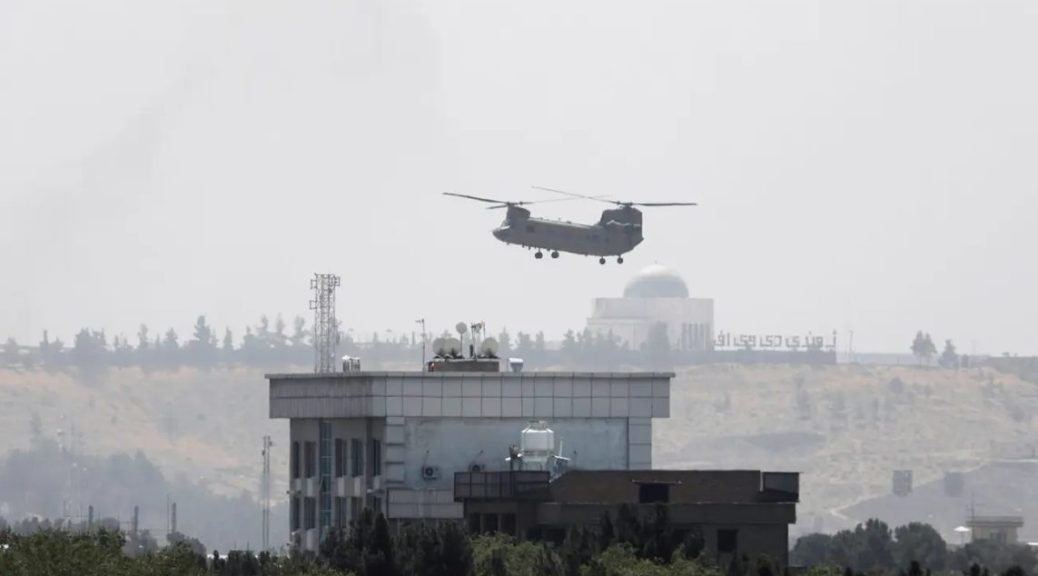
Do you remember the last time we saw helicopters evacuating embassy personnel and civilians following a U.S. overseas collapse? If you said April 29-30, 1975, upon the fall of Saigon to the North Vietnamese Army, you’d show you have a sense of history. Something that seems to not be in the portfolio of this country’s current shadow government or its top figurehead leadership in the form of Joe Biden.

Watching the events of the past few days, on top of the seven months that preceded them, we — even the skeptics and rationalizers — can have no doubt but that things are totally out of control and falling apart at an accelerating and alarming rate. On every key front we are seeing the abdication of responsible and competent leadership, and in every area where the country expects its government to keep it safe and secure — its primary duty — it has been failed.

I outlined specifics of these failures in an earlier piece where I explained why we are so fucked. I posted that piece less than three weeks ago, and its dire account now seems almost optimistic in comparison to what we’ve witnessed in recent days. One hopes these events might serve as a wake-up call to the country — even the corrupt mass media, who were complicit in putting us into the jeopardy we’re now in, have been critical of the so-called Administration’s catastrophic handling of the Afghanistan withdrawal — but it seems those holding the power are loathe to surrender even a millimeter of that power and are intent on blustering and lying their way through the mess — messes — they created. Worse, who is supposed to answer the wake-up call when one party, holding a deaf ear to the phone, controls the White House and both houses of Congress? The fox is guarding the hen house, and the rest of us are the hens.

On Monday we finally heard from Jell-O Joe, after days of silence while he went on “vacation,” and despite his empty claim that “the buck stops with me,” he preceded to blame everyone except himself for the Afghan disaster. If you haven’t already heard it, and you have a strong stomach, you can read the text of his blame game here.

“So what’s happened?” Biden blathered, as he went through his litany of blame. “Afghanistan political leaders gave up and fled the country. The Afghan military collapsed, sometimes without trying to fight.”

Never mind that all of what went down was 100 percent predictable, and predicted, and Biden and his feckless advisers and the Pentagon and the State Department took absolutely no precautions to put in place a contingency plan that would have allowed a withdrawal that didn’t turn into a total rout and disgrace for our country. There is equally little argument that can be made that most of the last 20 years in Afghanistan wasn’t something of a circle jerk of errors, with one bogus and misleading statement of success after another coming out of the Pentagon and from four administrations of both parties, once more bringing back memories of Vietnam.

Former UN Envoy to Afghanistan Peter Galbraith over the weekend laid much of the blame for the rapid collapse of the Afghan military and government on the toleration of widespread corruption in the country over two decades by the U.S. and its allies. Much of the trillion dollars the U.S. poured into Afghanistan went into politicians’ and war lords’ pockets, with loose or absent controls on the part of our DoD and State Department.

Back to where we started on Sept. 11, 2001

A country is great only to the extent its leaders are great. We are a country in disgrace, and don’t for a moment think that hasn’t been noted by the Chinese and the Russians, not to mention the plotters of terror around the globe. Which highlights yet another lie, a most dangerous one, Biden uttered Monday.

“We went to Afghanistan almost 20 years ago,” he said, “with clear goals: Get those who attacked us on September 11th, 2001, and make sure al Qaeda could not use Afghanistan as a base from which to attack us again. We did that. We severely degraded al Qaeda in Afghanistan.”

One after another, knowledgeable intel analysts and operatives, all with on-the-ground experience in Afghanistan, filled the airwaves today with their assessment that al Qaeda is already taking root in Afghanistan, that it never went away. And now with their brothers in arms and spirit once more in control of the country, they will have a clear way forward to reestablish their jumping-off point for launching attacks against the U.S. and other Western countries. Even the leading apologist for the left, the New York Times, has a piece called “Disaster in Afghanistan Will Follow Us Home.” You don’t have to be a genius or intel analyst to figure that out. You just have to not be Joe Biden.

Two quotes from former top officials in Democratic administrations really have it right. Bob Gates, former Defense Secretary in the Obama Administration, said — and has since stood by his statement — that Biden “has been wrong on nearly every major foreign policy and national security issue over the past four decades.” And Leon Panetta, another Defense Secretary and CIA chief under Obama and Chief of Staff to Bill Clinton, said, ““He is president of the United States. He is going to have to take responsibility.” Going on to compare the loss of Afghanistan to the Bay of Pigs fiasco of 1961, Panetta said that JFK, unlike Biden, “took responsibility for what took place.”

Or, if you prefer, Jell-O Joe’s old boss, Barack Obama, perhaps put it most succinctly: “Don’t underestimate Joe’s ability to fuck things up.”

When Biden says “And here’s what I believe to my core . . . ” you know that is just blather because Biden has no core. Over the 40-umpteen years of his undistinguished career, he has shown time and time again how he’ll blow with whatever wind is blowing, say anything he thinks will advance him, lie when that’s convenient, and just make things up as he goes along, all the while with his hand in the till. And now that he mostly dwells in La-La Land, the existence of a core to him is an even more preposterous concept. Jell-O Joe has as much of a core as the bowl of flavored gelatin “Dr.” Jill and his other handlers feed him when he’s not sucking on an ice cream cone.

And when the toadies in the Pentagon and State Department — more focused on things like “white rage” and Critical Race Theory than the nation’s security — spout nonsense, they are no better and also have to bear responsibility for this calamity. Just as one pathetic example, when Secretary of State Antony Blinken said Kabul wouldn’t fall from Friday to Monday, he was right — it fell from Friday to Sunday. If these incompetents, Blinken and Defense Secretary Lloyd Austin and Joint Chiefs Chairman Gen. Mark Milley, not to mention Biden himself and those pulling his strings, are not immediately fired, there is no hope to look forward to, and the only light at the end of the tunnel is that of an oncoming locomotive. Of course, for your answer, just look at the poison pill that was put into the vice presidency, the useless and frightening Kamala Harris, to make any move to apply the 25th Amendment to Biden an unattractive option.

To those who didn’t like Donald Trump’s tweets so voted against him: Are you happy now?

One wishes for the grownups to come back and put an end to this clown show.

A return to the 1970s. Only worse.

It seems no matter how far a country gets from its dismal past, it is always in danger of sliding back into it. Many of us who lived through the 1970s and all its dismal aspects — Vietnam, gas lines and dependence on OPEC, loss of faith in our political leaders, the Mariel Boatlift, raging inflation, raging crime, the Iranian takeover of our embassy, the degradation of our military, and our loss of prestige on the world stage — recognize how every element of the 1970s is back, in one form or another, most on steroids.

The country has become a dumpster fire of crises. We cited in our post of July 29 the range of crises — all induced by this Administration — the country is facing:

+ The catastrophe on the Southwest Border

+ Spiraling crime in big cities across the country, most Democratic ruled for decades

+ Our feckless foreign policy, Afghanistan being the most acute and visible example of that

+ Deliberate undoing of our long-sought energy independence

+ Rapidly rising inflation

+ Confusing and troubling mixed-messaging on COVID.

Now we have our latest version of the fall of Saigon. What is going on on our no longer existent Southwest Border makes the Mariel Boatlift look like absolutely nothing. Our military is chasing political correctness and a “woke” agenda while our adversaries gloat and plot. Our students fall further and further behind in their educational prowess, some not even being able to read and write in cursive or otherwise, and with entire states removing academic requirements for graduation (they’re “racist,” the benighted morons of Oregon say). And now, after the past week, what ally or client state or individual who assists us would have any faith in our word or commitments to protect them?

In an act almost as shocking as what has happened in Kabul, on August 11 Biden asked OPEC — the Organization of Petroleum Exporting Countries, which include Iran and Venezuela — to increase its production to help control rising fuel costs. This is the same Biden who, by a stroke of the pen, canceled the Keystone XL Pipeline, while greenlighting Russia’s Nord Stream 2 Pipeline, and reinstated controls that took America from energy independence, which President Trump helped usher in for the first time in 62 years, back to being dependent on oil from sworn adversaries and some of the most volatile areas on earth.

You may recall how we railed against OPEC in the 1970s for the deleterious effect it had on the country. Now Biden bows at its feet.

If you were like me, you might have fallen out of your chair when you heard this. It’s like our enemies have taken over power in the country — which really they have, since these people are intent on what they say is “fundamentally changing the country,” which are code words for destroying our way of life — and up has become down and down has become up.

Jimmy Carter might have been arguably the worst president of our lifetime. Until this president. Now, it’s no contest, and things truly are falling part. It is not a notional question: Can we survive this Administration? I’m not confident, and less so by the day.

U.S. Embassy Kabul, Afghanistan, August 15, 2021, photo by AP/Rahmat Gul. Used under Fair Use.

Dumpster Fire, photo by Ben Watts, Free Stock Photos. Used with permission.

This piece also appears on Substack. Please subscribe here, and there.

Review: 2034: A Novel of the Next World War

Review: 2034: A Novel of the Next World War

An old Foreign Service buddy of mine recently turned me on to the book 2034: A Novel of the Next World War. Co-authored by writer Elliott Ackerman and retired Admiral James Stavridis, my friend tells me the novel is all the buzz inside the Beltway these days. In no small measure, this is because in every war game simulation run in recent years, the ChiComs wind up handing the U.S. its ass on a platter. A sobering thought, it was enough to make me want to read this book.

It’s no coincidence that I’m posting this review on August 6, on the 76th anniversary of the day the U.S. dropped the atomic bomb on Hiroshima. While it takes more than a book to remind us, the specter of nuclear war has not receded into the realm of the totally implausible despite all the changes that have occurred in the world in those intervening years since the Enola Gay (which I’ve actually seen and stood next to) released its payload over the Japanese city of Hiroshima. If anything, an increasingly multi-polar world may be making the world ever more dangerous.

First, from a literary point of view, the book is well written. At times the action is gripping, and it becomes difficult to put the book down (a tendency I confess to have resisted and wound up reading the book in several tranches). There is a fair amount of personal back story of various characters, which got me a bit impatient, though such things usually do when my focus is on the action.

The general premise of the book is that China coordinates with the Iranians and the Russians to goad the U.S. into a conflict in which the U.S. is from the outset at a technological disadvantage. A series of miscalculations and missteps set the world’s two leading powers into a pattern that winds up in a tit-for-tat nuclear exchange, one that, just barely, falls short of being an all-out nuclear blow out. In the end, the world balance of power has shifted, and somehow India winds up emerging as the world’s king maker. There are elements of nuclear porn, for those who seek such things, but the book doesn’t wind up being Apocryphal. If anything, I found the ending rather unsatisfactory, but we’ll get to that.

One of the premises of the book is that the Chinese have developed a technology that renders entire fleets of their ships invisible to detection. Clearly this gives them a huge strategic advantage, but I had to wonder how plausible this is. We have satellites circling the globe with visual surveillance capability, and it just didn’t make sense to me that actual ships on the waters could be hidden from that kind of visual identification.

As it turns out, I recently came across an article where this very issue is raised. Apparently GPS technology already is being intercepted and manipulated by unknown actors to show ships and fleets in locations where they are not. Obviously, this can lead to serious consequences if, for instance, a nation thinks it is about to be attacked by a phantom fleet, which it believes to be real, and retaliates. But, much as I suspected in reading the scenario painted in 2034, visual satellite imagery is used to confirm the actual location of the ships detected and to compare that location with the phantom location to demonstrate the reality. So until someone shows me some technology that completely obscures a vessel’s visual presence (as well as the role played by human intelligence), I have to conclude that this is a stretch too far.

There were other things in the book that didn’t compute to me. Early in the book an entire U.S. naval fleet is destroyed by the Chinese, and yet our retaliation is restrained and the course of events is stretched over several months. If China (or anyone) wipes out an entire fleet of our ships, would we slow-walk our response, as happens in the book? I seriously doubt it. In fact, the whole war seems like it is in slow motion. I understand we’re on entirely new ground here and we have never engaged in a full-scale war with a nuclear power before. We may or may not make a first nuclear strike, but would a nuclear China be as restrained if faced with a massive conventional response? I can’t answer that question, with what I know, but the pace of events just didn’t seem realistic, though it did help fill pages.

Another thing I didn’t understand was a key part where the Russians take out underwater Internet cables passing under the Arctic Sea, completely disrupting domestic U.S. communication. I had to wonder why Internet cables running under the Arctic Sea would be connecting domestic U.S. Internet nodes, and why destroying them would disrupt our internal Internet connectivity. I also looked up current undersea cables and there don’t appear to be any running under the Arctic Sea. But even if there were, I can see where they might disrupt connections to Europe or maybe Asia, but not between the East and West coasts of the U.S. This seemed to be an unanswered question even though it was a critical event in the book.

The cable thing also raised the question why one side or the other wouldn’t have used an Electro-Magnetic Pulse (EMP) attack on the other, which would have had far more widespread effects without the need to resort to nuclear ground attacks and frying whole cities.

I understand a certain degree of literary liberty, but when logic seems not to apply to major elements of the plot, without any explanation, I find it troubling as a reader and it makes me question how much I can suspend disbelief. Perhaps we’ve gotten to the point where we believe that all things are possible with technology, but until pigs fly without benefit of technology, I’m going to retain a level of skepticism.

There are some interesting themes that run through the book. One of them seemed to be, low tech meets high tech and low tech wins (usually, anyway). This has long been a kind of life principle of mine. Are we too dependent (and would be even more so in 13 years which, by the way, doesn’t seem that far off) on technology? Probably. Especially if proper safeguards and backstops aren’t built into it. But meanwhile we are engaged in a technological competition with the Chinese. To believe 2034, they may well be winning that competition. And there is reason to believe they are, aside from the book.

One lesson, early on and which sets the whole story in motion, is how not following proper procedure and going off on deviations can be a very bad idea. A U.S. naval commodore, heading a patrol in the South China Sea, decides to deviate from SOPs to go check out a Chinese merchant vessel that appears to be in trouble. In doing so, she walks right into a trap that had been set by the Chinese. It might not be as heroic or dramatic, but sometimes it’s better to stay with the program and not follow one’s gut feelings or curiosities.

I have long believed that if we get into a nuclear war it would most likely be by accident or miscalculation. We have come pretty close a couple of few times. In the book, a series of mishaps and miscalculations allows a U.S. Navy pilot to get through to nuke Shanghai despite attempts by his commander to call off the attack. And things just continue to snowball.

Parts of the book turned out to be nothingburgers. There is a whole section devoted to a battle for the Strait of Hormuz between the Iranians and the Russians which seemed superfluous and much to-do about not much. I was expecting more involvement by Russia leading to the U.S. being forced to fight a two-front war, and that just never developed.

While, as I said, much of the book is gripping, I found the ending unsatisfactory. It is made to seem that the U.S. had been reduced to some sort of second- or third-rate power, while India, of all countries, had risen to be the major world power. Both the reality and the logic of that eluded me. In the course of the book the Chinese nuke Galveston and San Diego, but in the end the country seems demoralized and a shadow of its former self. Somehow I don’t see how loss of those two cities would have such a major impact on the country as it does in the book. There are even people living in refugee camps, which also seemed superfluous and unlikely.

We’ve faced crises before, whether it was grouping and striking back after Pearl Harbor, or following 9-11. And a major hurricane, like Katrina, certainly devastated a big part of the country, and we dealt with it, if imperfectly. Maybe if New York and Los Angeles were taken out it might be more likely. But with Galveston and San Diego being the targets, I don’t see it. Of course, at the rate and in the direction the country currently is headed, we might be so wimped out and divided and chaotic by then, that we just slip into being a third-rate power.

We also never do find out how things are in China after the war (except they don’t mind putting a bullet in the back of the head of someone who is perceived to have screwed up), and we are left wondering the final disposition of Taiwan, which China has invaded in the course of the war.

My friend who turned me on to the book disagrees with me on the ending. He thinks it would be quite realistic to believe that the country could be so demoralized if even relatively minor cities were nuked that it might actually break up, and the country would face an existential crisis the likes of which we only experienced during the Civil War. In his view, states with extreme politics, like California and Oregon, might opt out of the Union and attempt to become independent entities. There also would be lots of openings, he says, for malicious external actors to support some people’s worst inclinations. I’m not prepared to say his analysis is wrong, again, especially with the current negative trends we’re seeing in the country. I do think it would not be unrealistic to think both the country and the world would be profoundly altered by a war between the superpowers, especially one with nuclear exchanges.

As I proceeded through the book, I was reminded of an argument I had with a friend 40-some years ago. I argued at the time that logic would militate against a nuclear confrontation, and the other party argued that it would in fact be logic that would lead to such a conflict. Reading this book and seeing the progression of events, I actually could see the validity of that argument and how that very logical progression of events led to the conflagration that ensues.

The Washington scenes frequently reminded me of the things I didn’t like about being in the Foreign Service and the reasons that caused me eventually to leave it: The boneheads running the show, the clash of egos, the internal politics, the too many chefs in the kitchen, the hubris, the suits and ties running the ship of state aground. There were little giveaways to when the book was written and the authors’ perspectives, such as a reference to the one-term presidency of Mike Pence, but those didn’t much matter in the overall scheme of things.

Of course I felt bad about all the millions of incinerated people, on both sides. I even felt bad for the ex-wife of one of the main characters who got nuked in Galveston (and I felt bad for the neat little B&B there at which I once stayed). But, think what you will, I felt worst about this squirrel that the main Iranian character squeezes to death in his hand, and for its mate as she watches him do it. That just seemed gratuitously cruel and it bothered me all through the rest of the book.

Perhaps the main value of 2034 is that it draws our attention to the biggest external threat facing the country and the world. China has made no secret of its designs for domination both regionally and on the larger world stage. Its impact has been felt in the past year and a half through a devastating virus that it allowed to be released across the globe and, to date, has faced virtually no consequences for what, at best, was its negligence. Neither has it faced consequences for its repressive internal policies, the genocide it is conducting against the Uighurs, its crushing of Hong Kong’s democracy, or its open threats against Taiwan and even Japan. While our focus and national resolve drift, China’s has intensified.

There are a range of issues the book brings attention to, from the role of technology, to war strategy, to civil preparedness, to hardening our communications, to effective diplomacy. And they are all worthy of attention. But what it fails to address, what fall outside its purview, are the internal divisions that tear at our national fabric, the diversion of both our civilian and military leadership from the big issues of national security to some sort of “woke” agenda that only further weakens us, and our growing loss of educational acuity as China surges ahead. It is the internal threat that, in the end, may pose the greater danger than the external one. The import of that threat is not lost on China nor our other adversaries.

Bottom line: Read 2034, pay more attention to what China is up to, and what is — or isn’t — going on in Washington, too.

>>Click this link to buy the book on Amazon<<

2034: A Novel of the Next World War is by Elliot Ackerman and Admiral James Stavridis, published by Penguin Press, an imprint of Penguin Publishing Group, a division of Penguin Random House LLC. Copyright © 2021 by Elliot Ackerman and Admiral James Stavridis.

Elliot Ackerman is the author of the novels “Red Dress in Black and White,” “Waiting for Eden,” “Dark at the Crossing,” and “Green on Blue,” as well as the memoir “Places and Names: On War, Revolution, and Returning.” His books have been nominated for the National Book Award and the Dayton Literary Peace Prize. He is both a former White House Fellow and Marine, and served five tours of duty in Iraq and Afghanistan, where he received the Silver Star, the Bronze Star for Valor, and the Purple Heart.

Retired Adm. Jim Stavridis spent more than 30 years in the U.S. Navy, rising to the rank of four-star admiral. He was Supreme Allied Commander at NATO and previously commanded U.S. Southern Command, overseeing military operations through Latin America. At sea, he commanded a Navy destroyer, a destroyer squadron, and an aircraft carrier battle group in combat. He holds a Ph.D from the Fletcher School of Law and Diplomacy at Tufts University, where he recently served five years as dean. He has published eight previous books and hundreds of articles. Admiral Stavridis is chief international security and diplomacy analyst for NBC News, and a columnist at both Time magazine and Bloomberg Opinion. Based in Washington, D.C., he is an operating executive of the Carlyle Group, an international private equity firm, and chair of the board of counselors of McLarty Associates, an international consulting firm.

This piece also is posted on my fiction blog, Stoned Cherry, and on Substack in my community there, Issues That Matter. Follow me here, and there.

Applying RICO to the Biden Crime Family, the Dems, and the Media

Applying RICO to the Biden Crime Family, the Dems, and the Media

At the end of my last piece in this space, I promised to discuss why, and how, the RICO statute – the Racketeer Influenced and Corrupt Organizations Act – can and should be applied to the Biden crime family, the Democratic Party which has protected and furthered it, and the mass and social media that have engaged in a deliberate cover-up of its criminal activities. That’s what I will do in this piece.

Let me make some things clear up front. First and foremost, this is not about partisan politics. This is about corruption and crime that goes so deep that every American, regardless of political preference, needs to be not just concerned, but outraged. As a matter of disclosure, I will say that I support Donald Trump and will vote for him on election day, not so much because I am a huge fan of Trump – though I have more reasons to be one this time around than I did four years ago – but because the alternative is utterly unacceptable, and should be to any right-thinking voter. The pity is that so many people have already early voted without full knowledge of key facts that may have influenced how they voted.

Second, I’m not going to try to detail all of Joe Biden’s wrongdoing. That can take (and has taken) books. I’ve laid out in some detail much of the wrongdoing in my posts over the past year, and I urge to you read the primary stories where I laid out the corruption fostered by Biden in Ukraine and China. Many of the conclusions I drew then and in subsequent stories concerned how Biden’s son Hunter exploited his father’s position as Vice President of the United States to further his own business and profit interests. We now have compelling evidence that not only confirms what I detailed in those pieces, but that goes further to clearly and unambiguously implicate Joe Biden himself in clear abuse of his position and illegal profiteering, with the extent of the wrongdoing taking in many more countries, including Russia, Kazakhstan, Romania, the Czech Republic, and Poland.

Plausible deniability”

Rather than simply repeat information that now is publicly available – though repressed by most in the mainstream media and censored and blocked by the social media giants – I urge you in the strongest terms to go directly to the primary sources (links below) for confirmation that this is not just speculation at this point, and it decidedly is not Russian disinformation, as frauds and liars such as Calif. Rep. Adam Schiff would try to mislead you into believing. Both John Ratcliffe, Director of National Intelligence, and the FBI, the latter of which seized the Hunter Biden laptop in December 2019, have confirmed that the emails are not the product of Russian misinformation.

Foremost in your own investigation, if you did not watch it in real time as it aired on Fox News on Oct. 27, spend the time to listen to Tucker Carlson’s hour-long interview with Tony Bobulinski, a former business partner with the Bidens, who lays out exactly the highly dubious nature of the Bidens’ business activities and Joe Biden’s role in them (Bobulinkski, among other things, confirms that it is Joe Biden who is referred to as “the big guy” and “the chairman” in the emails contained on Hunter Biden’s laptop):

Tucker Carlson interview with Tony Bobulinkski – video and transcript of the full interview on the RealClear Politics site

Read and download the full report (below) of the U.S. Senate Committee on Homeland Security and Governmental Affairs and the U.S. Senate Committee on Finance – focus especially on the summary, and on pages 65-87 of the report:

Final Report – Homeland Security/Finance Committees

Read the transcript of former Florida Attorney General Pam Bondi’s speech to the Republican National Convention in August in which she outlines the corruption of Joe Biden and the Biden family

And read the stories in the New York Post about the emails and other items on Hunter Biden’s laptop:

The initial Oct. 14 story about how emails reveal how Hunter introduced a top Burisma official to his father.

Oct. 15 story detailing Hunter Biden’s murky business dealings in China

Oct. 16 story about Hunter’s troubled life and pained soul

Oct. 23 story about how Biden business group eyed N.Y. Gov. Mario Cuomo and Sen. Chuck Schumer for deals

Oct. 27 piece by Michael Goodwin in the Post about Joe Biden meetings

See an index of more of the Post‘s Hunter Biden stories

At one point in the Carlson interview, Bobulinski, a former Naval officer, said this:

And I’m — I’m thinking about the Biden family, like, how are they doing this? I know Joe decided not to run in 2016, but what if he ran in the future? Aren’t they taking political risk or headline risk?

And I remember looking at Jim Biden [Joe Biden’s brother and a campaign adviser, and one of the main beneficiaries of the Biden family business] and saying, how are you guys getting away with this, like, aren’t you concerned?

And he — he looked at me and he laughed a little bit and said, ‘plausible deniability.’ ”

You may recall that the administration of Richard Nixon attempted – unsuccessfully, as it turned out – to cover its tracks during Watergate through application of “plausible deniability,” and it’s been used as a form of cover by the CIA going back to the Kennedy administration.

The RICO Act

The RICO Act was passed in 1970 to combat crime conducted as part of an ongoing criminal enterprise. It targets organizations, and not just individuals, engaged in such criminal activities as illegal gambling, money laundering, bribery, kidnapping, extortion, sex and drug trafficking, murder, counterfeiting, and embezzlement, among others. To obtain a RICO conviction, the government must prove two or more covered criminal acts over a 10-year period, and must show that a defendant was invested in, maintained an interest in, or participated in a criminal enterprise that was involved in interstate or foreign commerce.

Read the full text of the RICO Act here

If you look at the Biden situation, referring to the above sources, several elements appear to fall under the RICO Act:

  • An ongoing enterprise
  • More than two instances of possible criminal activity
  • Involvement in interstate or foreign commerce
  • Potential criminal activities, including:
    • Extortion (using U.S. public funds, adding an additional level to the offense)
    • Bribery
    • Money laundering
    • Tax evasion
    • Violation of FARA (the Foreign Agents Registration Act)
    • Violation of the Foreign Corrupt Practices Act
    • Sanctions violations (negotiations to acquire a percentage of the Russian state-controlled energy company, Rosneft)

Any of the actions of the Biden family would be bad enough, but what becomes a matter of grave national concern are the deliberate and coordinated actions of the Democratic Party, Party-affiliated PACs, the mass media, and social media, to cover up the various potential offenses committed by Joe Biden, a candidate for President of the United States, and to prevent a large percentage of the American electorate from gaining knowledge of those offenses. This could have lasting impact on the country, and given the criminal nature of the actions being concealed, these parties are implicating themselves in their conduct and, therefore, should also be investigated for RICO violations.

If you have any doubt that this cover-up is deliberate and coordinated, all you have to do is consider that no mainstream broadcast network, other than Fox News, has spent any time reporting on any of this. Even worse than the usual lack of any kind of journalistic vetting of Biden or his running mate, you would have heard how the whole email thing is a product of “Russian disinformation.” Never mind the enormous resources and time the media spent on the last bout of “Russian disinformation,” waged allegedly to support Trump, which turned out to be a complete hoax. This time around, this matter is far from a myth or a hoax, but no attention is being given to it by the mass media. Publicly supported NPR went so far as to state outright that they won’t cover the Biden email scandal.

It has been credibly reported that officials of Democrat-controlled PACs called major media chiefs following the Bobulinski interview and threatened that they would have no access to a Biden administration if they carried any news of the interview. The result: Zero minutes of coverage on any media network outside Fox News. This goes beyond mere journalistic malpractice, which has become a commonplace. This is extortion, and by being complicit in it the media has become an accomplice to a crime. Given the national interest in the outcome of the election and the ability to make valid judgments about the candidates, and the very real possibility that a Presidential candidate could be compromised with America’s leading adversary, Communist China, I would argue this should at minimum merit a RICO investigation, and possible prosecution, by the Justice Department.

As troubling, Tucker Carlson is reporting as I’m writing this, on the night following the Bobulinski interview, that a package of original documents associated with the case, shipped cross-country from New York to Los Angeles by major national private courier, arrived opened and empty, and a thorough investigation by the courier company could not reveal what happened to the documents or who was involved in absconding with them. These are tactics more associated with Communist China or the former Soviet Union. But this is what is happening in 2020 America, a week before the most critical election in our time.

Bobulinski is reported to be staying at a location remote from his family in order to help protect his family from attacks.

Be aware that at no time has Joe Biden or his campaign denied the existence of the Hunter Biden emails. The best they can do is try to discredit how they came into the possession of the Post, which, of course, is Russia, Russia, Russia. Keep in mind that the U.S. had a Vice President, Spiro Agnew, resign his office exactly 47 years ago this month for corruption that is probably vastly eclipsed by Biden’s corruption. How the country has changed since that time, when such things were taken seriously. What is happening now with the media refusing to cover a major corruption story is unprecedented. The overseas media is covering this story more than the American media, which is scandalous.

Jack Dorsey lies under oath to the Senate

In my earlier post, Democracy Dies in Darkness – which I consider perhaps the most significant piece I’ve written in my 50-plus-year journalism career – I expressed the alarm every American should share at the way the social media giants, Twitter and Facebook foremost among them, have suppressed the Post stories, and retweets of them. On Oct. 28, Twitter CEO Jack Dorsey lied under oath to Sen. Ted Cruz, falsely and repeatedly claiming the block against the Post had been lifted. It has not been lifted, and the Post went on to relate how other media outlets were content to stand by as Twitter attempted to get the Post to essentially retract its documented stand, not unlike what would happen in an authoritarian state.

Along with being investigated for RICO violations, one hopes that Cruz and other senators to whom Dorsey lied make a criminal referral for perjury naming Dorsey.

The time for talk has passed,” said Missouri Sen. Josh Hawley. “Take away the special status given these tech companies.”

Hawley has been a consistent critic of the tech companies, and an advocate of removing the Section 230 protections afforded them and which shield them from liability based on their biased actions. But as Hawley pointed out, it was two hours into the hearings when Section 230 of the Communications Decency Act even came up, indicative of how Congress has not shown any resolve in doing anything substantive to rein in the enormous power – and damage being done to our democracy – of the tech giants.

Already in a Brave New World

It would be inaccurate to say that we are facing loss of our democracy if these things are allowed to continue. In effect, we are already there, and we have clearly entered this Brave New World where truth is turned on its head and thought control is forced on us. Should there be a Democractic victory, as illegitimate as it might be, in next week’s elections, we are facing entrenchment of these things on a permanent basis, as I described in my last piece where I asked if America is ready for the one-party state Party leaders have in mind.

Perhaps, you might ask, how people can be so ready to sell out their own country and its freedoms in favor of an authoritarian enemy and system? But consider how for decades there were many Americans – and these included journalists, teachers, scientists, artists, and others – who sold out to the former Soviet Union. They did this in support of their ideology, their view of what a “just” society might look like, their belief, as misguided as it was, that Soviet Communism represented a better solution for the country.

Why should we be surprised now that there are those today – including those same categories of people who sold out to the Soviets, and maybe now throw in some politicians, corrupt and otherwise, too – who are ready to toss in with our leading adversary. That includes one of the two candidates for President of the country. After all, Joe Biden himself has said it: “Come on, man, I mean, you know, they’re not bad folks, folks. But guess what, they’re not competition for us.”

Again, the state of affairs in 2020 America.

Featured image: Joe Biden and Xi Jinping, Larry Downing, Reuters. Used under Fair Use.

Tony Bobulinski, Fox News. Used under Fair Use.

Jack Dorsey on the cover of the New York Post of Oct. 29, 2020. Used under Fair Use.