Category: Technology

Back to the Moon!

Back to the Moon!

As long as it’s been since I’ve posted on this blog, it’s been way waaaayyyy longer since humankind has ventured past the bounds of low earth orbit into deep space. The last time was the flight of Apollo 17 which launched from Cape Canaveral — at the time, officially known as Cape Kennedy in honor of the assassinated president who set the nation on the path to the moon — on December 7, 1972, and returned to a splashdown in the Pacific Ocean on December 19, 12 days later but more than 53 years ago.

Two of the Apollo 17 astronauts, Gene Cernan and Harrison Schmitt, were the last humans to walk on the lunar surface, while their mission mate Ronald Evans orbited the moon in the command module. At least part of that history is to be added to now as the four crew members of the Artemis II mission hurtle toward the moon, escaping the grasp of earth’s gravity for the first time since the flight of Apollo 17.

There are naysayers today, just as there were in 1972, who question the value and purpose of the space program in general, and human space exploration in specific. My purpose in writing this essay isn’t to address those skeptics. There is ample evidence of the tangible value the space program has brought to both the U.S. and the larger world in the seven or eight decades it’s been a reality, and that evidence is easily uncovered. My answer to them is much simpler. We go into space, to the moon and points beyond, because it’s there. We don’t need any greater explanation or justification than that. It is in the human spirit to go beyond our known limits, our known frontiers, our known worlds, and space exploration captures and embodies and extends that spirit.

Back to the Cape

As a journalist who for some years covered the space program, I’ve spent a lot of time at the Cape and observing launches from both Kennedy Space Center and the Canaveral Air Force (now Space Force) Station. I can tell you from direct experience, seeing a launch on the tube or from a distance isn’t the same as being close up. I can see night launches, and occasional landings of SpaceX first stages, from my home, 120 miles (193 kms) distant, and even hear them, about 11 minutes later. But that’s not the same as being close-up to a rocket lifting off from the pad and heading for space.

I’ve become a bit complacent over the years and have only gone down to the Cape a few times since my career as a science and aerospace writer ended some decades ago. In truth, I almost didn’t go down for the launch of Artemis II (I was there when the initial launch of Artemis I was scrubbed shortly before launch time). It’s a bit of a trip, dealing with traffic and the crowds can be challenging, and the chances of a scrub all too real. As fate would have it, I had errands to run the day of the launch in Ocala, so I figured I was already part way there so decided in real time to just keep going. And that’s how I wound up on the shores of the Indian River in Titusville, directly opposite and just about nine miles from Pad 39A, where Artemis II was in final stages of preparation for launch.

It is always gratifying seeing the crowds of people who come from all over the country and, even more telling, all over the world, to see a launch. It’s especially gratifying seeing all the kids in the crowds, animated and excited as they await liftoff. One of the things that has struck me the most since the end of the Apollo program is how humankind waited and wondered throughout eons of history when a person might walk on the moon, and how whole generations have been born since that last human presence on the moon and were again relegated to waiting and wondering. And now these kids were again going to be able to see their dreams and wonderings realized.

My Personal Journey

My engagement with space and space travel goes back to my own childhood, growing up at the height of the Space Race in the 1950s and 1960s. I go into some depth on this in my piece Voyage to the Moon: My Personal Journey, posted in this space on the eve of the fiftieth anniversary of the first moon landing on July 20, 1969. That piece is as accurate and worth reading now as it was in 2019, and I strongly urge you to click on the link and read it. I won’t rehash all the detail included in that piece here.

That said, it is worth noting that, during my years covering the space program, I got to interview and in some cases hang out with half the guys who had walked on the moon. Most notable among them was Buzz Aldrin, second man to walk on the lunar surface, with whom I spent a few fun days palling around. Also notable, especially in light of the flight of Artemis II, was the time I spent with Walt Cunningham. Cunningham never walked on the moon, but he was part of the three-member crew of Apollo 7, the first manned mission of the Apollo program. That mission corresponds with Artemis II. The four Artemis astronauts — Mission Commander Reid Wiseman, Pilot Victor Glover, and Mission Specialists Christina Koch and Jeremy Hansen — won’t be walking on the moon, at least not on this mission. But they are the crew of the proof-of-concept mission that will lead to the first planned Artemis lunar landing in 2028. Unlike Apollo 7, which orbited the earth for nearly 11 days, in its 10-day mission Artemis II will travel to the moon, go around the back or “dark” side of the moon, and then sling-shot back for a return to earth. Its crew will have traveled further from earth than any other humans ever have.

The Launch

It is said that when the powerful Saturn V rockets which last sent humans to the moon lifted off, the sound waves broke windows in Titusville, the vantage point from which I was viewing the launch of Artemis II. Given the 8.8 million pounds of thrust, making Artemis the most powerful vehicle ever launched — 7.2 million pounds of thrust from the liquid-fueled main stage plus another 1.6 million pounds from the two solid rocket boosters latched onto the main stage — I fully expected sound waves at least equivalent to those generated by Saturn V’s 7.6 million pounds of liquid-fueled thrust. In truth, while I certainly heard the sound of the mighty rocket as it headed for space, I can’t say it was remarkable. Having witnessed many Space Shuttle launches, with their 6.4 million pounds of thrust, from the KSC press site — just three and a half miles from the launch pad — and feeling how those launches shook my insides, I expected more. Nevertheless, the liftoff was still a majestic moment, the sound of launch almost drowned out by the cheers and claps of the gathered crowds around me.

There had been a number of points in the last hours before launch, as I waited with the crowds and able to listen to the broadcast of a space group tracking the launch, when things looked iffy. There was the weather, which at times looked more than iffy. That fortunately improved toward launch time. There was a hangup closing and sealing the main hatch. It was found that a human hair was preventing the perfect seal needed, so that problem was corrected. There were high temperature readings with an onboard battery, and the mission management crew subsequently decided the readings were an instrumentation error and not a problem with the battery. Perhaps the biggest issue was with the Flight Termination System (FTS), a range problem. Flight controllers were unable to communicate with the system which would terminate the flight — read that as blow up the vehicle — were something to go wrong during ascent. At one point I was giving the chance of launch no more than 70%. To me, it’s always preferable, if there is to be a scrub, that it come sooner rather than later. In any case, finally, Shuttle-era gear was hauled out to deal with the FTS issue which resolved that problem. Things were looking better for launch.

Launch time — 6:24 p.m. EDT — came and went, with no launch. I had moved into position close to the shoreline where I could get a clear view of the launch site, through an opening in some bushes that would frame my photos, and waited, like everyone else. There was a Russian or Ukrainian family to my right, and their kids kept running back and forth in front of me on the rocks, a source of some annoyance. A number of different nationalities, mostly Asian and Latin, were to my left. There was a two-hour launch window, but I decided I’d give things 10 minutes before abandoning my post to see if I could learn the source of the holdup. Before that time tolled someone listening to a countdown report called out that launch would be in three minutes. I built in some time for a delay in the broadcast, which proved prescient since the vehicle ignited on the launch pad when the person was still calling out 30 seconds. Liftoff came about 10 minutes later than initially planned, but it was flawless as Artemis headed for space.

I won’t burden you with further verbiage about the launch. The pix and the videos that follow them below will tell you all you need to know and, if you didn’t have a chance to see the launch, wherever you are, you can share in it here. For now, three days in, things are going well with the mission, and if that trend continues we’re still on schedule for humans once more to set foot on the moon in about two years.

Click on the image links below for some videos of the launch. Here’s a hint: If you just click on the links, you probably won’t hear the sound of the launch. Instead, right click on each link, select “Save Link As,” and save the vids to your hard drive. Then view them with a video viewer such as VLC Media Player or Microsoft Media Player. Be sure your sound is turned up. It’s worth the slight trouble to hear the sound of the launch and of the crowd. Also, be sure to back click to get back to this post from the videos.

Alternatively, you can watch the vids, which play correctly with sound, on my Substack post. Just click on that link to go there.

All images and videos by the author.

This piece also appears on my Substack, Issues That Matter. Comment, share, and subscribe, here, and there.

Turning Twitter Around: A Battle Won in the War for Free Speech?

Turning Twitter Around: A Battle Won in the War for Free Speech?

Unless you’ve been living in an ice cave deep in the far reaches of the Antarctic continent for the past couple of weeks, you’re aware of the battle between Elon Musk, the world’s wealthiest human, and the guardians of the septic system known as Twitter. You’re probably also aware that on Monday this week the battle was ceded by Twitter’s board and, pending government regulator approval and a vote of the shareholders, Musk will acquire all of Twitter’s stock and take the company private.

With an offer of $54.20 a share — a price encapsulating a subtle hidden message — the deal, valued at about $44 billion, was achieved with finance from Morgan Stanley and some other banks. Musk, worth an estimated $268 billion, is expected to put in about $21 billion in equity, the balance coming from debt and margin loan finance.

“Free speech is the bedrock of a functioning democracy, and Twitter is the digital town square where matters vital to the future of humanity are debated,” Musk said in a statement following announcement of the deal. In a recent public presentation, he also said, “Having a public platform that is maximally trusted and broadly inclusive is extremely important to the future of civilization. I don’t care about the economics at all.”

One would think that those for whom free speech should mean a great deal — people like the journalists, commentators, writers, academics, politicians, and other members of the chattering class that populate the platform — would be buoyed by those words. And sadly, tragically, one would be disappointed, hearing the great outpouring of blather criticizing both Musk and his ideas about the importance of free speech. For those people, the only free speech that matters is that which promotes their own leftist, woke, elitist, and establishmentarian view of the universe, and anyone who disagrees with it can stuff it. That is the state of discourse in this country and beyond, Twitter being but a distilled version of it.

The wailing and gnashing of teeth

Judging by the wailing and gnashing of teeth, ranging from Twitter employees, themselves responsible for so much of the repression of free speech on the platform, to commentators on CNN and MSNBC, to so-called celebrities, both known and unknown, one would think Musk’s acquisition of Twitter was akin to the death of unbiased speech, instead of its — far more likely — liberation. But in a time when “misinformation” equals anything that doesn’t support the official party line, however ludicrous and discredited that line might be, and when the epithets “racist” and “homophobic” can be bandied about like beads at a Mardi Gras parade, a true supporter of free speech might take heart at Musk’s intents.

While one can factually argue that Facebook and Google are both far bigger platforms and far more repressive of free speech than Twitter, Twitter is — as Musk describes it — “…the digital town square where matters vital to the future of humanity are debated.” So in that sense, it is where the society’s gatekeepers and opinion setters gather and, for that reason, it holds far more power over the direction the society takes. And those who have benefited the most from holding sway over that direction are now panic-stricken that their oversized power and prestige and position might be threatened.

Actress Jameela Jamil who, pardon my ignorance, I confess I’ve never heard of, tweeted, “Ah [Musk] got twitter. I would like this to be my what lies here as my last tweet. I fear this free speech bid is going to help this hell platform reach its final form of totally lawless hate, bigotry, and misogyny. Best of luck.”

Not to be outdone, an “activist” named Shaun King deleted his Twitter account after posting, “At its root, @ElonMusk wanting to purchase Twitter is not about left vs right. It’s about white power….He’s upset that Twitter won’t allow white nationalists to target/harass people. That’s his definition of free speech.”

Huh?

George Takei OOOH MYYY

Irony, irony, and more irony

Not a huge surprise, given contemporary realities, that the left, once married to principles of free speech, now dread, fear, and even condemn it. Irony? Or the result of the relentless erosion of traditional liberal values? Both you say?

Being unintentionally ironic, Star Trek actor George Takei, whom I’ve at least heard of, had this to say: “I’m not going anywhere. Should this place become more toxic, I pledge to strive even harder to lift up reason, science, compassion and the rule of law. The struggle against fascism, misinformation, and hate requires tough fighters. I hope you stay in the fight, right beside me.”

One has to wonder if “reason and science” include blocking and de-platforming, as Twitter has done, any questions that COVID-19, arguably the biggest story of the past two years, might — might — have originated in a laboratory in Wuhan, China, or if they include the possibility that the COVID vaccines maybe aren’t all they were cracked up to be. One also wonders if “the rule of law” and “the struggle against fascism, misinformation, and hate” could extend to the criminal activities of the Biden crime family, given that Twitter not only blocked but locked out the accounts of those reporting, or even linking to the articles, on the Hunter Biden laptop, the so-called Laptop From Hell, and the damning evidence it contained in the days leading up to the pivotal 2020 presidential elections. Or possibly the “Russia hoax” story and all the hatred it generated, which Twitter and much of the mainstream media were more than eager to promote as “truth” (and still do, despite the proof we now have that it was a manufactured lie promulgated by the Hillary Clinton campaign).

Similar questions might be raised about the tweet of Dr. Eric Feigl-Ding, founder of the World Health Network. who wrote, “Just a thought–next time we have $44 billion laying around, can we please spend it to solve the pandemic, climate change, hunger, poverty, and malnutrition?” Maybe, one might think, some honest debate on those subjects can lead to more reasoned understanding of them, rather than treating them as tenets of religious faith.

None other than the nearly canonized Barack Obama told Stanford University students last Thursday that not more, but less free speech is needed to combat dreaded “misinformation” (read: anything that disagrees with the ruling class and official orthodoxy) on social media platforms. This coming from a world-class spreader of “misinformation” in the form of promulgating the Russia hoax, among other falsehoods. Of course, this view encapsulates Obama’s inherent distrust of the ordinary citizen to make his or her own judgments when faced with conflicting information.

Some of the silliest outcries were raised by those who said billionaires shouldn’t own tech companies or media. Do they mean people like billionaire Jeff Bezos of Amazon fame, who owns The Washington Post, or Mexican billionaire Carlos Slim, who owns a significant chunk of The New York Times? Or perhaps they mean billionaire Mark Zuckerberg and Facebook, or Google billionaire founders Larry Page and Sergey Brin, or possibly billionaire Twitter founder Jack Dorsey? One suspects not, given the liberal tilt of all those billionaires. It’s just the billionaires, like Elon Musk, of a libertarian and free-speech tilt that they don’t approve of. Apparently lacking any sense of irony, one WAPO columnist went so far to say it was “dangerous” when billionaires buy media, seemingly oblivious to his own boss’s net worth.

And of course, behind much of the angst is the fear that the dreaded Orange Man, Donald Trump, might be allowed back on the platform. The horror! That a former president of the United States with tens of millions of supporters might be allowed to speak his mind. But those afflicted with Trump Derangement Syndrome — which should be a bona fide mental illness listed in the Diagnostic and Statistical Manual of Mental Disorders, or DSM — might take comfort in Trump’s announcement that he didn’t plan on returning to Twitter but would stay with his own new platform, TRUTH Social.

A disclaimer

In the interest of fairness and honesty, things not much found on Twitter, let me offer a disclaimer of my own. Actually, two disclaimers.

First, I am not now nor have I ever been a member of Twitter. Even before it fully descended into the sewer of hatred and venom and bias in which it now wallows, I found it to be unconducive to effective communication. I wrote about this several years ago, and my opinion of it has not changed, except in a negative direction, since. Actually, it was back in 2015 when I had this to say in my comment about Twitter.

I am sure I could more effectively promote my own work, which continues to languish in obscurity, were I to take a place on Twitter, but I feel I have to deal with enough negativity in life without diving into the waves of mindless invective that permeate Twitter and, in truth, just about every other place online where people express their views, no matter how mindless and hateful. I fully acknowledge that that trend might continue, and possibly accelerate, if and when Musk takes the halters off the platform, but that is the price of free speech. Of course, as Twitter in its current manifestation demonstrates, it’s also the price of repressed speech.

I’ve long been a believer in the view expressed by Supreme Court Justice Louis Brandeis in his concurring statement in the 1927 case of Whitney v. California: “If there be time to expose through discussion the falsehood and fallacies, to avert the evil by the processes of education, the remedy to be applied is more speech, not enforced silence.”

My second disclaimer concerns Elon Musk. There is much about Musk I admire — his brilliance, his acute business acumen, his successful track record in creating effective private access to space. I also admire his mouthiness and willingness to not to take guff from anyone, whether it’s the head of the Russian space program, Elizabeth Warren, or the raving critics of his acquisition of Twitter. On the other hand, I’m not a huge fan of Tesla and EVs in general, but especially since Tesla is arguably more a Chinese than an American company. I also strongly disagree with Musk over the role of hydrogen, which Musk calls “incredibly dumb,” as the fuel of the future. Further, I’m not a fan of naming one’s child X Æ A-12, as he and current wife Grimes, AKA Claire Elise Boucher, named their son, youngest of Musk’s six children. But I try not to be too judgmental of peoples’ parenting.

One can take heart in Musk’s invitation to his fiercest critics to remain on Twitter.

“I hope that even my worst critics remain on Twitter,” he tweeted, “because that is what free speech means.”

The war to preserve free speech is far from over, but this could be an important win on the battlefield of ideas.


Featured image: Elon Musk accepts Axel Springer Award, Berlin, December 2020, Britta Pedersen/Pool, via Getty-Images. Used under Fair Use.

George Takei, OOOH MYYY, ed7, Giphy.Com. Used with permission.

This piece also appears on my Substack, Issues That Matter. Subscribe here, and there, and share the piece.

Finally, Something That *Is* Bigger Than Watergate

Finally, Something That *Is* Bigger Than Watergate

For half a century we’ve heard one political scandal after another called “bigger than Watergate.” None other than Watergate co-reporter Bob Woodward has uttered those words over and over as he peddled his various books across the years, relying on the famed laurels he earned at the early pinnacle of his career. And now, finally, thanks to the plodding but relentless investigation of Special Counsel John Durham, we’re getting details of a scandal that, if substantiated, really is bigger, far bigger, than Watergate.

A recent 19-page court filing made by Durham’s team contains clear indications that the now nearly three-year-old investigation is looking past — far past — indicted Hillary Clinton presidential campaign legal advisor Michael Sussmann. Three times in the submission Durham informs the court that he is conducting “an active, ongoing criminal investigation” not limited to defendant Sussmann. Sussmann, for his part, has pleaded not guilty to lying to the FBI, and has answered with his own six-page filing accusing Durham of being wrong about key facts and attempting to prejudice the jury pool.

Part of Durham’s allegations is that Trump’s 2016 presidential campaign was spied on by Sussmann, working with cybersecurity experts, and  touting the information to the media and government agencies, including the FBI and CIA, hoping to spur an investigation of Trump. Which, we may recall, is exactly what eventuated, in the form of the FBI’s Crossfire Hurricane investigation and the subsequent ill-fated, but costly and highly destructive, investigation conducted by Special Counsel Robert Mueller.

While the Watergate burglars physically broke into Democratic Party headquarters, Durham’s allegations imply an electronic break-in to the Trump campaign. Those kinds of dirty tricks might make the scandal as big as Watergate, but not necessarily bigger. The bigger issue, the one that — again, if substantiated — would make this scandal not only bigger than Watergate, but substantively a direct threat to national security, is that a government contractor, referred to as “Tech Executive-1” in the Durham filing but reported to be early Internet industry pioneer Rodney Joffe, may have been gleaning and passing on data from White House communications during Trump’s presidency. Joffe has not been charged in the case.

Was Trump Right?

Trump has alleged all along that his campaign and, subsequently, his presidency, was spied on. He called the campaign spying “Spygate” and alleged it was conducted by his opponent, who is called Crooked Hillary. He clearly feels, if prematurely, vindicated by Durham’s filing. In an exclusive interview earlier this week Trump told Fox News Digital, “It looks like this is just the beginning, because, if you read the filing and have any understanding of what took place, and I called this a long time ago, you’re going to see a lot of other things happening, having to do with what, really, just is a continuation of the crime of the century. This is such a big event, nobody’s seen anything like this.”

In a prior statement, Trump said, “What Hillary Clinton and the Radical Left Democrats did with respect to spying on a President of the United States, even while in office, is a far bigger crime than Watergate.” He called for further criminal charges and implied that the perpetrators, in an earlier time, would face the death penalty, which is what his opponents would have called for were he the offending party.

“Can you imagine,” Trump said in his statement, “if the roles were reversed and the Republicans, in particular President Donald Trump, got caught illegally spying into the Office of the President? All hell would break loose and the electric chair would immediately come out of retirement.”

Asked by a Daily Mail reporter to respond to the allegations contained in the Durham filing, Clinton first ignored the question, walking masked past the reporter and waving. She later came out with a tweet to blame Trump and Fox News for “spinning up a fake scandal.”

“Trump & Fox are desperately spinning up a fake scandal to distract from his real ones. So it’s a day that ends in Y,” Clinton tweeted. ‘The more his misdeeds are exposed, the more they lie.”

To back up her denial, she linked to an article in Vanity Fair written by Democratic Party toadie Bess Levin and subtitled, “In less breaking news, Donald Trump remains a moron.”

Aside from the two former candidates sparring, part of the issue revolves around the value of the data mined by Joffe’s group. According to Durham’s filing, the investigation has approximately 17,000 documents related to Tech Executive-1’s companies, including approximately 226 emails relevant to Sussmann’s defense. While it is not clear whether any specific information was gathered from White House communications, it appears that Joffe’s efforts “exploited” the communications to garner what is called DNS — Domain Name System — information indicating which computers White House computers connected with in an effort to garner derogatory information about Trump. One objective, which failed, was to tie Trump to the private Russian bank, Alfa Bank.

Durham Has the Clinton Campaign in His Sights

It’s been known for some time that the Clinton campaign and the bogus Russian dossier, which contained numerous unsubstantiated and false accusations that attempted to tie Donald Trump to Moscow, has been under investigation by Durham’s team. On Nov. 3 of last year the primary source for the infamous dossier, Igor Danchenko, was arrested and charged with lying to federal officials about his Russian contacts during his 2017 interviews with the FBI.

Along with supplying fabricated information to Christopher Steele, the former British intel operative who provided the dossier to the Clinton campaign, Danchenko had lied about never speaking with what was identified as “PR Executive-1,” described as a “long-time participant in Democratic Party politics.” It was later revealed that PR Executive-1 is Charles Dolan, Jr., a former executive director of the Democratic Governors Association who advised Hillary Clinton’s 2008 presidential campaign and also volunteered for her 2016 campaign. It is alleged that Dolan supplied Danchenko with information and Danchenko’s deception about his contacts with Dolan “was highly material to the FBI’s investigation of these matters.”

One key thing revealed in Durham’s recent filing is that Justice Department Inspector General Michael Horowitz had not been fully forthcoming about his activities that are relevant to Durham’s probe of the FBI’s Trump-Russia investigation. For one thing, Horowitz had failed to disclose that he met with defendant Sussmann in March 2017. A focus of that meeting was discussion of how the computer of an employee of the Office of the Inspector General had been detected connecting to a virtual private network in another country, information Sussmann had gathered through his connection with Joffe.

Also revealed was that Horowitz had failed to turn over two cell phones belonging to FBI General Counsel James Baker, the official Sussmann is accused of lying to, claiming he was not advising the Clinton campaign while peddling stories of Trump-Alfa Bank connections. Durham has sought possession of a number of FBI phones, including the Baker phones, and is “working diligently” to review relevant materials on them for presentation to the court.

Unindicted Co-conspirators

During the Watergate festivities we heard a lot about “unindicted co-conspirators.” Well, there are plenty of them in the current imbroglio. Not the least of them are the media miscreants who spouted the lies about the alleged “Russia-Trump” conspiracy as if they were fact (and in most cases, still do, and who are now covering up the latest Durham revelations), and Democratic Party apparatchiks, not the least of which are California Representative Adam Schiff, Chair of the House Intelligence Committee, and House Speaker Nancy Pelosi, who almost certainly knew, and know, the allegations about Trump were bogus. Working in tandem, those co-conspirators wasted the country’s time, trust, and resources for the better part of five years, and are continuing to squander the national trust and treasure in an effort to drive a stake in Trump’s heart.

There are plenty of guilty parties who may or may not ever be indicted by Durham or anyone else. These include not just Hillary Clinton herself, but also the current occupant of the Oval Office who, along with his boss Barrack Obama, was informed of the phony efforts to defame Trump and allege collusion with Russia to distract attention from Clinton’s illegal use of a private server for conduct of classified government business. They also include former CIA Director John Brennan, who informed Obama and Biden of the plot, former Director of National Intelligence James Clapper, who knew the allegations against Trump were unsubstantiated and who lied to Congress, former FBI Director James Comey, who approved of false filings to the national security FISA Court, his deputy, Andrew McCabe, and former FBI Deputy Assistant Director of Counterintelligence Peter Strzok, all of whom furthered the bogus plot.

We know all this went on thanks to former Director of National Intelligence John Ratcliffe, Clapper’s successor, who held multiple conversations with Durham and confirmed there was sufficient documentation of all this rot. Perhaps most explosive and damning is a CIA Counterintelligence Operational Lead (CIOL) that the CIA forwarded to Comey and Strzok stating that Clinton allegedly approved in the 2016 election “a plan concerning U.S. presidential candidate Donald Trump and Russian hackers hampering U.S. elections as a means of distracting the public from her use of a private email server.”

Does it get any clearer than that? I don’t think so. Now the question is, will any of these big names, whether it’s that of Hillary Clinton or Comey or Brennan or Obama or Biden, wind up in any indictments? I doubt, and have doubted for a long time, that our dual system of justice will bring justice to the biggest offenders. As I said about three years ago, in March 2019:

“But do I see it happening? Do I believe that tomorrow the sun will come up in the West and set in the East? The depth of corruption, the extent of the collusion, and the two levels of justice we live with in this country all make prosecution of Hillary and most of the other guilty parties about as likely. Sure, there might be some low-level functionaries punished, beyond the resignations and firings that have already taken place. Maybe. But the worse offenders? The most egregious actors? Not likely.”

I hope I’m proven wrong. But I doubt I will be. The better chance is that we’ll see Hillary again vying to be crowned to what she sees as her divinely ordained place as President of the United States. May that divinity have mercy on our souls.

Featured image: Hillary Shocked, source unknown, from BizPacReview.com. Used under Fair Use.

Donald Trump, source unknown, from HuffingtonPost.com. Used under Fair Use.

John Durham, source unknown, from NeoNettle.com. Used under Fair Use.

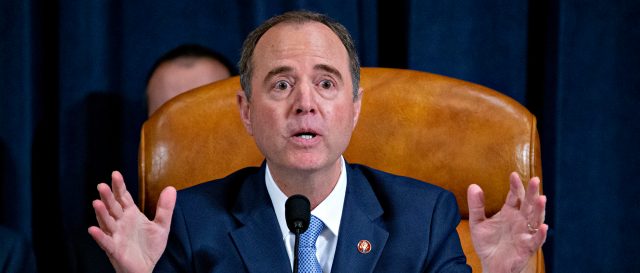
Adam Schiff, Getty Images, from DailyCaller.com. Used under Fair Use.

This piece also appears on my Substack, Issues That Matter. Subscribe here, and there, and share the piece.

Review: Ghost Fleet: A Novel of the Next World War

Review: Ghost Fleet: A Novel of the Next World War

It’s back to world war again. Last month I reviewed 2034: A Novel of the Next World War. Now I’ll review Ghost Fleet: A Novel of the Next World War. What’s that, you ask? Both books have the same subtitle? Yup. Apparently world wars sell books. Since Ghost Fleet came first, it would be the 2034 authors and publisher poaching the subtitle. Originality, anyone?

Anyway, the same Foreign Service buddy who suggested I read 2034 suggested that I read Ghost Fleet, too. It’s one more of those books that is reputedly all the buzz inside the Beltway. This is because, as mentioned in my other review, every war-game simulation run shows the ChiComs winning and handing us our ass. This is basically the premise of Ghost Fleet, that we’re at a disadvantage in a confrontation with China, and the book takes us through the ensuing conflict.

Foreign Policy had this to say about the place the book held in the Pentagon in 2016:

“It’s on the desks of four-star generals and junior naval officers, and it has found its way on to the recommended reading lists for every branch of the American military . . . At a time when commanders and intelligence officials are worried about retaining America’s technological edge against resurgent great power rivals — crystallized in Friday’s of the Defense Department’s annual report on China — the book has captured imaginations and sparked debate inside the Pentagon. Ghost Fleet has landed at an auspicious time: After 15 years of grinding ground wars against elusive insurgents armed with homemade bombs, the U.S. military is both yearning to get back to its roots in high-end conflict and wondering how to counter old adversaries with new hi-tech tools.”

I guess that was a time when our military — for lack of a better word — leadership was more concerned with defending the U.S. against real threats than superfluous things like promoting Critical Race Theory, gender equity, climate change, and combating alleged white supremacy. It’s pretty startling the changes that have taken place just in the past nine months in that regard, though I think the seeds of those changes were planted long ago. And now, with the debacle of our shameful Afghanistan surrender and withdrawal, the threat to this country has never been greater in many decades, and yet it is more clear, to friend and foe alike, that we are less psychologically prepared to counter any threats than perhaps at any time in our history. So whether one accepts the premise of the book or not, it is clear that through our exhibited fecklessness and weakness the temptation to our enemies has been magnified exponentially and entirely through our own unforced errors.

The Future as Seen from 2014

Ghost Fleet was written in 2014 and came out in 2015, so there are some clear anachronisms in it. One thing that jumped out was the widespread use in the book of smart glasses that are based on Google Glass, and we all know what happened to that idea. Technology plays a big part in the book and in the war, as one might expect. But one has to question some of that technology. For instance, a Chinese teenage girl is depicted just flicking her fingers to manipulate smart rings on her digital joints and create dire situations half way around the world. Call me a skeptic, but I don’t see where finger flicks could be deployed with sufficient precision to accomplish their goals. I mean, I have a hard enough time getting my tablet to do anything with my fingers on the screen. These things might make for colorful visuals, but I don’t see them working in real life.

Some things, like our dependence on computer chips used in sophisticated military aircraft and machines that are made in China, enabling the planting of spyware and tracking capability in them, is plausible, though others more knowledgeable of such things than I am have pointed out how shielding and other safeguards would largely make such things ineffectual. Peoples’ movements are tracked in great detail by a network of surveillance cameras, to the point where one can hardly take a dump without being observed, and then deadly drones, called quadcopters, come in to take out perceived enemies. Not totally inconceivable, but stretched to a point that challenges credulity. These scenes frequently reminded me of the 2016 – 2018 TV series Colony, which featured an alien invasion of Los Angeles.

As in 2034, technological advantages held by our adversaries help tip the balance toward them. But the question has to be raised whether the answer is simply more technology, more dependence on technology, or whether being smarter about how that technology is developed, built, deployed, and hardened against infiltration is the better approach. Ghost Fleet is almost like a clarion call for those at the top to pour more trillions into high-end technology while it’s also a dire warning against such an approach. The money game is at the heart of Washington politics, but how much does it further expose us to our enemies? And what role should more low-tech approaches play, undercutting our adversaries’ dependence on technology?

One disturbing element of the book is how virtually everyone, on both sides, has become essentially drug addicts. They rely on “stims” and implanted “pumps” to enhance their performance, do their jobs, even stay awake. This seemed superfluous to the overall story line, but it’s far from the only superfluous element.

The Ghost Fleet

The book’s title, and much of its action, centers on the mothballed fleet of ships — the Ghost Fleet — that have been taken out of service and are moldering at various places around the country. Once the war has started, China (actually, an updated version of China, something called “the Directorate,” made up of a mix of business moguls and military brass who overthrew the former Chinese Communist Party following the collapse of Indonesia) and Russia have disabled U.S. communications and surveillance capabilities. The Directorate also invaded, in a sneak blitz attack, and holds the state of Hawaii, where much of the action goes on.

With most of the U.S. Navy destroyed, the Pentagon resorts to putting the Ghost Fleet into action. Especially a high-tech, but mothballed, destroyer known as the U.S.S. Zumwalt — an actual vessel, seen in the image above in its sea trials. Mounted with a new and powerful weapon called a rail gun, this is going to be our answer to the mighty Chinese fleet. And like the lead characters in a TV crime drama running between the bullets but never getting hit, somehow the Chinese don’t see what is going on with its refurbishment and refitting, and then the Zumwalt manages to survive every attack launched against it once sent out on the prowl.

While serving up much of the dramatic and personal action in the book, these two elements — that we’d ever tolerate occupation of a U.S. state without massive retaliation, and how so much reliance was put on a single obsolete naval vessel — further stretched credulity. Throw in an eccentric billionaire who manages to take over a previously impermeable Chinese space station, after the Russians had taken over the International Space Station by locking out the sole U.S. astronaut aboard, and a sexy serial killer whose cleverly murderous ways are directed at the Chinese occupiers in Hawaii while feeding her own homicidal desires, and you have a mix more colorful than plausible.

Additionally, as a former intel analyst, I have to question how the Chinese and Russians could gear up for their attacks without us seeing what they were up to. We can identify specific cargoes being loaded on ships from our satellite surveillance and humint capabilities (assuming someone was watching, which they would be, before our satellites were incapacitated), and that just didn’t compute to me. Or how the Chinese wouldn’t see what we were up to refitting the Zumwalt at Mare Island.

The book has been criticized on literary terms, and I have to say I frequently found the book annoying. There are so many locations, subplots, and characters to keep track of — switching between them every one, two, or three pages throughout the book — there were times I was tempted to throw the book down. Rather than building my suspense, that got to be too much and just irritated me. I wound up spending an inordinate amount of time flipping back in the book to see who a specific character was or what was going on in a given subplot. Also, the book comes to a screeching halt in the middle of the most critical action, implying somehow we had prevailed without filling in the details how we did, and that also annoyed me.

While the book is a novel — at 404 pages, a rather long one — it also has 374 end notes meant to document every detail in the book and intended to lend credibility to it.

I won’t argue that Ghost Fleet doesn’t raise some questions worth evaluating, or that it isn’t entertaining enough in numerous places. But I wouldn’t get my ideas on how a future war might start, be fought, won, or lost, from the book. Or any work of fiction. I’d suggest that our military and political leadership get their heads out of their reading lists and get back to looking in a hard-headed way at world realities. Not that I have much faith that they will.

>>Click this link to buy the book on Amazon<<

Ghost Fleet: A Novel of the Next World War is by P.W. Singer and August Cole, an Eamon Dolan Book, published by Mariner Books, an imprint of Houghton Mifflin Harcourt. Copyright © 2015 by P.W. Singer and August Cole.

P.W. Singer is a strategist at New America, a Professor of Practice at Arizona State University, and Principal at Useful Fiction LLC. He has been named by the Smithsonian as one of the nation’s 100 leading innovators by Defense News, as one of the 100 most influential people in defense issues by Foreign Policy to their Top 100 Global Thinkers List, and as an official “Mad Scientist” for the U.S. Army’s Training and Doctrine Command. Singer is the author of multiple best-selling, award winning books in both fiction and nonfiction, ranging from Wired for War to Ghost Fleet. Described in the Wall Street Journal as “the premier futurist in the national-security environment,” Singer is considered one of the world’s leading experts on changes in 21st Century warfare, with more books on the military professional reading lists than any other author, living or dead.

August Cole is a nonresident senior fellow at the Brent Scowcroft Center on International Security at the Atlantic Council. He is the director of the Art of Future War project, which explores narrative fiction and visual media for insight into the future of conflict. His fiction writing tackles themes at the core of American foreign policy and national security in the twenty-first century, including the privatization of military and intelligence operations and the future of American power in the Pacific. He is also writer-in-residence at Avascent, an independent strategy and management-consulting firm focused on the defense and aerospace sectors. From 2007 to 2010, Cole reported on the defense industry for the Wall Street Journal.

Photo of U.S.S. Zumwalt by U.S. Navy and General Dynamics Bath Iron Works, via Getty Images. Used under Fair Use.

This piece also is posted on my fiction blog, Stoned Cherry, and on Substack in my community there, Issues That Matter. Follow me here, and there. And if you like the piece, please share it. Links below.

Review: 2034: A Novel of the Next World War

Review: 2034: A Novel of the Next World War

An old Foreign Service buddy of mine recently turned me on to the book 2034: A Novel of the Next World War. Co-authored by writer Elliott Ackerman and retired Admiral James Stavridis, my friend tells me the novel is all the buzz inside the Beltway these days. In no small measure, this is because in every war game simulation run in recent years, the ChiComs wind up handing the U.S. its ass on a platter. A sobering thought, it was enough to make me want to read this book.

It’s no coincidence that I’m posting this review on August 6, on the 76th anniversary of the day the U.S. dropped the atomic bomb on Hiroshima. While it takes more than a book to remind us, the specter of nuclear war has not receded into the realm of the totally implausible despite all the changes that have occurred in the world in those intervening years since the Enola Gay (which I’ve actually seen and stood next to) released its payload over the Japanese city of Hiroshima. If anything, an increasingly multi-polar world may be making the world ever more dangerous.

First, from a literary point of view, the book is well written. At times the action is gripping, and it becomes difficult to put the book down (a tendency I confess to have resisted and wound up reading the book in several tranches). There is a fair amount of personal back story of various characters, which got me a bit impatient, though such things usually do when my focus is on the action.

The general premise of the book is that China coordinates with the Iranians and the Russians to goad the U.S. into a conflict in which the U.S. is from the outset at a technological disadvantage. A series of miscalculations and missteps set the world’s two leading powers into a pattern that winds up in a tit-for-tat nuclear exchange, one that, just barely, falls short of being an all-out nuclear blow out. In the end, the world balance of power has shifted, and somehow India winds up emerging as the world’s king maker. There are elements of nuclear porn, for those who seek such things, but the book doesn’t wind up being Apocryphal. If anything, I found the ending rather unsatisfactory, but we’ll get to that.

One of the premises of the book is that the Chinese have developed a technology that renders entire fleets of their ships invisible to detection. Clearly this gives them a huge strategic advantage, but I had to wonder how plausible this is. We have satellites circling the globe with visual surveillance capability, and it just didn’t make sense to me that actual ships on the waters could be hidden from that kind of visual identification.

As it turns out, I recently came across an article where this very issue is raised. Apparently GPS technology already is being intercepted and manipulated by unknown actors to show ships and fleets in locations where they are not. Obviously, this can lead to serious consequences if, for instance, a nation thinks it is about to be attacked by a phantom fleet, which it believes to be real, and retaliates. But, much as I suspected in reading the scenario painted in 2034, visual satellite imagery is used to confirm the actual location of the ships detected and to compare that location with the phantom location to demonstrate the reality. So until someone shows me some technology that completely obscures a vessel’s visual presence (as well as the role played by human intelligence), I have to conclude that this is a stretch too far.

There were other things in the book that didn’t compute to me. Early in the book an entire U.S. naval fleet is destroyed by the Chinese, and yet our retaliation is restrained and the course of events is stretched over several months. If China (or anyone) wipes out an entire fleet of our ships, would we slow-walk our response, as happens in the book? I seriously doubt it. In fact, the whole war seems like it is in slow motion. I understand we’re on entirely new ground here and we have never engaged in a full-scale war with a nuclear power before. We may or may not make a first nuclear strike, but would a nuclear China be as restrained if faced with a massive conventional response? I can’t answer that question, with what I know, but the pace of events just didn’t seem realistic, though it did help fill pages.

Another thing I didn’t understand was a key part where the Russians take out underwater Internet cables passing under the Arctic Sea, completely disrupting domestic U.S. communication. I had to wonder why Internet cables running under the Arctic Sea would be connecting domestic U.S. Internet nodes, and why destroying them would disrupt our internal Internet connectivity. I also looked up current undersea cables and there don’t appear to be any running under the Arctic Sea. But even if there were, I can see where they might disrupt connections to Europe or maybe Asia, but not between the East and West coasts of the U.S. This seemed to be an unanswered question even though it was a critical event in the book.

The cable thing also raised the question why one side or the other wouldn’t have used an Electro-Magnetic Pulse (EMP) attack on the other, which would have had far more widespread effects without the need to resort to nuclear ground attacks and frying whole cities.

I understand a certain degree of literary liberty, but when logic seems not to apply to major elements of the plot, without any explanation, I find it troubling as a reader and it makes me question how much I can suspend disbelief. Perhaps we’ve gotten to the point where we believe that all things are possible with technology, but until pigs fly without benefit of technology, I’m going to retain a level of skepticism.

There are some interesting themes that run through the book. One of them seemed to be, low tech meets high tech and low tech wins (usually, anyway). This has long been a kind of life principle of mine. Are we too dependent (and would be even more so in 13 years which, by the way, doesn’t seem that far off) on technology? Probably. Especially if proper safeguards and backstops aren’t built into it. But meanwhile we are engaged in a technological competition with the Chinese. To believe 2034, they may well be winning that competition. And there is reason to believe they are, aside from the book.

One lesson, early on and which sets the whole story in motion, is how not following proper procedure and going off on deviations can be a very bad idea. A U.S. naval commodore, heading a patrol in the South China Sea, decides to deviate from SOPs to go check out a Chinese merchant vessel that appears to be in trouble. In doing so, she walks right into a trap that had been set by the Chinese. It might not be as heroic or dramatic, but sometimes it’s better to stay with the program and not follow one’s gut feelings or curiosities.

I have long believed that if we get into a nuclear war it would most likely be by accident or miscalculation. We have come pretty close a couple of few times. In the book, a series of mishaps and miscalculations allows a U.S. Navy pilot to get through to nuke Shanghai despite attempts by his commander to call off the attack. And things just continue to snowball.

Parts of the book turned out to be nothingburgers. There is a whole section devoted to a battle for the Strait of Hormuz between the Iranians and the Russians which seemed superfluous and much to-do about not much. I was expecting more involvement by Russia leading to the U.S. being forced to fight a two-front war, and that just never developed.

While, as I said, much of the book is gripping, I found the ending unsatisfactory. It is made to seem that the U.S. had been reduced to some sort of second- or third-rate power, while India, of all countries, had risen to be the major world power. Both the reality and the logic of that eluded me. In the course of the book the Chinese nuke Galveston and San Diego, but in the end the country seems demoralized and a shadow of its former self. Somehow I don’t see how loss of those two cities would have such a major impact on the country as it does in the book. There are even people living in refugee camps, which also seemed superfluous and unlikely.

We’ve faced crises before, whether it was grouping and striking back after Pearl Harbor, or following 9-11. And a major hurricane, like Katrina, certainly devastated a big part of the country, and we dealt with it, if imperfectly. Maybe if New York and Los Angeles were taken out it might be more likely. But with Galveston and San Diego being the targets, I don’t see it. Of course, at the rate and in the direction the country currently is headed, we might be so wimped out and divided and chaotic by then, that we just slip into being a third-rate power.

We also never do find out how things are in China after the war (except they don’t mind putting a bullet in the back of the head of someone who is perceived to have screwed up), and we are left wondering the final disposition of Taiwan, which China has invaded in the course of the war.

My friend who turned me on to the book disagrees with me on the ending. He thinks it would be quite realistic to believe that the country could be so demoralized if even relatively minor cities were nuked that it might actually break up, and the country would face an existential crisis the likes of which we only experienced during the Civil War. In his view, states with extreme politics, like California and Oregon, might opt out of the Union and attempt to become independent entities. There also would be lots of openings, he says, for malicious external actors to support some people’s worst inclinations. I’m not prepared to say his analysis is wrong, again, especially with the current negative trends we’re seeing in the country. I do think it would not be unrealistic to think both the country and the world would be profoundly altered by a war between the superpowers, especially one with nuclear exchanges.

As I proceeded through the book, I was reminded of an argument I had with a friend 40-some years ago. I argued at the time that logic would militate against a nuclear confrontation, and the other party argued that it would in fact be logic that would lead to such a conflict. Reading this book and seeing the progression of events, I actually could see the validity of that argument and how that very logical progression of events led to the conflagration that ensues.

The Washington scenes frequently reminded me of the things I didn’t like about being in the Foreign Service and the reasons that caused me eventually to leave it: The boneheads running the show, the clash of egos, the internal politics, the too many chefs in the kitchen, the hubris, the suits and ties running the ship of state aground. There were little giveaways to when the book was written and the authors’ perspectives, such as a reference to the one-term presidency of Mike Pence, but those didn’t much matter in the overall scheme of things.

Of course I felt bad about all the millions of incinerated people, on both sides. I even felt bad for the ex-wife of one of the main characters who got nuked in Galveston (and I felt bad for the neat little B&B there at which I once stayed). But, think what you will, I felt worst about this squirrel that the main Iranian character squeezes to death in his hand, and for its mate as she watches him do it. That just seemed gratuitously cruel and it bothered me all through the rest of the book.

Perhaps the main value of 2034 is that it draws our attention to the biggest external threat facing the country and the world. China has made no secret of its designs for domination both regionally and on the larger world stage. Its impact has been felt in the past year and a half through a devastating virus that it allowed to be released across the globe and, to date, has faced virtually no consequences for what, at best, was its negligence. Neither has it faced consequences for its repressive internal policies, the genocide it is conducting against the Uighurs, its crushing of Hong Kong’s democracy, or its open threats against Taiwan and even Japan. While our focus and national resolve drift, China’s has intensified.

There are a range of issues the book brings attention to, from the role of technology, to war strategy, to civil preparedness, to hardening our communications, to effective diplomacy. And they are all worthy of attention. But what it fails to address, what fall outside its purview, are the internal divisions that tear at our national fabric, the diversion of both our civilian and military leadership from the big issues of national security to some sort of “woke” agenda that only further weakens us, and our growing loss of educational acuity as China surges ahead. It is the internal threat that, in the end, may pose the greater danger than the external one. The import of that threat is not lost on China nor our other adversaries.

Bottom line: Read 2034, pay more attention to what China is up to, and what is — or isn’t — going on in Washington, too.

>>Click this link to buy the book on Amazon<<

2034: A Novel of the Next World War is by Elliot Ackerman and Admiral James Stavridis, published by Penguin Press, an imprint of Penguin Publishing Group, a division of Penguin Random House LLC. Copyright © 2021 by Elliot Ackerman and Admiral James Stavridis.

Elliot Ackerman is the author of the novels “Red Dress in Black and White,” “Waiting for Eden,” “Dark at the Crossing,” and “Green on Blue,” as well as the memoir “Places and Names: On War, Revolution, and Returning.” His books have been nominated for the National Book Award and the Dayton Literary Peace Prize. He is both a former White House Fellow and Marine, and served five tours of duty in Iraq and Afghanistan, where he received the Silver Star, the Bronze Star for Valor, and the Purple Heart.

Retired Adm. Jim Stavridis spent more than 30 years in the U.S. Navy, rising to the rank of four-star admiral. He was Supreme Allied Commander at NATO and previously commanded U.S. Southern Command, overseeing military operations through Latin America. At sea, he commanded a Navy destroyer, a destroyer squadron, and an aircraft carrier battle group in combat. He holds a Ph.D from the Fletcher School of Law and Diplomacy at Tufts University, where he recently served five years as dean. He has published eight previous books and hundreds of articles. Admiral Stavridis is chief international security and diplomacy analyst for NBC News, and a columnist at both Time magazine and Bloomberg Opinion. Based in Washington, D.C., he is an operating executive of the Carlyle Group, an international private equity firm, and chair of the board of counselors of McLarty Associates, an international consulting firm.

This piece also is posted on my fiction blog, Stoned Cherry, and on Substack in my community there, Issues That Matter. Follow me here, and there.