Category: Public Policy

Bigger Than a Big Weather Story

Bigger Than a Big Weather Story

When I was a practicing journalist I came to learn that there are few stories bigger than a big weather story. I still remember, more than three decades later, my managing editor at the daily paper where I worked standing in the middle of the newsroom as a tropical storm was headed our way and bellowing, “Blow it all out of proportion!” And we dutifully did.

So what’s bigger than a big weather story? The current furor over COVID-19, AKA the coronavirus, reminds me of our coverage of tropical storms and hurricanes, but on steroids. The media has certainly seen to the task of blowing it all out of proportion, making it bigger by far than a big weather story.

Now I can already hear the protests and mocking retorts. “But, BUT! This thing is deadly! It’s killing people! It’s a pandemic! It will destroy civilization as we know it!”

Yes, yes, I know all that (except the last one, of course), and I don’t mean to minimize the potential for death and destruction that this virus can wreak, any more than I would minimize the potential of seriously bad weather to kill and destroy. I’m also not intending to discourage people from taking reasonable precautions to protect themselves and others, though I am advocating that people not overreact. While some people, mostly older people and those with serious underlying medical conditions, are at high risk, many cases of the virus in the U.S. have been relatively mild. I think it’s both useful and even hugely beneficial to keep things in perspective and not run off the cliff by blowing things all out of proportion.

Striking a balance

As with any emergency, two factors are critically important. One is to recognize the danger and how to best address it, and the other is to stay calm and avoid panic. The kind of media coverage we’ve gotten on COVID-19, for the most part, has been heavy on the former (even as it was late in coming and largely distorted, which it remains), and exceedingly light on the later. I don’t think it has done what it could to make people safer and shockingly little to calm them or put things in perspective. We’ve seen the results of this as people rush to alter their everyday lives in ways that often are gross overreactions while not necessarily making them any safer. Meanwhile, the impact on the economy, with more than a 20% drop in the markets and massive slow-downs and shut-downs of whole industries, appears to be perhaps more harmful to the country than the virus itself.

We’ve watched on television as people in places, mostly on the West and East Coasts, stripped store shelves bare, as if theynauris-pukis-S0XbrnbUo-g-unsplash close quarters were expecting some sort of plague of locusts to descend on them. By way of comparison, as recently as a few days ago everything remained normal here where I live in North-Central Florida. I felt people were being sensible, given the remote risk involved, and there were no signs of panic. And then the dominoes started falling here as elsewhere. The National Hot Rod Association announced it was postponing the Gator Nationals hot rod races in Gainesville, which particularly pissed me off, partly because I had already bought my ticket, but more because it is an outdoor event, furchrissake. Florida colleges and universities are considering moving all classes online. And then yesterday I visited some of the local stores and, while I wouldn’t characterize the atmosphere as one of panic, it clearly had shifted from the usual norm. I’m not an expert, but I have to think the chance of contracting a virus in the closed confines of a supermarket has to be greater than in the open air.

As in other places, along with water, toilet paper and some other products had been stripped from the shelves. While I can kind of understand and even expected the water – these stores run out of water even in more normal times – but toilet paper? Folks, this isn’t a dysentery epidemic. What possible need for toilet paper, beyond normal consumption, can anyone have? And it turns out this isn’t just happening in this country, but overseas, too. There is the family in Australia who (by mistake) ordered not 48 rolls but 48 cases of toilet paper. By their estimate, 12 years worth of the stuff. Now admittedly the order was placed before the coronavirus furor reached full bore, but the family is finding they’ve become very popular among people who can’t find TP in the stores in Oz and are re-selling the rolls as a fundraiser.

Watching people rolling carts topped to the brim with products, one wonders if they’re planning on withdrawing to underground bunkers to await the all-clear after the radioactive fallout from nuclear war has stopped dropping or for when the invading aliens have returned to their distant galaxy. In large part promoted by the media, this sort of rush is now under way across the country.

One report I got was from my contractor, who described the scene in coastal Mississippi: “I stocked up on enough food and supplies to last a month just in case we have to be isolated but I’ve seen people buying enough to last for the rest of the year. It’s absolutely ridiculous.” Number, as of today, of confirmed cases of COVID-19 in Mississippi: 10, at least one of which originated out of state. Number of deaths in the state from COVID-19: 0. Mississippi’s population: 2.99 million.

Ridiculous, indeed.

Putting things in perspective

To further see how ridiculous, let’s put things in perspective a bit. As of today, this county where I live has had a grand total of no cases of coronavirus. The county to the east has had five cases, the county to the north has had one (which came from Georgia, the state, not the country), and one to the southwest has recorded one case. None of the other four counties that border on this county has had any cases, and no deaths have been recorded in any of these counties. The state of Florida, which has about 22 million people, not counting its many visitors, has so far confirmed 76 cases and three deaths, several cases involving people who had traveled abroad or were from other states.

Meanwhile, so far this year, if averages from other recent years can be relied on, in just 75 days something like 630 people have died in road accidents on the state’s streets and highways and another 51,000 or so have been injured. Perhaps if people paid more attention to their driving and less to concern about wiping their butts they’d be a lot better off.

I haven’t even been able to find accurate statistics on how many people have come down from the flu or died from it in Florida, but nationwide, the Centers for Disease Control (CDC) estimates that as many as 49 million people this flu season alone have contracted the flu, there have been up to 23 million medical visits and 620,000 hospitalizations, and 52,000 deaths, including 144 children to date (that includes 12 so far in Florida). By comparison, the CDC is reporting 1,629 cases of coronavirus in 46 states and the District of Columbia, and 41 deaths, with no child deaths in the U.S. Not that any of those cases or deaths are to be dismissed, but the comparison with the illness and deaths from the flu and other things can’t be ignored. In this country, we see more than 67,000 people die each year from opioids.

Hysteria and playing politics

If you look objectively at what the current Administration in the White House has done to control introduction and spread of this virus, it has acted decisively and quickly. When it became apparent that the virus had originated in or around the city of Wuhan in China, the President on Jan. 31 ordered a limited ban on entry into the U.S. by most travelers coming from China, and it went into effect on Feb. 2. This past week, on March 11, the President ordered a similar ban on travel from Europe, with exemptions for travelers from the U.K. and Ireland, both of which were later added to the ban. And on March 13 he declared a national state of emergency, with the effect of releasing additional federal resources and funding to deal with the crisis.

To assure a coordinated approach, the President on Feb. 26 had put Vice President Mike Pence in charge of the government’s response to the coronavirus, with experts from the CDC and National Institutes of Health (NIH) leading the medical response to the threat posed by COVID-19. If you didn’t see that press conference you should now since I think it was one of the most explanatory and straightforward presidential press conference I’ve ever seen.

You’d almost never know that President Trump was doing anything to address the threat of coronavirus if you only follow the never-Trumpers on the left wing of the media who, along with some on the Democratic side of the aisle in Congress, have disgustingly done their utmost to politicize what is a national crisis. It reached the point where on some networks program hosts blatantly squelched any views that offered support to the President. This was transparently obvious, for instance, to anyone watching as CNN’s Don Lemon – who, in my assessment, would have a hard time beating out a clever hamster in an intelligence contest – repeatedly shut down former Ohio Gov. John Kasich (himself no big Trump supporter) as Kasich attempted to defend the President’s response to the crisis.

Along with the anti-Trump prejudice, we heard such inanities as commentators saying it was “zenophobic” and “racist” to call macau-photo-agency-4I6VHLP5Ws4-unsplash masked familythe virus “the Wuhan virus” or “the Chinese virus,” despite the fact that the origins of the virus in and around Wuhan is little disputed. That encouraged Chinese officials to blast the U.S. for saying the virus originated in China and even to threaten to withhold vital medications from the U.S. Meanwhile, lots of viruses and ailments, including Ebola, West Nile, Zika, and Lyme, not to mention “the Spanish flu” and “the Asian flu” – remember those, from 1918 and 1957, respectively? – have been named after the area in which they originated, and no one ever called those names racist or zenophobic.

Two big scandals exposed by the coronavirus

Not to sugar coat anything, there are at least two big national scandals this coronavirus thing has in fact uncovered, and we should be grateful that it has. One is the lack of our capacity to produce kits to test for the virus on a massive scale. While South Korea has been able to test 20,000 people a day, it is safe to say we don’t really know how many people in the U.S. have been tested. We do know that testing capacity in this country has been severely limited – perhaps no more than 20,000 tests in total performed to date – and this falls squarely on the shoulders of the CDC. Conflicts between the CDC and some states, such as the conflict with Washington Gov. Jay Inslee, at the epicenter of the outbreak, have been reported, and little has been done to tap the capacity of the private sector to produce test kits of sufficient number. Fortunately, on March 13 the FDA approved pharmaceutical giant Roche’s new automated test, which should allow a rapid ramp-up of testing capability as it begins to roll out. Roche says it already has 500,000 tests ready and can produce another 1.5 million of them per month. Going forward, a more flexible approach to developing and deploying testing for various diseases needs to be implemented.

The other big scandal, and perhaps the bigger and more difficult one to address, is how dependent the U.S. has become on overseas production of pharmaceuticals and pharmaceutical components, with China holding the lion’s share of production of some key medications. It is estimated that China is the source of 97 percent of the antibiotics used in the U.S., and two countries, China and India, produce most of the pharmaceuticals and pharmaceutical materials used in the U.S. Along with the strategic threat this preponderance of source represents, there also have been issues of quality control and corruption in the Chinese pharmaceutical industry. It would seem that moves should begin immediately to domesticate key elements of this country’s pharmaceuticals production, something other countries also should do.

We have learned lessons from previous pandemics, such as the H1N1 pandemic of a decade ago, but sometimes lessons are forgotten and each new pandemic brings with it new challenges. Making systemic fixes to address such obvious and serious problems as these two needs to be a national priority. And that is not blowing things out of proportion.

Photo credits: Featured image: Max LaRochelle/Unsplash; Crowded: Nauris Pukis/Unsplash; Masked Family: Macau Photo Agency/Unsplash

Ding-Dong! The Wizard Is Dead

Ding-Dong! The Wizard Is Dead

In the 1939 classic film The Wizard of Oz, the Wicked Witch of the East is killed when Dorothy’s house, spirited off to Oz from Kansas by a cyclone, lands on her. In 2020 real life, the Wicked Wizard of the East, Iranian Maj. Gen. Qasam Soleimani, was killed when he came into the crosshairs of an American drone flying over Baghdad’s international airport in Iraq. Ding-dong! The wizard is dead.

As the Munchkin Coroner states in the 1939 film, “As Coroner, I must aver I thoroughly examined her, and she’s not only merely dead, she’s really, most sincerely dead.”

Ditto for Soleimani.

Just as the Munchkins rejoiced at seeing the wicked witch’s stockinged feet protruding from under Dorothy’s transplanted house, there is grounds to celebrate the demise of Soleimani, the head of Iran’s deadly Quds Force. Unfortunately, the figurative kingdom is rife with naysayers and handwringers, and political divisiveness seems ever-ready in contemporary America to overcome any shared sense of victory.

While it is Pollyannish to expect that there won’t be some consequences in the targeting of Soleimani, regarded as the second most powerful figure in Iran’s arcane political structure, it is just as Pollyannish to think that there wouldn’t be consequences were he still alive and having breakfast this morning on Al Rasheed Street in downtown Baghdad.

The havoc and death wreaked by Soleimani stretches back four decades to when, in 1979, he joined the Islamic Revolutionary Guard Corps (IRGC) following the Iranian revolution and, beginning in the Iraq-Iran War of the early 1980s, he rapidly advanced within the hierarchy. In 1998 he took over command of the Quds Force, designated a terrorist organization by the State Department. Sometimes called “the world’s number one bad guy,” consider these feats of Soleimani and the Quds Force he headed:

Taking out Soleimani wasn’t just a random act. It followed an attack by Iranian-backed Shiite militiamen on the U.S. Embassy in Baghdad on New Year’s Eve, in which the attackers had penetrated the entrance to the compound and burned a reception area. While no one was kllled in the attack, the U.S. responded by sending in 100 Marines to secure the compound, given the failure of the Iraqi government to meet its internationally mandated requirement to protect diplomatic facilities.

There was more involved than the embassy attack, though. Both Secretary of State Mike Pompeo and Joint Chiefs Chairman Mark Milley made it clear that reliable intelligence indicated that a wave of Iranian-inspired terrorist attacks against U.S. assets in the region was being planned and was imminent. And, of course, Soleiman was brazen enough to show up at Baghdad’s international airport, exposing himself to the drone attack that killed him and also Abu Mahdi al-Muhandis, deputy head of the Iran-backed Iraqi Popular Mobilization Forces militia.

“I can’t talk too much about the nature of the threats. But the American people should know that the President’s decision to remove Soleimani from the battlefield saved American lives,” Pompeo told CNN. “The risk of doing nothing was enormous. Intelligence community made that assessment and President Trump acted decisively last night.”

Pompeo said hundreds of American lives had been at risk. He later told Fox’s Sean Hannity that the attack also had saved European lives, though he hadn’t gotten the kind of support he expected from European allies.

The Brits, the French, the Germans all need to understand that what we did, what the Americans did, saved lives in Europe as well,” he said.

Milley said the U.S. had intelligence that was “clear, unambiguous” that Soleiman was planning a campaign of violence against the U.S., leading to the decision to attack him. Targets included American military outposts in Syria and diplomatic and financial targets in Lebanon.

“By the way, it still might happen,” Milley said.

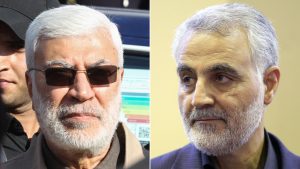
Abu Mahdi al-Muhandis and Qasem Soleiman
Abu Mahdi al-Muhandis, left, deputy head of the Iranian-backed Iraqi Popular Mobilization Forces, and Qasem Soleimani, commander of Iran’s Islamic Revolutionary Guards Corps Quds Force, right, both killed in the U.S. strike.

Iran’s Supreme Leader Ayatollah Ali Khamanei immediately appointed Maj. Gen. Ismail Qaani to replace Soleiman as head of the Quds Force and, predictably, pledged revenge. Qaani said the Quds agenda would remain unchanged.

As predictable as Khamenei’s reaction was, so was the response in Congress, which broke down along party lines. The anti-Trump Dems, for whom the President can do nothing right, were quick to criticize the action, going so far in some cases to say the strike on Soleimani was illegal, though reportedly legal departments at both State and Defense, as well as at Justice, approved the strike.

House Minority Leader Nancy Pelosi complained that Congress hadn’t been consulted on the planned attack on Soleimani – no surprise there, given the tendency of Congress to leak like a rusty old sieve – and she had the temerity to call the killing of the man who had murdered hundreds of thousands of people, including hundreds of Americans, “provocative and disproportionate.”

Meanwhile, not to be outdone, Vermont Senator and Democratic presidential candidate Bernie Sanders called the killing of Soleimani an “assassination” and introduced legislation to block funding of any military action in the region. Most of the other candidates in the race piled on with criticism of the attack.

There was some push back, though, even within the parties. Another Dem candidate, former New York City Mayor Michael Bloomberg, was quick to strike back at Sanders, calling his “assassination” claim “outrageous.”

If he was talking about killing the general . . . this is a guy who had an awful amount of American blood on his hands. I think that’s an outrageous thing to say,” Bloomberg said. “Nobody that I know of would think that we did something wrong in getting the general.”

While prominent Republicans, including Sen. Lindsey Graham and Sen. Marco Rubio, expressed strong words of support for the attack, another Republican, Sen. Rand Paul, expressing his libertarian view on foreign affairs, said the Trump administration should not embark on a war in the Middle East without Congressional approval.

As the naysaying and handwringing goes on, and will in the days and weeks and more to come, if there is one prediction that will always be correct it is forecasting violence in the Middle East. If that’s anyone’s prediction, they’d be right, with or without Soleimani. In anticipation of Iran’s reaction, the U.S. is sending an additional 3,500 troops to the region. Soleimani may be really, most sincerely dead, but the seething animosities of the region most certainly aren’t, and there are no ruby slippers, like the ones that passed to Dorothy from the deceased Wicked Witch of the East, to magically bring them to a close. So stand by. Film at 11.

Disclosure: The author was an intelligence analyst with the State Department covering the Middle East.

Photo credits: Main image: Donovan Reeves / Unsplash, used with permission; al-Muhandis and Soleimani images, AFP via Getty, used under Fair Use.

Waltzing Merrily Over a Cliff

Waltzing Merrily Over a Cliff

“I  don’t care whether you’re driving a hybrid or an SUV. If you’re headed for a cliff, you have to change direction.”

Barack Obama

That might be a warning that House Speaker Nancy Pelosi would be advised to heed as the Democrats in Congress push relentlessly ahead in their quest to undo the election of President Donald Trump. On the flimsiest of charges, they appear intent to proceed with impeaching the President, a move born of their hatred for Trump and doomed to fail. As they waltz merrily over the cliff, they are bolstering Trump’s approval ratings and almost certainly aiding his reelection chances.

Depending on what media you pay attention to, you might either, a) think the case against Trump is ironclad and he is nothing short of a tyrant and reprobate, or b) that he’s been railroaded by political animus and blind prejudice. There is plenty of agida stirred up on both sides, largely fostered by selective picking and choosing of what to focus on by various media sources, not to mention plenty of outright lying (I say that having heard it with my own ears) and obfuscation by more than a few supposed journalists.

For instance, as just one example, if your source for news (I use the term advisedly) is CNN, you never would have heard the opening statement of Senate Judiciary Committee Chairman Lindsey Graham, a Republican, at the committee’s Dec. 11 session with Department of Justice Inspector General Michael Horowitz, nor would you have heard Horowitz’s mention of the 17 clear errors and omissions committed by the FBI in seeking the FISA court order that began the whole Russia affair that was scurrilously pinned on Trump. All you would have heard were statements by Democratic Sen. Dianne Feinstein eliciting responses from Horowitz that seemed to indicate all was done properly, which – if you somehow heard the rest of what Horowitz had to say — it decidedly wasn’t. You also would have gotten the full opening statement of House Judiciary Committee Chairman Jerrold Nadler, a Democrat and one of the leaders of the anti-Trump mob, in the impeachment hearings his committee was conducting.

I’ll be doing a separate analysis of Horowitz’s findings and report in a future posting. For now, let’s just quote what Horowitz had to say about the claim by former FBI Director James Comey – who now has passed from unbridled arrogance to perhaps certifiable narcissism – that the IG’s report vindicates him in his role in initiating the investigations of Trump.

The activities we found here don’t vindicate anybody who touched this,” Horowitz said.

Another Big Swing, A Bigger Miss

At the risk of sounding redundant, the current episode is just the latest in the Dems’ ineffectual attempts to take out Trump. I laid out the basic game plan in my three-part series, “Another Swing, Another Miss.” In Part I I detailed how the Dems’ repeated efforts to unseat Trump amounted to one strike after another. In Part II I detailed how there is indeed a Ukraine scandal, being used as the pretext for the impeachment effort, but the scandal lies not with Trump but with former VP Joe Biden and his son Hunter. And in Part III I described the much bigger, but little reported on, scandal involving the Bidens and China. Now we’re going to see how three strikes aren’t enough for the Dems’ to give it up and how they are following their anti-Trump obsession right over the political cliff.

The process took a step closer to the cliff’s edge earlier on the day I am drafting this as the committee headed by Nadler, the Wiffer-in-Chief, voted entirely along party lines to move two articles of impeachment to the full House for a final vote, ostensibly in the coming week. This followed a contentious 14-hour committee debate that ended suddenly at Nadler’s order at 11 p.m. last night, prompting Republican members to call the process a “kangaroo court” and Nadler’s order “Stalinesque.”

After ridiculous Democrat charges of “bribery” and even “treason” as hearings were under way in the House Intelligence Committee, headed by the shifty Rep. Adam Shiff, the final two articles are nothing less than anti-climatic. The best they could come up with is “abuse of power” – based on the allegations that Trump withheld military aid from Ukraine in order to seek an investigation of his presumed political rival, Joe Biden – and “obstruction of Congress” – based on the President’s refusal to cooperate with the House investigations, which he has termed a “witch hunt.” While the Constitution says a President can be removed for “high crimes and misdemeanors,” there is no federal or state statute against either charge.

Given further that the White House released the full transcript of the July 25 telephone conversation between Trump and Ukraine President Volodymyr Zelensky in which there was no indication of the quid pro quo Dems’ have insisted was present, and the right of a President to demand an investigation of suspected corruption in conduct of foreign affairs, the first article appears DOA. As for the second article, disputes between an Administration and Congress over executive privilege are legion throughout the life of the republic. This Administration’s refusal to turn over documents or permit members of the Administration to testify would not be the first stand-off between the two co-equal branches of government. Ultimately, the courts could rule on the matter, though the Supreme Court, the third co-equal branch, has been reluctant to wade into such matters.

Let’s not forget that former Attorney General Eric Holder was found in contempt of Congress, too, and the total penalty for him, under the Obama Administration, was a big zero.

Speaker Pelosi, not known for coherent statements, was even more incoherent than usual in trying to defend the articles the committee came up with.

I myself am not a lawyer,” babbled Pelosi. “Sometimes I act like one. Not as often as I act as a doctor. I practice medicine on the side without benefit of diploma, too.” Huh? But wait, she wasn’t done. “This is a decision that was recommended by our working together with our committee chairs, our attorneys and the rest.” Not done yet. “And they (the articles) are … uh … a continuation of a pattern of misbehavior on the part of the President. People are realizing, when they see what that was, they think, the public thinks, that they should be determining who the President of the United States is, not some foreign power.” Well, yeah, and that “public” is who elected Trump as President, isn’t it? The same “public” whose vote you’re trying to undo because you don’t like how it turned out? And finally, “It’s no use having the discussion here. This is a discussion we will take to the floor of the Senate.”

Going Over the Cliff

And that’s where the whole process goes over the cliff. Given that it takes 67 senators to vote in favor of removing the President from office, that there are 53 Republican, 45 Democratic, and 2 independent members of the Senate, and a vote will be almost entirely along party lines, there is no chance the President will be removed from office.

There has been some backing and forthing between Trump and Senate Majority Leader Mitch McConnell over whether it will be a long trial with lots of the witnesses, like Hunter Biden and Adam Schiff, that Trump has said he’d like to call, or a quick process, that McConnell seemed to favor. In reality, it is Supreme Court Chief Justice John Roberts who would actually preside over the trial and will have a lot to say about its conduct. Regardless, the end result is fait accompli. As McConnell has said, “The case is so darn weak, coming over from the House, we all know how it’s going to end. There is no chance the President is gonna be removed from office.”

Meanwhile, polls have been showing that a majority, albeit a slight majority, of Americans now are opposed to impeachment, and even more opposed to removing him from office, and Trump’s favorability ratings have been rising through all this. At least one major poll, Rasmussen’s daily tracking poll, as of Dec. 13 puts Trump’s approval at 49% (it recently was up to 51%), three points above where President Obama was at the same point in his first term.

None of this can inspire confidence among Dems given that the outlook for 2020 becomes ever more problematic for them. Some major polls are now showing Trump beating all or most of the Democrat presidential front runners in key battle ground states. Throw in the massive Conservative victory in the UK on Dec. 12, and there is plenty of grounds for Pelosi and the left-leaning Dems, to whom she seems to have capitulated, to take heed of Obama’s warning on what to do when they’re headed for a cliff.

Photo Credits: Nancy Pelosi: Unknown; Donald Trump: Reuters. Both used under Fair Use.

Another Swing, Another Miss Part III

Another Swing, Another Miss Part III

This is third part of a posting, Another Swing, Another Miss, that I initially put up on Oct. 2. Part II appeared on Oct. 4 and, ostensibly, this will be the final installment in the series. If the points made in these postings aren’t clear to you by the time you’ve gotten through this third part, we’re both wasting our time.

In the first part I predicted that the Democrats’ latest attempt to pin something, anything, on President Trump would fail, as did all their previous times at bat against him. In that part I promised to explain what “there” there is in the Ukraine imbroglio, the latest incarnation of the Dems’ attempt to undo the results of the 2016 election – a “there” not with Trump, but with former VP and current presidential contender Joe Biden. I kept that promise in the second part and then went on to say there is a much bigger “there” in which Biden and his son Hunter are involved.. Now, in this part, I will explain that biggest “there” of all, which involves China.

If you haven’t read the first two parts in the series yet you should now, and then go on to read this part. All this will make much more sense to you if you understand what leads up to it.

A Profitable Family Outing on Air Force Two

On Dec. 4, 2013, then-Vice President Joe Biden, son Hunter Biden, and Finnegan Biden, Hunter’s daughter and Joe’s granddaughter, stepped off of Air Force Two into the chill winter air of Beijing. They were greeted by children bearing flowers before being whisked off to meetings with top Chinese leaders. With the trappings of a family outing – all, of course, on the U.S. taxpayer’s nickel – the Bidens had arrived on what turned out to be not just a high-profile state visit, but a most lucrative few days for Hunter.

Hunter, Joe, and Finnegan Biden tour Hutong Alley during December 2013 visit to Beijing. What back alley deals did Hunter make during the visit? Photo by Andy Wong – pool/Getty Images. Used under Fair Use.

Ten days after the visit, during which Hunter Biden’s meetings with high-ranking Chinese officials went largely unreported, Rosemont Seneca Partners, the hedge fund in which the younger Biden is a principal, concluded a deal, initially valued at $1 billion but later expanded to exceed $2 billion, in which Bohai Capital, a subsidiary of the Chinese government-owned Bank of China, agreed to invest in Rosemont Seneca. Together, they formed a new entity called Bohai Harvest RST.

Remember in Part II of this series I asked you to remember the name “Bohai”? Well, there you have it: Bohai – the name of the innermost gulf of the Yellow Sea – represents the Chinese government’s investment in the private fund headed by the son of the then-VP of the United States. The other principal in the fund was Christopher Heinz, the stepson of then Secretary of State John Kerry. Together Bohai Capital and Rosemont Seneca formed Bohai Harvest RST (BHR). The RS stands for Rosemont Seneca and the T stands for the Thornton Group, headed by James Bulger, the nephew of notorious Massachusetts gangster Whitey Bulger. James Bulger’s father, younger brother of Whitey, Billy Bulger, longtime leader of the Massachusetts state senate and ally of John Kerry, serves on the board of the Thornton Group.

So, what you have is the Chinese government making a major investment in a fund headed by the sons of some of America’s most connected officials. While Chris Heinz later denied any involvement with the Chinese deal or with Bohai Harvest RST, Hunter Biden’s role in the fund and the deal has been well documented, largely through the work of investigative author Peter Schweizer. The body of Schweizer’s work has been widely quoted and recognized for its in-depth quality and accuracy, most prominently including his previous book, Clinton Cash: The Untold Story of How Foreign Governments and Businesses Made Bill and Hillary Rich. Now some sources, like Politifact, reported that Bohai’s investment in the fund was much less than originally envisaged, topping at “just” $425 million. But that number comes directly from Hunter Biden’s attorney, George Mesires. It is challenged by another investigative reporter, John Solomon, who says that the BHR web site showed Bohai’s investment in the BHR venture at more than $2 billion, before the fund suddenly took down the site as the Biden controversy emerged recently. So much for the “fact checking” done in this case. But we risk getting lost in the weeds. The point is, a deal worth a significant sum of money coming from the government of one of America’s prime competitors went to the son of the Vice President of the U.S. on the heels of a high-level state visit.

The Chinese venture also comes into play in the Ukraine story since, as we noted in Part II of this series, Burisma Holdings paid a reported $3.4 million to a company named Rosemont Seneca Bohai LLC. When you have money behind you, you can cast a very wide net, unhindered by oceans or national boundaries.

One might consider that, just as Hunter Biden had no experience with Ukraine or the energy sector when he made his lucrative deal with Burisma, he had no experience with China (other than a couple of visits preceding the Dec. 2013 trip to meet with top Chinese financial executives) or investment banking when he struck the even more lucrative deal with the Bank of China in formation of BHR. Keep in mind as well the point I made in Part II, that it’s not just impropriety that is the issue, but even the appearance of impropriety that public officials should avoid, an imperative seemingly lost on Joe Biden.

Now here is a little quiz for you: If you think this China deal was completely coincidental and not indicative of Hunter Biden’s leverage of his father’s position and influence, as some members of Congress and of the mass media would have you believe, I’d ask that you rate yourself on a scale of 0-10, where “0” equates to “I am hopelessly naive,” “5” equates to “I am profoundly dense and incapable of connecting the dots,” and “10” equates to “I am a staunch Democratic stalwart and believe only Trump and Republicans can do anything wrong.”

Not Just Some Gaffe: “You Know, They’re Not Bad Folks, Folks”

As questionable as the ethics of Joe Biden might be in allowing his son to leverage his position as VP in the deals Hunter Biden engineered in China and Ukraine, it’s important to consider how his son’s financial pursuits appear to have influenced the senior Biden’s view of global realities, particularly in regard to China. This is particularly critical given Biden’s bid to fill the highest office in the land.

In May of this year, Biden made a statement at a campaign stop in Iowa that boggles the mind of anyone even remotely familiar with the strategic threat China poses to the U.S. and, in fact, the world.

China is going to eat our lunch?” rhetorically asked the former VP and man that would be president. “Come on, man. They can’t even figure out how to deal with the fact that they have this great division between the China Sea and the mountains in the east, I mean in the west. They can’t figure out how they are going to deal with the corruption that exists within the system. I mean, you know, they’re not bad folks, folks. But guess what, they’re not competition for us.”

It’s a bit ironic that Biden refers to corruption in China, but even that mention is embedded in the bigger muddle represented by those six sentences. And lest you write this off as just another of Biden’s gaffes, consider that, a couple weeks later at a campaign stop in New Hampshire, Biden doubled down on his earlier remarks.

What are we doing? We’re walking around with our heads down, ‘Woe is me,’ ” Biden told the crowd gathered to hear him. “No other nation can catch us, including China. I got criticized for saying that. I’ve spent as much time with Xi Jinping as any world leader has.”

Joe Biden, right, shares the stage with John Kerry, in front of the flag of Singapore. Photo by AP. Used under Fair Use.

There might be some element of truth in that last claim, but the time Biden spent with China’s president certainly didn’t seem to provide him with any clarification of Xi’s intents or those of the country he heads. Criticism of Biden’s comments came from across the political spectrum, ranging from former Republican presidential candidate Mitt Romney to Bernie Sanders, one of Biden’s competitors for the top office.

I’ll stick with the language in our national security strategy and our national defense strategy, which identifies China as a strategic competitor,” said Randall Schriver, Assistant Secretary of Defense for Asia. And FBI Director Christopher Wray recently said that China “ . . . in many ways represents the broadest, most complicated, most long-term counterintelligence threat we face.”

Even Trump, who regularly is accused by his detractors of not being fully conversant with global geopolitics, chimed in with the obvious: “For somebody to be so naive, and say China’s not a problem — if Biden actually said that, that’s a very dumb statement.” Indeed.

The issue of Chinese investment in Hunter Biden’s equity group becomes a problem for the U.S. when one looks at some of the investments made by Bohai Harvest RST. These include investment in a technology the Chinese government can use to surveil and repress its Muslim minority, as well as in an automotive firm, mining companies, and various technology ventures. Just one of those investments was the $600 million acquisition of Henniges Automotive, an American automotive supplier developing dual-use technologies with military applications, which was headquartered in Michigan. BHR took a 49 percent stake in the venture, with the Aviation Industry Corporation of China (AVIC), a Chinese state-run military contractor, acquiring the majority and controlling interest in the company.

But c’mon, folks! Why should Americans be concerned about transfer of these kinds of technologies to the Chinese? You know, they’re not bad folks! And why would a $2 billion-plus deal to his son’s benefit color the senior Biden’s view of the Chinese? I mean, Hunter’s other antics and failings (I’m being exceptionally kind not to call them misdeeds – this piece is well worth reading if you want to learn more about those) haven’t affected Joe’s support of his younger son. Why should anything else do that? And after all, the administration Joe Biden was part of didn’t see any problem in delivering $400 million in cold hard cash to the murderous regime in Tehran. So what’s to see here, folks?

Go along to get along might be Biden’s motto. Money makes the world go ’round, doesn’t it?

Pelosi’s Invention

So now, getting back to where all this started, House Speaker Nancy Pelosi and House Intel Committee Chair Adam Schiff want to Impeach Donald Trump for wanting to look into Joe Biden’s role in his son’s profitable business dealings in Ukraine and China. In any sane world this would appear to be beyond the bounds of reason, much less decency. But this isn’t a sane world. Rather, it’s the whack-o and thoroughly corrupt world of U.S. partisan politics.

Actually, while Schiff, who has his own questionable Ukraine connections, has been annointed head of the “impeach Trump” bunch in the House (keep in mind that impeachment usually falls to the House Judiciary Committee, headed by the incompetent Jerry Nadler, not the Intelligence Committee), Speaker Pelosi has held back from actually calling for impeachment. Her solution is to create what she calls an “impeachment inquiry.” Keep in mind that there is no Constitutional provision for anything called an “impeachment inquiry.” Nor is there any law that provides for such a thing. The whole concept is Pelosi’s invention. Ostensibly this is her way of bowing to pressure from within her caucus and to keep up harassment of the President, of continuing to throw whatever accusations, no matter how specious or lacking in basis, at him, all of which will be dutifully reported by the sycophantic mass media, while avoiding putting the whole matter to a vote.

It’s obvious to Pelosi that, lacking anything of real substance, even if the House votes to impeach Trump, there is absolutely zero chance that the Republican-controlled Senate would convict him and remove him from office, especially given polls that show little public support for impeachment. Such an outcome would represent a political embarrassment to Pelosi and a potential disaster to the Democrats, and one that would come in an election year that could not just doom the Dems’ hope to re-take the White House but even their chances of retaining control of the House. It also helps detract from the utter lack of anything of substance coming out of the Democratic-controlled House, leading to public approval ratings of Congress at and below an abysmal 19 percent level. Thus, we have this so-called “impeachment inquiry.”

Joe and Hunter Biden at Georgetown-Duke basketball game with the senior Biden’s boss, Barack Obama. Photo by Nick Wass/AP. Used under Fair Use.

In the midst of the ongoing firefight I think it would be naive not to expect the power-hungry Hillary Clinton from trying to exploit the whole morass and climb back on to the wagon she hopes will lead to her nomination as the Democratic candidate in 2020 and, ultimately, the presidency, which she sees as her birthright. Never mind how this might play out with voters. This is a matter of Hillary’s imperial, even divine, vision she has for her place in history. She already has been making her presence known after relative silence over the past three years. Again, the reality that whether it benefits Hillary or not, the current brouhaha will blow back on Joe Biden is not lost on Pelosi. As I earlier postulated, I think Pelosi and other influential Dems have realized that Biden can’t beat Trump and so are trying to knock him out of the race. It will be interesting to see what is thrown at him by his fellow contenders at the next Democractic Presidential Debate on October 15.

Meanwhile, wrongdoing by Hillary, other Dems, including those highly placed in the Obama administration, as well as by those within the FBI and the intelligence community, are under investigation by Attorney General Bob Barr and federal prosecutor John Durham. It’s entirely possible that Pelosi and Schiff are pushing things forward so they can beat Barr to the punch. And Barr and Durham’s punch looks like it could be devastating to the Dems.

Of course lots of things might change in the coming weeks and months. Little is a given in politics, all the less so in the overwrought atmosphere presently prevailing. But all things being equal, this is how things look at this juncture, and thus my prediction that, for all the hoopla, the current wailing and gnashing of teeth will equate to one more swing and one more miss for the Dems as they flail about in their attempt to bring down the duly elected President of the United States.

Set your alarm for Nov. 3, 2020, and stay tuned to this space meanwhile, if you can bear to watch as more of this pathetic drama plays out.

Featured image: Joe, Finnegan, and Hunter Biden deplane from Air Force Two in Beijing. Photo by Telegraph.co.uk. Used under Fair Use.

Another Swing, Another Miss Part II

Another Swing, Another Miss Part II

This is a continuation of a posting, Another Swing, Another Miss, that I put up on Oct. 2. If you haven’t read it yet you should now, and then go on to read this part. What follows here will make much more sense to you if you understand what leads up to it.

In the first part I promised to explain what “there” there is where Joe Biden is concerned in the Ukraine imbroglio which certain members of Congress are attempting to pin on President Trump. I will explain the Ukraine “there” in this segment, which serves as a preface to what, in my estimation, is a far greater “there” where Biden and his son Hunter are involved: China.

Now, let’s look at where the Ukriane “there” that is, is. And it lies with the Bidens, Joe and Hunter, and Hunter’s associates, including the stepson of former Senator and Secretary of State John Kerry. Reverting back to the senior Biden’s braggadocio about his threat to the Ukrainians, with which I began Part I, Biden claims it was the consensus of the U.S. government that the prosecutor that was the object of his threat, Viktor Shokin, was corrupt and had to go. But recent investigations by reporter John Solomon found that Shokin has sworn to a European court, under oath and penalty of perjury, that he was in fact investigating Burisma Holdings, the energy exploration and production company that had taken Hunter Biden onto its board.

In his statement to the court, Shokin said, “The truth is that I was forced out because I was leading a wide-ranging corruption probe into Burisma Holdings, a natural gas firm active in Ukraine and Joe Biden’s son, Hunter Biden, was a member of the Board of Directors. On several occasions President Poroshenko asked me to have a look at the case against Burisma and consider the possibility of winding down the investigative actions in respect of this company but I refused to close this investigation.”

Consider that Hunter Biden had no experience either in the energy sector or in Ukraine, and yet he was brought on as a board member and hired as a consultant and paid up to $50,000 a month for this “expertise,” with much larger sums going to his private equity firm. This came within weeks’ of his father being named by Barack Obama as U.S. “point man” to the Ukraine. Even The New York Times reported in December 2015 that Burisma and its oligarch-billionaire founder, Mykola Zlochevsky, were under investigation by the Ukraine Prosecutor General’s office. But this is just the tip of the iceberg.

Plausible Deniability?

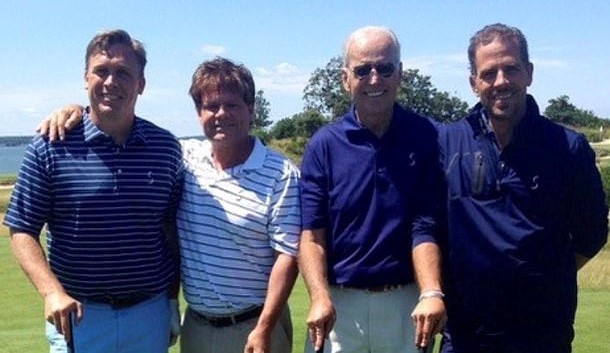
Joe and son Hunter Biden, right, play golf with Burisma board member Devon Archer, far left, in August 2014. Used under Fair Use.

It’s a general principle that liars often trip themselves up because they can’t get their stories straight. While Joe Biden insisted he had no knowledge of this son’s business dealings and never discussed them with his son, Hunter said he did discuss them with his father – albeit only once, according to Hunter. And then, lo and belold, Fox News political commentator Tucker Carlson this past week revealed an August 2014 photo of the senior Biden golfing with son Hunter and fellow Burisma board member and Hunter business associate Devon Archer. Archer had joined the Burisma board in April 2014, with Hunter Biden coming aboard the Burisma board the following month. Ever hear of “plausible deniability”? Apparently that’s what the senior Biden was hoping for until the plausibility of his denial got blown.

But wait! It gets better!

Hunter Biden and the stepson of then Secretary of State John Kerry, Christopher Heinz, had formed Rosemont Seneca Partners, a $2.4 billion private equity firm, with Archer, a former college roommate of Heinz, who was the managing partner. The New York Times has reported that, after adding Archer and Biden to its board, Burisma paid $3.4 million to a company known as Rosemont Seneca Bohai LLC (remember that last name, “Bohai,” which forms the basis for the bulk of the Biden iceberg). Apparently one of the three business associates, at least, saw the potential conflict of interest in this arrangement. Shortly after Biden and Archer’s association with Burisma was announced, Heinz, who had been a major fundraiser for his stepfather, sent an email to two of Kerry’s top aides at the State Department insisting he had no involvement with the Burisma deal. The conservative think tank Citizens United obtained a copy of the email through a FOI request.

“This email raises a lot of questions,” Citizens United President David Bossie said to the Washington Examiner. “Why would Chris Heinz distance himself from Hunter Biden’s decision to join Burisma’s board in an email to John Kerry’s senior staff at the State Department? It’s time for Joe Biden to answer questions about his family’s business in the Ukraine and what his own role was in those dealings.”

Added Bossie, “These are questions that congressional oversight committees should be demanding answers to.” Should be, but so far haven’t, choosing instead to pursue Trump.

Archer would subsequently resign from Rosemont Seneca and Burisma when he was arrested by federal agents in May 2016 on charges of defrauding a Native American tribe. A federal judge later overturned Archer’s conviction on the charges, citing insufficient evidence. But meanwhile, part of the investigation of Burisma being conducted by Prosecutor Shokin, whom the senior Biden managed to have fired, involved looking into the role the company played in the loss of $1.8 billion of the $3 billion in aid the U.S. provided to the Ukraine under the Obama Administration. And any responsible member of Congress, or any citizen, really, would question that the President of the United States would want this matter investigated? Really?

Joe Biden reminding former Ukraine President Petro Poroshenko that Poroshenko was paying for lunch, at the Nuclear Security Summit held in Washington in March 2016. Former SecState John Kerry, left, looks on. It was more than a lunch that Biden’s son managed to take out of Ukraine. Photo by Jonathan Ernst, Reuters. Used under Fair Use.

The official rules governing State Department employees require not just the avoidance of impropriety, but even the appearance of impropriety in their dealings. I wonder how much the former Vice President thought about the appearance, much less the substance, of what was going on as he dragged son Hunter along on his official coattails. As a Foreign Service officer, I used to have misgivings when someone or other would offer to buy me lunch. I’d usually reciprocate the gesture, anyway, and it would have taken a lot more than a bowl of pasta or a plate of grilled fish to influence me in execution of my duties to look after the interests of the U.S. taxpayer. But I guess not having a well placed daddy, as Hunter Biden did, might have deprived me of entrée into opportunities much more lucrative than a lunch.

We’re not even getting into the role that Ukraine played in the Hillary Clinton campaign and its attempt at smearing candidate Trump in the 2016 campaign. Or the Ukraine connections of House Intel Committee Chairman Adam Schiff, so intent on skewering and bringing down Trump using the President’s conversation with Ukraine President Volodymyr Zelensky, which we dealt with in the Oct. 2 posting, as pretext. Or what John Brennan, CIA Director under Obama, was doing in Ukraine, traveling under a false passport in April 2014. All that may have to wait for other days and other postings.

The intricately interwoven net of connections and corruption involving highly placed members of the Democratic Party that come together in Ukraine defies any ability to diagram it. You, gentle reader, may wonder why the second poorest country in Europe should figure so highly in U.S. politics. It is more than that Ukraine is a surrogate in the West’s antagonism with Putin’s Russia. What is more salient is that the country is one of the world’s most corrupt. Transparency International gives Ukraine a rating of 32 points out of a perfect score of 100, ranking it as the 120th most corrupt country out of 180 ranked. Corruption is endemic in the former Soviet republic, which The Guardian rates as “the most corrupt nation in Europe.” What better place to pursue corrupt schemes than where the ground has already been prepared and sown?

Now you may recall how I asked you, higher in this piece, to remember the name “Bohai,” as in Rosemont Seneca Bohai LLC, the company in which Hunter Biden is a principal and which was paid $3.4 million by Burisma Holdings. That is the link to an even bigger “there” there for the Biden father-son duo than the Ukraine deal, and it leads us to a much bigger actor on the world stage: China. Stay tuned for Part III along the trail as we go from Kyiv to Beijing and the biggest payday yet for the younger Biden.