Tag: Public Policy

We Are SOOOO F*cked

We Are SOOOO F*cked

If you live in America, as I do, and you feel like the bottom monkey in that photo, no one would blame you. That might be true in some other countries right now, too, but I’m relating it mostly to my own country.

Watching the latest missteps, blunders, malfeasance, general incompetence, obvious dementia, and shameless dishonesty of what passes for our current Administration, there is not a day nor night that goes by that I don’t hold my hands to my head and say, “We are SOOOO fucked.”

Usually multiple times. It’s so bad sometimes I have to cover my eyes, unable to witness the latest travesty to waltz across the tube. And this from someone with a pretty strong stomach when it comes to horror scenes. Unfortunately, these horror scenes aren’t cinematic, but are Washington’s version of reality.

One has to wonder how what is supposed to be the most powerful country on earth has allowed itself to sink to this level. Actually, it can all be explained, and if you read my last post (which, if you haven’t, you need to now), you’ll understand precisely how it happened, just as you would if you’ve been reading my posts over the past several years.

No, it’s not a conspiracy theory (for which I have exceedingly little patience) to say it’s all part of a huge and far-ranging plot. No, it’s all been documented. And the plotters are already warming up for the next scene in their grand scheme to once more pull a fast one on the American public. One can hope we’re now inoculated to their schemes, perhaps more than we’re inoculated to the virus that is the single biggest thing the Democratic Party has going for it, but the cynic in me is not encouraged, despite the pundits’ blather to the contrary.

Now it is true that most American voters don’t believe the senile Jell-O Joe Biden is in charge in the White House, or anywhere else outside his self-delusional imagination, and that majority has to have grown even more watching some of his latest, if rare, and excruciatingly embarrassing, public performances. Anyone who has had an even passing brush with dementia in a loved one or otherwise knows what they’re witnessing. Of course, we should all be concerned that the country is being run by a shadow government, but the even bigger concern should be how that shadow government is driving the ship of state straight for the rocks, full speed ahead.

Their intent was pretty clear even before Jan. 20, and the evidence of what it consisted of was plainly manifest when, in one day, Jell-O Joe, at the direction of his handlers, whoever they are — and I do have some theories — undid four years of progress. Now, six months and a week and some into this horror show, it’s hard to even decide on an order for listing the most egregious elements which cross all fronts, domestic and foreign. So let’s just look at some of them, not in any kind of strict order.

The Border

Whose name is on those t-shirts? Can you spell Biden?

For me, it’s a toss up, which is more concerning, our troubled foreign policy, the huge upsurge in violent crime, or the catastrophe at our southwest border. In terms of immediate impact on the country and its inherent barbarity and inhumanity, I’ll go with the border. Jell-O Joe made it clear that our border would be open to anyone who goes to the trouble of crossing it, regardless of legal right to do so, and the hordes of border crashers — about a million in the first six months of this year alone, and heading to a new all-time record of 2 million by the end of the year — have been sure to quote him as having personally issued their invitation. And along with them has come a flood of illegal drugs, including enough deadly fentanyl sufficient to kill a large percentage of the country, illegal weapons, women and children being sex trafficked, violent criminals, and a wave of tens of thousands of new COVID infections. The Mexican cartels smuggling all those illegals have profited hugely, in the billions of dollars, from this free-for-all, and they didn’t even have to contribute to the Democratic Party or be a son of the President to cash in on this bonanza.

All the elements of what the Democratic Party seeks — a flood of future new illegal voters, augmentation of the permanent underclass on which the party depends for its very existence, and a wave of new COVID infections on which to build fear and set the stage for stealing the 2022 mid-term elections as it did in 2020 — are there, in plain sight. Well, plain sight, if the mass media cared to show what actually is going on along the border, especially along the lower Rio Grande. But of course, unless you’re watching Fox News, you may not have seen the mass of humanity, from more than 100 countries all over the world, pouring across our non-existent border every day since Jan. 20. And if you think this is only a border problem, consider that the Administration has been secretly busing and even using the military to fly illegal aliens all over the country.

To put things in perspective, consider that a million people is more population than six states. It would be the population of the 12th largest city in the country, between San Jose and Fort Worth. By the end of the year, at the current rate, two million people will be more than the population of 14 states and it would be equivalent to the fifth largest city, between Houston and Phoenix. Add the new numbers to illegals already in the country, and you’re looking at outnumbering all except the top few biggest states. Do the math, and you’ll see why this utter mockery of U.S. law is being allowed, oaths to faithfully execute the laws be damned. Adding insult to injury, you appoint a feckless Vice President who couldn’t care less about the border as the Border Czar, and a Homeland Security Secretary whose last concern seems to be security of the homeland, and who has no problem blatantly lying about what is going on at the border.

Crime

On the chance you haven’t been on an extended underwater cruise aboard a nuclear submarine or getting your news from CNN or MSNBC, you’ve been aware of surging violent crime around the country. Consider, if you will, these numbers which compare 2021 rates with 2020 rates, which already had surged in many cities compared with 2019:

Atlanta – Homicides are up 58% and shootings are up 40%

Portland, Oregon – Homicides are up 533% and shootings are up 126%

New York City – Homicides are up 13% and shootings are up 64%

Los Angeles – Homicides are up 22% and shootings are up 51%

Chicago – Homicides are up 5% and shootings are up 18%

Philadelphia – Homicides are up 37% and shootings are up 27%

Overall, 37 cities with available data saw an average increase in murders of 18% in the first three months of this year, compared with 2020. In Austin, murders are up 79%, rising from 19 to 34 in the first five months, year-to-year.

Police cars line up in Baltimore, one of the few big cities run by Democrats for decades where the murder rate hasn’t surged in 2021. Of course, the FBI already ranks it second in the nation — only St. Louis outranks it — with a higher murder rate than El Salvador, Guatemala, and Honduras, from whence so many of those illegal migrants allegedly are fleeing crime.

Blacks are victims of these homicides and shootings to a disproportionate degree. While last summer’s widespread violence and lawlessness and the insane call to “defund the police” certainly set the stage for this surge, legislative, judicial, and prosecutorial abandonment of cash bail and releasing known and accused criminals to roam the streets have played no small role in the surge in violent crime, including aggravated assault, in dozens of cities across the country, from New York to Philadelphia to St. Louis to Los Angeles. A sane person would say more, not fewer, police were needed — including the 81 percent of black Americans who want the same level of, or more, policing — and would think a prosecutor’s job is to (speak of radical ideas) prosecute criminals, and not release them out on the streets to victimize more innocent citizens. Instead, George Soros financially backs these renegade prosecutors, the Dems blame it all on Donald Trump, and Jell-O Joe blames it on legal gun ownership instead of looking at their own incompetence and failed policies. This band of inveterate liars even had the chutzpah to say it was Republicans who wanted to defund the police. But, of course, we were talking about sane people, weren’t we?

Foreign Affairs

It’s called the Twenty-Fifth Amendment. But have you seen who is next in line?

If the worst thing about our current shift in foreign policy was a return of the apology tour that began under Barack Obama, things in this arena wouldn’t be too bad. But when we are berated by China for our alleged human rights abuses, and we just sit there and take it, and say nothing when Beijing mows under the rights of Hong Kongers and threatens Taiwan and Japan, that’s a more serious issue. And what can you say when the Commander in Chief has to resort to index cards to explain U.S. policy toward North Korea, or when the same said CiC keeps mixing up Syria and Libya on an international stage? What I’d say is that we’re in the proverbial deep doo-doo.

Biden restored $235 million in aid, frozen by the Trump Administration, to the Palestinians, and within weeks Hamas rockets were launched by the thousands onto Israel. For their good behavior and peaceful attitude, he added another $38.5 million to sweeten the pot and ostensibly pay for more rockets, which Hamas buys from the Iranians and other sources.

Of course, that’s just chump change compared with the $3 billion in funds that Biden unfroze so they could be returned to Iran. All part of the Administration’s plan to revive the disastrous nuclear agreement with that country. After all, the world’s leading state sponsor of terrorism which has vowed death to America and to Israel wouldn’t dream of using all that money for any nefarious purposes. Would it?

We’re pulling out of Afghanistan, which might not be the worst idea were we do to it in a controlled and honorable way. Instead it’s like we just discovered we passed our stop on the Metro and need to jump off the train and call an Uber at the next station. Never mind the carnage that many Afghans, who stood by us and supported us through the 20 years of this seemingly endless engagement, already are facing, or the abandonment of perhaps the best government the Afghans have had, ever.

Now no discussion of our misadventures in foreign affairs would be complete without mention of Secretary of State Antony Blinken inviting the UN, that bastion of human rights, to investigate “the scourge of racism, racial discrimination, and xenophobia” in the U.S. After all, the UN’s Human Rights Council includes such bastions of human rights as China, Cuba, Libya, Eritrea, Algeria, Russia, and Saudi Arabia. And let’s not forget Mauritania, where slavery is actively practiced to this day. Don’t you feel all fresh and clean, confessing your sins to these paradigms of liberty and justice? What? You don’t? You MUST be a racist!

Energy and Inflation

Under Trump, America became energy independent for the first time in 62 years. It felt pretty good knowing it wasn’t Saudi princes or Russian oligarchs profiting when I filled up at the pump. But that couldn’t be allowed to persist under Biden, and one of his first acts was canceling the Keystone XL Pipeline, keeping the oil it would have carried from Canada on less environmentally sound trains and trucks, and XTing as many as 11,000 good paying union jobs (which he likes to blather so much about). Now while America and its close ally Canada doesn’t need a pipeline, in Biden’s world, Putin, Russia, and Germany do, so he greenlighted Russia’s Nord Stream 2 Pipeline by waiving sanctions against the company building it, Nord Stream 2 AG, and its German CEO, Matthias Warnig. Oh, did we mention that Warnig is a close ally of Putin, is a former East German Stasi intel officer, and has served on the supervisory boards of major Russian companies? Now who is Putin’s puppy?

Homelessness isn’t just hidden away any more.

You may have noticed, as I have, how it’s costing you nearly 60 percent more at the pump than it was a year ago, and in some places, like California, gasoline is approaching $6 a gallon, more than in many European countries. Also rising are electric rates, up more than 20 percent in my case, and it’s not all due to the rising cost of petroleum. And if you miss those wild wonderful Jimmy Carter years, we’ve even experienced fuel shortages and lines at the pumps.

Rising energy costs are just one factor fueling inflation, which is surging at rates not seen in 13 years and, in some categories, in 30 years. Along with fuel, consumers are seeing increases in categories as diverse as food, vehicles, home purchases, and construction materials. Record federal debt — currently standing at $28.5 trillion, and climbing — and gratuitous federal payments that make it more attractive for many workers to stay home than go back to work add to the upward pressure on prices. We’ve — by “we,” I’m referring to our illustrious Congress, which the American public holds in even lower esteem than it does the mass media — now come to talk about trillions like they’re rounding errors. Can anyone spell Weimar Republic?

COVID

Finally, in this round-up, we come to what has been the national obsession of the past 18 months, COVID-19. If one wants to be generous, the best one can conclude is that the Biden Administration has succeeded — and that “success” lies in sending out incredibly mixed and confusing signals. If one looks closer at the facts, little of the twisting and turning public pronouncements make any sense, and both the hypocrisy of the Administration’s positions as well as their real purpose come into focus. While bleating about wanting more people to get vaccinated, the Administration comes out with new “guidelines” telling vaccinated people to again wear masks under certain circumstances. Never mind that a fully vaccinated American has a higher chance of being hit by lightning or bitten by a shark than contracting COVID-19, much less dying from it. By the CDC’s own numbers, breakthrough infections — not deaths, just infections — occur in one of 10,000 people. That’s .01%. Deaths from COVID in fully vaccinated individuals are even more rare. Yet we’re supposed to change our behaviors once more over this supposed new threat.

Much hoopla is made of the Delta variant of the virus, but what isn’t being said is the fact that this variant, while more contagious than initial variants, is less deadly. Far less, for vaccinated individuals. Those in power don’t want you to know that, but even in Britain, where this variant took off after its introduction from India, they’re acknowledging this fact.

If you’re expecting consistency from the likes of CDC Director Rochelle Walensky — who seems to have roughly the intelligence of your average chihuahua and kowtows to the party line, whether it comes from the White House or the powerful American Federation of Teachers — you’re not going to get it. Any more than you’ll get it from the Exalted Poobah Anthony Fauci who, among a litany of flip-flops that could occupy an entire piece, lies to Congress about the NIH’s possible role in creating COVID-19 in the first place.

Meanwhile, while studies show that having contracted COVID-19 conveys natural immunity in most cases, we have absolutely no information on how long the immunity granted by vaccination lasts or whether booster shots will be needed. One would think that finding some evidence addressing these questions would be a top priority.

Some people feel you just can’t be safe enough. That’s how the Administration wants you to be.

If you’re confused by the messaging coming out of the White House and its own version of Baghdad Bob, spokesbabbler Jen Psaki — who tells you to follow the guidance just because they told you to — look behind the scenes to see what people in power do. This might reveal their true motivation. Remember what I said up above about all those infected illegals being allowed in and then shipped all over the country? And how they’re indicative of how the Administration really isn’t serious about limiting spread of COVID and is a key piece in the Dem plan to create the nationwide fear and panic to steal the 2022 mid-term elections, like they did the Presidential election of 2020? If you have the bad habit, as I do, of applying logic to what people do, it’s hard to avoid coming to this conclusion.

Another indication of how little the Administration really cares about your well-being is the recent decision by the Justice Department to drop its investigation into the 15,000 COVID nursing home deaths in New York, or similar huge death counts in other Dem-controlled states, like Pennsylvania and Michigan, while limiting its investigation in New Jersey. Anyone who felt sorry for Attorney General Merrick Garland not making it to the Supreme Court can drop their regrets now that we see he’s just one more hard-left Dem apparatchik. So much for justice, even for the dead or their families.

Me, I’m happy to live in the free state of Florida and to have a governor not subject to the whims and wishes of the White House and the Democratic Party. I just hope all those people fleeing here from the unfree states don’t bring their stupid political ideas with them. As a country we might be like that bottom monkey in the photo, but here we’re hanging on as long as we can, trying not to be screwed any more than we are, anyway.

And make no mistake: We all are.

Photo credits: Featured photo by cottonbro on Pexels; used with permission. Biden Let Us In by Washington Examiner; used under Fair Use. Baltimore Police Cars by Bruce Emmerling on Pixabay; used with permission. Historic political cartoon, source unknown; used under Fair Use. Downtown Tent by Adam Thomas on Unsplash; used with permission. Masked Couple by Obi Onyeador on Unsplash; used with permission.

Beginning with this post, I’ll also be posting on Substack in my new community there, Issues That Matter. Follow me here, and there.

Redux: The Hurricane Next Time

Redux: The Hurricane Next Time

I originally posted the piece that appears below on Sept. 21, 2017, in the aftermath of Hurricane Irma. There have been more hurricanes since, most notably in this part of the world Hurricane Michael, which destroyed a good part of the Florida Panhandle last year, and now Hurricane Dorian, which devastated the Bahamas in the past week. What I said in 2017 still applies today: There will always be another storm, and such storms create winners and losers — mostly losers.

With Dorian, Florida was mostly a winner, while the Bahamas, not far offshore, took the brunt of the storm. When a Category 5 storm not just hits but sits for a couple days right over your location there isn’t going to be much left. And that is the case with the Bahamas. It will be days, weeks, maybe even months before the full damage done and casualties sustained are tallied. In the coming days I hope to post some legitimate ways in which people can provide assistance to the people of the Bahamas. Watch this space.

In the original piece I laid out a plan that could enable this country, and possibly others in the paths of these devastating storms, to be better prepared for them and more able to deal with their aftermath. To my knowledge, in the intervening two years, nothing along the lines of what I proposed or any other effective comprehensive preparation or recovery plan has been implemented. While lessons continue to be learned — Florida’s response under its new governor, Ron DeSantis was even more orderly and effectively implemented than the response to Irma described in the original piece — and our ability to track and, more importantly, predict great storms continues to grow, we’re still dealing with a very imprecise science and art in facing some of the earth’s greatest challenges.

Perhaps most discouraging, virtually none of the steps I and others proposed for protecting the most vulnerable — the infirm and the elderly — in storms have actually been implemented, other than some on paper. Meanwhile, 12 of the 14 deaths my initial piece mentioned in the nursing home in Hollywood, Fla., have been ruled homicides and three nurses and a facility administrator have been charged with manslaughter. But their attorneys say they are being scapegoated for the failures of local and state officials, including then-Gov. RIck Scott, in failing to respond to calls for help. One also wonders why the owners of that nursing home have not been charged for their negligence in not properly equipping the facility or having an effective EAP in place.

“The decision to charge these people is completely outrageous,” Lawrence Hashish, an attorney for one of the charged nurses, told USA TODAY. “They are scapegoats, low-hanging fruit for the Hollywood police.”

There is plenty of blame to go around for things done wrong after many of these storms. One doesn’t have to expect perfection, which is a remote possibility in any event, to look and push for improvement, action on lessons learned, an upward learning curve. Doing things the same way over the years, in storm after storm, and expecting different results is the stereotyped definition of insanity. So I once more posit my proposals, which I think have merit and could be of use in that next storm, or the ones after it. Your thoughts are welcomed. Here is what I said in 2017:

  *     *    *

Another week, another hurricane. There was Harvey. And then Irma. Jose is heading north. Maria has worked its devastation. Hurricane Season being what it is, the storms line up across the Atlantic and the Pacific. Whatever the next time is, there will be a next time. And another hurricane.

I’m back aboard my boat after evacuating to Destin in the Florida Panhandle to get out of the way of Irma. Part of my excuse for the delay in posting to this blog. Irma, it turned out, was accommodating and jogged northeast just before it hit the Tampa Bay area. Good news for me and my neighbors. Bad news, very bad news, for people in the interior of the state and further to the northeast. Storms create winners, and losers. Mostly losers.

Ask the people of Houston and elsewhere in Southeast Texas. Ask the people of the Florida Keys, or Southwest Florida, and lots of other places in the state. Ask the people of Barbuda and St. Thomas, of Sint Maarten and Saint-Martin and Puerto Rico. And before them, ask the people of the Philippines, of Mississippi and Louisiana, of Mexico and Honduras and South Carolina and New Jersey and even New Hampshire and numerous other places.

Hurricanes aren’t picky and they don’t discriminate. They’re equal opportunity destroyers and, given enough time, they spread their devastation around. Of course, the planet would have worse problems were it not for the big storms that redistribute the earth’s heat energy, but try telling that to someone who can’t get out of their house without a boat, or no longer has a house at all, or who has no water, food, or electricity. Or lost a loved one. It’s a tough sell.

I’ve been around hurricanes almost my whole life, in their projected path several times but, if you ignore passing through two of them during one sea transit of the North Atlantic as a kid, I’ve never been in the middle of one. I guess that’s my hurricane karma. But I’ve seen the aftermath of them, spent weeks that turned into months that turned into years living with the after effects of Katrina, and I’ve had a chance to observe both close-up and at a distance the preparations for their arrival and dealing with what they leave behind.

It’s those two elements – advance preparations and dealing with hurricane aftermaths – that I want to focus on here. Some of what I have to say is based on observation of those two things in several storms, and some is based on a plan I developed while living with the protracted recovery from Katrina.

Based on the events of recent weeks, at least in the U.S., I think some lessons have been learned. Some are partly learned. But we still have a continuing learning curve to go up and more work to be done.

The debacle that was the overland evacuation in Texas from the approach of Hurricane Rita in 2005 taught us some things about evacuations. Rita, the Atlantic’s fourth most intense hurricane ever recorded, the most intense storm ever seen in the Gulf of Mexico, and coming just three week’s after Hurricane Katrina’s onslaught, prompted fears the storm would devastate the Texas Coast. This led to an uncoordinated series of evacuations that poured between 2.5 million and 3.7 million people onto the state’s highways, leading to total gridlock. While the concept of contraflow, to reverse all inbound lanes on the Interstates to outbound, was already known, the order to implement it came too late and it took more than eight hours to make the change-over. Of the seven people in the U.S. who died directly as a result of Rita, only one was in Texas. But an estimated 113 people died in the botched Texas evacuation, including 23 nursing home residents who were killed when the charter bus they were on caught fire on the Interstate.

In advance of Hurricane Harvey this year, Houston Mayor Sylvester Turner decided not to issue any evacuation order for the city. Not mandatory, not voluntary. Turner, looking back at Rita, reasoned that you can’t put 6.5 million people on the highways without creating mayhem. But virtually the entire city wound up inundated, with many left homeless, or stranded in flood-damaged houses from record rainfall. Some were electrocuted when, for reasons that are not apparent, the power was not cut off as a precaution as is normally done. It seemed the city was far from prepared for the storm to come.

As for evacuations, the answer, of course, is not to evacuate an entire city the size of Houston, the nation’s fourth largest, but to evacuate the most vulnerable areas. To provide local shelters. To move some people in buses and not everyone in private vehicles. And to do the necessary to avoid ancillary deaths, to the extent possible. It wasn’t a mystery that Houston was going to be pummeled with massive rainfall. The path and potential of the storm was known, as was Houston’s topography and propensity to flood. And yet, there was no evacuation order.

Contrast that response with the response of Florida Gov. Rick Scott and state, county, and local officials in Florida. With Irma on its way and a high likelihood it would hit the state in some place or other, Scott went on what was almost a personal campaign to get people to evacuate the most vulnerable areas, and made it as easy as possible for them to do so. Tolls were removed from the state’s toll roads – they are about to be reinstated at this writing – hotels were ordered to accept pets, the Florida National Guard was partially mobilized, and state troopers were used to escort fuel trucks.

The first priority was evacuating the Florida Keys, which are tethered at the bottom of the state by 90 miles of the Overseas Highway, the sole land access to the Keys. Other areas deemed most vulnerable, the low areas of Southeast and Southwest Florida, were the next priority. And then other vulnerable areas came after that. Scott’s campaign launched a week before Irma’s arrival, and kept up throughout the storm and in its aftermath, and continues even well after the storm. Florida’s evacuation was not perfect – there were serious fuel outages, long delays at times on the state’s Interstates and other highways, and Irma’s vagaries wound up unexpectedly sparing some areas while hitting others, hard – but overall it went pretty well, given the enormous number of people affected.

Not everyone followed the evac. orders, and authorities said they would not arrest anyone for not complying. While a major reason for an evacuation is so first responders don’t have to risk their lives searching for stragglers in trouble, authorities also said that after a certain point no one should count on a rescue. Whatever the factors involved – in part, at least, the euphoria and excessive confidence that pervades many Keys residents – those who stayed behind in the islands came to find out the devastation a Category 4 hurricane can bring. It’s not yet known what the death toll is in the state as teams go through the destroyed housing of the Keys looking for survivors and casualties.

Of the points where preparations for the storm failed, perhaps the most telling and disturbing was the lack of back-up plans, power, and action by some nursing homes, both in Texas and Florida. The incident that has gotten the most attention was a nursing home in Hollywood, Fla., where so far 14 elderly residents have died. With a hospital just across the street, it’s hard not to assign negligence to the managers and owners of this facility. The state has opened an investigation and alleged criminal negligence, but meanwhile the horse – 14 of them so far – has left the proverbial barn and can’t be brought back.

A spokesperson for the nursing home association said that nursing homes are not required to have generators, only a back-up power supply. Whatever the hell that means. From my perspective, based on what happened in these and other storms and the personal experience of my own mother when she was alive, there is entirely too little oversight of nursing homes and assisted-living facilities. This paucity of oversight applies in other times, too, not just when there are storms. But certainly things need to be beefed-up to deal with natural disasters. Every nursing home and assisted-living facility should be required to have an emergency action plan (EAP), which should be reviewed by regulators, and also to conduct drills practicing the EAP, to the extent practical. There also has to be more attention paid to those “back-up power supplies” and sufficient generation capability should be required to not just keep the lights on, but also run the air conditioning in hot areas and heat in cold ones.

As I mentioned, I lived on the Mississippi Gulf Coast through most of the recovery from Katrina. The very slow pace of recovery in both Mississippi and Louisiana was a source of frequent frustration to me, but it was a true bane to those who had to suffer through it. In some cases, people have never recovered. Burdened with too much bureaucracy and red tape and some truly bone-headed decisions, FEMA proved to be largely inefficient and, for many, ineffective in its response. In the end, someone calculated that for all the money spent on FEMA and other agency responses, the government could have built a new house and put two new cars in the driveway for each affected family. That is a scandal of the first order.

What I have seen, and experience has borne out, is that a multi-pronged approach is needed to respond to any natural disaster of this magnitude. In the plan I previously developed, this approach would be more forward looking than backward looking. At the head of the effort would be a disaster council combining federal government agencies, non-profit relief organizations, faith-based groups (which often provide a major portion of recovery efforts), and the profit sector. All these groups have a stake, and a contribution to make, both in preparing for natural disasters and in recovery. And this applies not just to hurricanes, but to other natural disasters, such as tornadoes, earthquakes, and major fires.

Similar councils should be established at the state level in the most affected states, with coordination between the state and national councils. And under my plan, Congress and state governments should consider establishing a disaster fund into which both public and private funds would be deposited in advance of disasters, not leaving things to allocations after the fact, which often come too late to deal with the worst immediate effects of a major storm or other disaster. This approach makes the response both prospective – looking ahead to future disasters – and retrospective – looking back in the aftermath of those that have already occurred. The cost will be there in any event, but by having funds already allocated they can be assigned quicker and will offer the most and most efficient benefit to those affected.

We tend to avoid thinking about what might happen tomorrow, even less about paying for it. But just as our learning curve in preparation and recovery has continued to go up with each major storm, I see this as a logical next step in our approach to dealing with hurricanes and other natural disasters, which are not just going to go away.

The Orchestrated Smoke Screen on the Southern Border

The Orchestrated Smoke Screen on the Southern Border

I had resolved not to fall for the smoke screen that as been raised in the media about children being separated from their parents on the southern border, and here I am about to deal with it.

I call it a smokescreen since it’s pretty obvious that it has been raised at this time and in this way to distract attention away from the hearings going on in Congress this week over the Inspector General’s report detailing unprecedented corruption and malfeasance within the FBI, beginning with the Hillary Clinton email so-called investigation.

I’m not going to ignore that report or those hearings, but the din over the children on the border has gotten to the point where it’s virtually impossible not to deal with it, and there is so much utter nonsense and dishonesty embedded in the blather that it offends the senses of anyone even vaguely familiar with what is going on. So, despite my best intents, here I am discussing the border issue. The other, no less important, issue will have to wait for a subsequent posting. Okay, let’s get going with this.

No matter where you come down on the question of whether children should or shouldn’t be separated from their parents when the parents are apprehended for crossing the border illegally, if for even a moment you think this isn’t an orchestrated crisis, I have several hundred miles of border fence I’d like to sell you at a very good price. Neither the timing nor the volume nor the shrillness of the cries nor ferocity of chest beating and rending of garments over this latest border crisis isn’t without behind-the-scenes orchestration.

To establish where I’m coming from on this, I will cite my background as a U.S. consular officer posted to what is called a high-fraud post. That’s a post that gets a high percentage of fraudulent visa applications. It was awhile back and in a different part of the world, but I saw lots of fraud and lots of tactics used by people who would enter and stay illegally in the U.S. And much of what I saw can be applied to interpreting the current situation, including how people would use and abuse their children when their goal was entry to the U.S.

Let’s start with the issue of political asylum, since a big part of the media angst has been over children separated from parents seeking political asylum in the U.S. And let’s start with the facts and not the emotions. For a moment, let’s assume (and it’s a big assumption) that someone has bona fide grounds for seeking political asylum. According to the international standard, they should seek asylum in the first country they come to where they might find protection. In this case, for those coming from Central America, that would be Mexico. But these people are not seeking asylum in Mexico. They want to declare it in the U.S., which is a long way from the countries in which they originate.

Next thing: If you wish to declare yourself as a political asylee, you do it at a port of entry. A regular border crossing. You are showing yourself openly as having a legitimate reason why you should be admitted to the country. But most of these alleged asylum seekers are crossing the southern border illegally, like any other border jumper. Then when they’re caught by the Border Patrol they say they are seeking political asylum. Well, they can say anything they want, can’t they? If they got away with entering the country illegally and managed to make it to the hinterlands, for one moment do you think many, if any, would then apply for political asylum? I highly doubt it.

When I was at that aforementioned high-fraud post, we received a communication from someone at the State Department in Washington. They explained they weren’t supposed to do this, but thought we needed to have something brought to our attention, which was that many of the people we were issuing visitor visas to were declaring political asylum once they got to the U.S. This person in the Department also sent copies of the letters that were filed on behalf of these “asylees,” and every single one of them had been typed on the same typewriter (this was back when typewriters, which had distinctive characteristics, still roamed the earth), were all worded the same, and were all put out by the same bottom-feeder immigration attorney in San Francisco. That was bad enough, but the country we were in and from which these “asylees” hailed had then none of the conditions that would justify a claim of political asylum. Let me just say we tightened up considerably on our already tight visa-issuance consideration standard.

I think it would be naive to assume that all these people showing up across the southern border and declaring political asylum just spontaneously came there. Let’s not forget that a few years ago the Obama Administration put out word on the radio and in the newspapers in Central America telling people what they needed to do to get to the U.S. so they, too, could declare political asylum. More on that period a bit later. But clearly there is something more than just chance behind this latest wave of arrivals.

As for the question about whether children should be separated from their parents, that is one especially prone to emotional responses. Assuming the adults are the children’s parents – which not all are – personally I think it’s not a great policy and generally think it can lead to more problems than it avoids. That said, let’s not be Pollyannish about this whole thing.

One has to wonder what leads a parent to put their children through the danger of a long journey through a country like Mexico, to put them at the mercy of coyotes who exploit and abuse and rape and even kill immigrants, and in some cases to put the children up on the roof of a train for a journey of several days and nights. And then those same parents take their children across the Rio Grande or into the Arizona and New Mexico desert, and all the dangers entailed in that. These are all things that might be considered, in calmer moments, child abuse, and would have the parents charged by CPS and the children taken away from them. I mean, parents have been charged with abuse for letting their kids walk home unaccompanied from school in the suburbs, and yet there are those who would defend these egregious practices that can lead to death and serious injury for the children. What is wrong with these people?

Let me tell you another tale from my consular posting, if you have any delusions about how some parents will exploit and abuse their children to get themselves into the U.S. We handled immigrant visa applications for citizens of a neighboring country which had, at the time, the highest overstay rate in the U.S. That’s the rate at which people arrive with valid visas and then don’t leave when their stay is up.

Adults from this particular country – and I’m sure it’s not the only country in which this occurs – would get a visitor visa, go to the U.S., and stay for years until their numbers for immigrant visas came up, based on some family relation or another. At that point they would have to leave the U.S., go back to their home country, and go through a visa interview, which is where I would come in. Meanwhile, these folks would leave their children behind while they were overstaying in the U.S. to be raised by the children’s grandparents in the home country. We’re not talking a few weeks or months here. We’re talking several, even many, years, so the children who might have been infants when the parents abandoned them were pretty well grown into preteens and teens by the time their parents returned to claim them. I had no compunction against asking those children, in the visa interviews I conducted, how they felt about being abandoned like that by their parents. I can tell you, most of them weren’t too happy about it. And for their part, all the parents could do was squirm in their seats and grin stupidly. Frankly, I thought it was disgraceful, and I had no problem telling the parents that. Unfortunately, this kind of child abandonment wasn’t grounds for denying them the visas they sought.

That was bad enough. But what do you say about a parent who would subject their children to the kinds of risks that they face on the trip north to the U.S., or once they cross the border? Those opposing the Administration’s policies seem to be silent on the topic.

The numbers in the current “crisis” don’t come anywhere near the numbers of unaccompanied minors and family units that overran the southern border back in 2013, 2014, and 2015, under the Obama Administration. Currently, we’re talking about a few thousand children and families. Compare that with fiscal year 2013 when, according to U.S. Border Patrol statistics, 38,759 unaccompanied minors showed up on the southern border. Or the next fiscal year, when the number of unaccompanied minors swelled to 68,541. Meanwhile, “family unit apprehensions” numbered 14,855 in FY 2013 and 68,445 in FY 2014. Do you recall the kind of outcry then that we’re seeing now? I don’t. I do remember the images of what the detention centers looked like at that time, and I have to agree with what President Trump had to say about them.

“You look at the images from 2014,” the President said, “I was watching this morning and they were showing images from 2014 and they blow away what we’re doing today. I saw images that were horrible.”

If you watched Fox News at the time, as I did, you would have been shocked at what you saw nightly. You might not even have seen those images if you watched some of the other media. Those same media that are screaming about what is happening now.

Which leads us to the conclusion that this current outcry, along with being a smoke screen, is politically motivated. It’s one more – pardon the expression – trumped-up offense the Dems think they can pin on the President. The angst and tenor of some of the rhetoric is over the top. And then, when the President relents and signs an executive order stopping the separation of children from their parents, the Dems aren’t happy with that, either. Anything short of releasing all those who cross the border illegally into the general population, never to be seen again (and ostensibly to eventually become Democratic voters, the real goal), won’t appease them. Just keep moving the goal posts and criticizing the Administration and claiming there is nothing you can do about it by getting serious about passing meaningful immigration legislation, and you can fool at least some of the people.

Many of the anecdotes coming out of all the hysteria would be amusing, were they not so serious. A bit of levity did, however, come on the news Tuesday evening when Florida Congresswoman Debbie Wasserman Schultz and Senator Bill Nelson, the valedictorian and salutatorian of Democratic hubris and grandstanding in the Sunshine State, whined about not being granted access to a youth detention center in Hialeah, Fla.

Balderdash” – I’m not making this up – is the word Nelson actually used to describe what he had been told in being turned away. Obviously they thought they could just barge their way into the facility and then use it to make political hay. Or, more likely, they knew all along they wouldn’t be granted entry without going through the usual channels. Whatever. Are people naive enough not to see through this sort of thing? I fear they are. However else can these people get elected to office?

Then we have actor Peter Fonda (remember him? Easy Rider? What, 1969?) urging the kidnapping of the President’s young son, Barron, and placing him in a cage with pedophiles. Now if you, kind reader, or I were to make that sort of goad I can just about guarantee that we’d be paid a visit by the Secret Service or the FBI. I wonder what will happen in Fonda’s case, even with First Lady Melania Trump referring him to the Secret Service for investigation. Oh, he’s issued an apology. So sincere, I am sure. Like his calls for raping DHS Kirstjen Nielsen and other tasteless tweets that, were he not of the leftist persuasion, would bring down outrage. Instead we get the sound of crickets from that side of the political divide.

And then there was the near riot that broke out when DHS Secretary Nielsen was cornered inside a DC restaurant – it’s hard to ignore the irony of it being a Mexican restaurant, an irony not lost on those organizing the demonstration, either – by a shouting, jeering mob of Washington Democratic Socialists. So much for democratic discourse and tolerance amid the orchestrated hysteria (a call to the demonstration was put out in a series of tweets).

Finally, one can only wish that someone on the Democratic side of the aisle would call for an end to the offensive references comparing the Administration’s border policy to Nazi Germany and the round-up of U.S. citizens of Japanese decent during the Second World War. Really? Concentration camps? But that’s not going to happen, since some of those offensive references are coming literally from – surprise! – that side of the aisle.

Okay, I’ve said my piece, for now, on this subject. I can almost predict that all the frenzy will blow over as soon as the hearings on the FBI and the abuse of power that went on within it are over. We’ll get to that matter in due course. Meanwhile, don’t believe much of what you see and hear in the media maelstrom centered on the southern border which, I assure you, is more about putting up a smoke screen than anything really to do with the children.

The Hurricane Next Time

The Hurricane Next Time

Another week, another hurricane. There was Harvey. And then Irma. Jose is heading north. Maria has worked its devastation. Hurricane Season being what it is, the storms line up across the Atlantic and the Pacific. Whatever the next time is, there will be a next time. And another hurricane.

I’m back aboard my boat after evacuating to Destin in the Florida Panhandle to get out of the way of Irma. Part of my excuse for the delay in posting to this blog. Irma, it turned out, was accommodating and jogged northeast just before it hit the Tampa Bay area. Good news for me and my neighbors. Bad news, very bad news, for people in the interior of the state and further to the northeast. Storms create winners, and losers. Mostly losers.

Ask the people of Houston and elsewhere in Southeast Texas. Ask the people of the Florida Keys, or Southwest Florida, and lots of other places in the state. Ask the people of Barbuda and St. Thomas, of Sint Maarten and Saint-Martin and Puerto Rico. And before them, ask the people of the Philippines, of Mississippi and Louisiana, of Mexico and Honduras and South Carolina and New Jersey and even New Hampshire and numerous other places.

Hurricanes aren’t picky and they don’t discriminate. They’re equal opportunity destroyers and, given enough time, they spread their devastation around. Of course, the planet would have worse problems were it not for the big storms that redistribute the earth’s heat energy, but try telling that to someone who can’t get out of their house without a boat, or no longer has a house at all, or who has no water, food, or electricity. Or lost a loved one. It’s a tough sell.

I’ve been around hurricanes almost my whole life, in their projected path several times but, if you ignore passing through two of them during one sea transit of the North Atlantic as a kid, I’ve never been in the middle of one. I guess that’s my hurricane karma. But I’ve seen the aftermath of them, spent weeks that turned into months that turned into years living with the after effects of Katrina, and I’ve had a chance to observe both close-up and at a distance the preparations for their arrival and dealing with what they leave behind.

It’s those two elements – advance preparations and dealing with hurricane aftermaths – that I want to focus on here. Some of what I have to say is based on observation of those two things in several storms, and some is based on a plan I developed while living with the protracted recovery from Katrina.

Based on the events of recent weeks, at least in the U.S., I think some lessons have been learned. Some are partly learned. But we still have a continuing learning curve to go up and more work to be done.

The debacle that was the overland evacuation in Texas from the approach of Hurricane Rita in 2005 taught us some things about evacuations. Rita, the Atlantic’s fourth most intense hurricane ever recorded, the most intense storm ever seen in the Gulf of Mexico, and coming just three week’s after Hurricane Katrina’s onslaught, prompted fears the storm would devastate the Texas Coast. This led to an uncoordinated series of evacuations that poured between 2.5 million and 3.7 million people onto the state’s highways, leading to total gridlock. While the concept of contraflow, to reverse all inbound lanes on the Interstates to outbound, was already known, the order to implement it came too late and it took more than eight hours to make the change-over. Of the seven people in the U.S. who died directly as a result of Rita, only one was in Texas. But an estimated 113 people died in the botched Texas evacuation, including 23 nursing home residents who were killed when the charter bus they were on caught fire on the Interstate.

In advance of Hurricane Harvey this year, Houston Mayor Sylvester Turner decided not to issue any evacuation order for the city. Not mandatory, not voluntary. Turner, looking back at Rita, reasoned that you can’t put 6.5 million people on the highways without creating mayhem. But virtually the entire city wound up inundated, with many left homeless, or stranded in flood-damaged houses from record rainfall. Some were electrocuted when, for reasons that are not apparent, the power was not cut off as a precaution as is normally done. It seemed the city was far from prepared for the storm to come.

As for evacuations, the answer, of course, is not to evacuate an entire city the size of Houston, the nation’s fourth largest, but to evacuate the most vulnerable areas. To provide local shelters. To move some people in buses and not everyone in private vehicles. And to do the necessary to avoid ancillary deaths, to the extent possible. It wasn’t a mystery that Houston was going to be pummeled with massive rainfall. The path and potential of the storm was known, as was Houston’s topography and propensity to flood. And yet, there was no evacuation order.

Contrast that response with the response of Florida Gov. Rick Scott and state, county, and local officials in Florida. With Irma on its way and a high likelihood it would hit the state in some place or other, Scott went on what was almost a personal campaign to get people to evacuate the most vulnerable areas, and made it as easy as possible for them to do so. Tolls were removed from the state’s toll roads – they are about to be reinstated at this writing – hotels were ordered to accept pets, the Florida National Guard was partially mobilized, and state troopers were used to escort fuel trucks.

The first priority was evacuating the Florida Keys, which are tethered at the bottom of the state by 90 miles of the Overseas Highway, the sole land access to the Keys. Other areas deemed most vulnerable, the low areas of Southeast and Southwest Florida, were the next priority. And then other vulnerable areas came after that. Scott’s campaign launched a week before Irma’s arrival, and kept up throughout the storm and in its aftermath, and continues even well after the storm. Florida’s evacuation was not perfect – there were serious fuel outages, long delays at times on the state’s Interstates and other highways, and Irma’s vagaries wound up unexpectedly sparing some areas while hitting others, hard – but overall it went pretty well, given the enormous number of people affected.

Not everyone followed the evac. orders, and authorities said they would not arrest anyone for not complying. While a major reason for an evacuation is so first responders don’t have to risk their lives searching for stragglers in trouble, authorities also said that after a certain point no one should count on a rescue. Whatever the factors involved – in part, at least, the euphoria and excessive confidence that pervades many Keys residents – those who stayed behind in the islands came to find out the devastation a Category 4 hurricane can bring. It’s not yet known what the death toll is in the state as teams go through the destroyed housing of the Keys looking for survivors and casualties.

Of the points where preparations for the storm failed, perhaps the most telling and disturbing was the lack of back-up plans, power, and action by some nursing homes, both in Texas and Florida. The incident that has gotten the most attention was a nursing home in Hollywood, Fla., where so far 14 elderly residents have died. With a hospital just across the street, it’s hard not to assign negligence to the managers and owners of this facility. The state has opened an investigation and alleged criminal negligence, but meanwhile the horse – 14 of them so far – has left the proverbial barn and can’t be brought back.

A spokesperson for the nursing home association said that nursing homes are not required to have generators, only a back-up power supply. Whatever the hell that means. From my perspective, based on what happened in these and other storms and the personal experience of my own mother when she was alive, there is entirely too little oversight of nursing homes and assisted-living facilities. This paucity of oversight applies in other times, too, not just when there are storms. But certainly things need to be beefed-up to deal with natural disasters. Every nursing home and assisted-living facility should be required to have an emergency action plan (EAP), which should be reviewed by regulators, and also to conduct drills practicing the EAP, to the extent practical. There also has to be more attention paid to those “back-up power supplies” and sufficient generation capability should be required to not just keep the lights on, but also run the air conditioning in hot areas and heat in cold ones.

As I mentioned, I lived on the Mississippi Gulf Coast through most of the recovery from Katrina. The very slow pace of recovery in both Mississippi and Louisiana was a source of frequent frustration to me, but it was a true bane to those who had to suffer through it. In some cases, people have never recovered. Burdened with too much bureaucracy and red tape and some truly bone-headed decisions, FEMA proved to be largely inefficient and, for many, ineffective in its response. In the end, someone calculated that for all the money spent on FEMA and other agency responses, the government could have built a new house and put two new cars in the driveway for each affected family. That is a scandal of the first order.

What I have seen, and experience has borne out, is that a multi-pronged approach is needed to respond to any natural disaster of this magnitude. In the plan I previously developed, this approach would be more forward looking than backward looking. At the head of the effort would be a disaster council combining federal government agencies, non-profit relief organizations, faith-based groups (which often provide a major portion of recovery efforts), and the profit sector. All these groups have a stake, and a contribution to make, both in preparing for natural disasters and in recovery. And this applies not just to hurricanes, but to other natural disasters, such as tornadoes, earthquakes, and major fires.

Similar councils should be established at the state level in the most affected states, with coordination between the state and national councils. And under my plan, Congress and state governments should consider establishing a disaster fund into which both public and private funds would be deposited in advance of disasters, not leaving things to allocations after the fact, which often come too late to deal with the worst immediate effects of a major storm or other disaster. This approach makes the response both prospective – looking ahead to future disasters – and retrospective – looking back in the aftermath of those that have already occurred. The cost will be there in any event, but by having funds already allocated they can be assigned quicker and will offer the most and most efficient benefit to those affected.

We tend to avoid thinking about what might happen tomorrow, even less about paying for it. But just as our learning curve in preparation and recovery has continued to go up with each major storm, I see this as a logical next step in our approach to dealing with hurricanes and other natural disasters, which are not just going to go away.

Pointing Immigration in the Right Direction

Pointing Immigration in the Right Direction

My service as a U.S. consular officer in the late 1980s and early1990s quickly debased me of any previous open-borders ideas I might have had prior to that time. While serving as vice consul for the geographically largest consular district in the world, covering most of the South Pacific and part of the North Pacific, I came to realize how poorly our immigration system served the country. Our two-officer office – me and the consul, my immediate boss – processed some 21,000 non-immigrant visas (NIVs) and about 6,000 immigrant visas (IVs) annually. I personally handled about two-thirds of the NIV applications and about a third of the IV applications. To say that some of those IV interviews verged on the scary would be an understatement, and made me wonder about the quality of people we were admitting for permanent residence in the U.S.

What occurred to me then was that the U.S. badly needed to implement a points-based immigration system similar to what already was long in place in Canada as well as in Australia and New Zealand, and has since even been adapted by the UK. Not that it would supplant this country’s family-based immigration system, but rather would supplement it, while revising the family-based system of preferences. While other countries were getting the cream of the crop of immigrants, we were limited basically to what came over the transom with our chain-migration policies, and that was not always beneficial to the U.S.

During my tenure as vice-consul in Fiji, yet another seemingly hair-brained idea was introduced, the so-called Diversity Visa Program (DVP), better known as the visa lottery program. A brain child of Congress, it allowed people from many countries deemed to be “under-represented” among U.S. immigrants to compete in a lottery to obtain the right to apply for permanent residence status. Besides debasing the whole concept of U.S. residency, this scheme essentially opened up a new category of immigrant visas to anyone who could fill out a postcard or pay someone to do it for them, as if we didn’t already have enough immigrants coming to the U.S., many with no discernible skills.

Over the intervening quarter century I have seen limited progress in immigration reform, combined with some steps in the wrong direction, acerbated by an ill-informed and prejudiced public and media debate over immigration. With this past week’s introduction of the so-called RAISE Act (RAISE – not Reyes – standing for Reforming American Immigration for Strong Employment), I am for the first time in more than 25 years seeing reforms introduced that actually seem to make some sense. And of course the naysayers immediately came out in force, spouting the same sorts of nonsense that have kept our immigration system stuck under a law that dates back some 65 years, the Immigration and Nationality Act of 1952, as amended and modified by some less overriding intervening laws.

To begin to understand the forces arrayed against any real reform of our outmoded and ineffectual immigration policy, one needs to understand two truisms about what the major political parties hope to gain from immigration: The Democrats want cheap votes, and the Republicans want cheap labor. These two impulses are the biggest factors keeping things pretty much where they are, if not pushing them further in the wrong direction. And it is these same factors that are the biggest enemies of the American people at large and which help keep our economy in a low-growth mode in which real wages remain stagnant while the costs of the welfare state continue to grow.

It’s also important to understand that the U.S. is not a laggard when it comes to immigration. While it may no longer be strictly true that we admit more legal immigrants than all other countries in the world combined, it is true that we admit, by far, the largest number of legal immigrants each year – more than a million people – and that number does exceed the total number of immigrants admitted by all the other largest immigrant-welcoming countries of the world combined. At present, close to 45 million immigrants (both legal and illegal) live in the U.S. There are some 85 million people, or about 27 percent of the total population, who are immigrants or the U.S.-born children of immigrants.

There are a lot of myths and stereotypes about immigration and these help perpetuate our current system. One of those myths is that immigrants strengthen the economy and do better than native-born Americans. While this was once true, it has not been true in more than a quarter century, and since then, in general terms, immigrants tend to fare worse than the overall population. This fact is buttressed by the numbers that show that immigrants to the U.S. are far more likely to wind up in poverty than the native-born population. Here are some disturbing figures from the Center for Immigration Studies:

Despite similar rates of work, because a larger share of adult immigrants arrive with little education, immigrants are significantly more likely to work low-wage jobs, live in poverty, lack health insurance, use welfare, and have lower rates of home ownership.

  • In 2014, 21 percent of immigrants and their U.S.-born children (under 18) lived in poverty, compared to 13 percent of natives and their children. Immigrants and their children account for about one-fourth of all persons in poverty.
  • Almost one in three children (under age 18) in poverty have immigrant fathers.
  • In 2014, 18 percent of immigrants and their U.S.-born children (under 18) lacked health insurance, compared to 9 percent of natives and their children.
  • In 2014, 42 percent of immigrant-headed households used at least one welfare program (primarily food assistance and Medicaid), compared to 27 percent for natives. Both figures represent an undercount. If adjusted for undercount based on other Census Bureau data, the rate would be 57 percent for immigrants and 34 percent for natives.
  • In 2014, 12 percent of immigrant households were overcrowded, using a common definition of such households. This compares to 2 percent of native households.
  • Of immigrant households, 51 percent are owner-occupied, compared to 65 percent of native households.
  • The lower socio-economic status of immigrants is not due to their being mostly recent arrivals. The average immigrant in 2014 had lived in the United States for almost 21 years.”

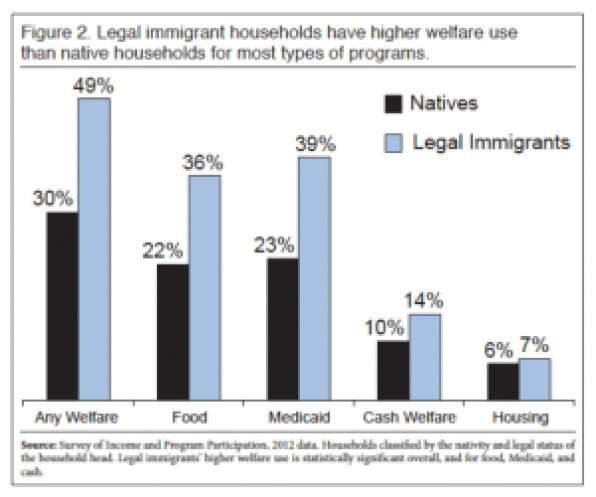
While laws are in place that are supposed to limit immigrants’ access to welfare and other public assistance programs – the idea being that newcomers to the country are supposed to be able to support themselves, or have sponsors that will support them until they can support themselves – so many exceptions are made, so many jurisdictions overlook the rules, and so many benefits are obtained through the U.S.-citizen children of immigrants, that immigrants tend to use social welfare programs at rates in excess of the native population. The two charts that follow (also from the Center for Immigration Studies) clearly demonstrate the numbers. The first one compares legal immigrants with the native population while the second one compares illegal immigrants, who do even worse and aren’t even supposed to be here, with the native population.

Welfare Use Legal Immigrants

Welfare Use Illegal Immigrants

Another key element that is widely misunderstood, further evidenced by some of the silly things said in the days since the RAISE Act was unveiled, is the system of preferences under which our current immigration system operates. This system imposes strict numerical caps on different categories of immigrants from various countries, and creates serious distortions that those only peripherally familiar with the rules don’t understand. For instance, while there is no cap for the spouses or unmarried minor children or the parents of U.S. citizens, 21 years old and older, there are limits for just about every other category of immigrant.

The chart below shows the current (August 2017) preference limits for the various preference categories. It shows the dates when petitions would have had to be filed for intending immigrants in those categories, or preferences, to file their applications this month to be approved for immigrant visas. Depending on the country, these dates can vary significantly.

Preference Chart August 2017

For instance, for the first preference, the unmarried son or daughter, 21 years or older, of a U.S. citizen (native-born or, more commonly, naturalized), their petition would have had to be filed prior to 2011 in most countries of the world to file their applications for visas beginning this month. But if they are a citizen of the Philippines, the petition would have had to have been filed in 2007, or in 1996 if they are a citizen of Mexico. In other words, perhaps the beneficiaries were 22 or 25 or 27 when the petition was initially filed, but now they are anywhere from 10 to 21 years older. And these time periods don’t include processing times, which can be a year or more, once the application is filed.

If the applicant subsequently marries after the petition is filed, they drop to the F3 category and the preference dates of it.

For a second preference applicant in the F2A category – the spouse or unmarried minor child of lawful permanent residents (LPRs) – the wait has been a little more than a year worldwide. Not too bad. But for the unmarried son or daughter of an LPR who was over 21 when the petition was filed, the wait jumps to six years for most countries, 10 years for citizens of the Philippines, and 21 years for citizens of Mexico. If that unmarried minor child subsequently marries, they’re completely out of luck since there is no category for married children of LPRs.

As the chart shows, things get worse as one goes down the preference categories, until reaching F4, the preference category for brothers and sisters of U.S. citizens, when the wait can be as long as 22 years. Now that is a lot better than when I was a consular officer, when the wait for some countries was as long as 120 and 150 years, but it’s still a very long time. In practical terms, what these very long wait times do is encourage people in those categories to come on visitor visas to the U.S. and then overstay their visas, hoping to find some other mode to become legal.

In fact, more than half of those qualifying for immigrant status are already in the U.S. in some sort of temporary or illegal status, changing status when their preference comes up or simply remaining illegally if their preference never comes up, which distorts the entire system and enables those who are willing to jump the queue and break our laws to gain an advantage.

Seeing the effect these very long wait times have on people, it has been my contention since my consular days that the brother/sister category should be eliminated altogether. And that is one of the things the RAISE Act sensibly does, along with dispensing with the DVP, which never should have been introduced in the first place. I’d further argue, to cut out much of the incentive for overstaying, that changing status in the U.S. also should be strictly limited to those categories of immigrants for which no preference limits exist.

What is very difficult, if not impossible, under our current system of chain migration is to migrate independently to the U.S. – something that once was allowed and frequently done. There are many highly qualified potential migrants who would love to immigrate here, but who are blocked by our system of family preferences. So what happens with many of these people? They wind up migrating to another country, and our loss is Canada’s or Australia’s or New Zealand’s gain. The same applies to graduates of U.S. colleges and universities who study under student visas and then are forced to go back home after graduation. We’ve educated these people, and then don’t reap the benefit of that education, passing it on somewhere else. Again, these are exactly the kinds of people we should be seeking through our immigration system, and who will gain points under the RAISE Act.

One of the dumbest arguments I heard this week came from U.S. Sen. Lindsey Graham of South Carolina. He said that the RAISE Act would destroy his state’s economy by blocking lower-level employees who work in hotel and agricultural jobs. First of all, if those are the only kinds of jobs available in the Palmetto State, South Carolina has more serious problems than the RAISE Act would cause. Of course, that’s not true, and there are more jobs in South Carolina and across the land that can use more highly skilled people to fill them. Additionally, there already are programs, such as the H-2A temporary agricultural worker visa, to address the demand for agricultural workers, not to mention a ready supply of illegal workers that Republicans like Sen. Graham seem all-to-eager to tolerate. Sen. Graham’s assertion actually reinforces the argument that our current immigration system funnels people into lower-level positions and helps depress wages across the board while forcing lower-skilled U.S. workers to compete with immigrants, legal and otherwise, for scarce jobs. It also fits neatly into the theory that Republicans support cheap labor.

Meanwhile, we’ve heard a chorus of objections from the Democrats, reinforcing the theory that nothing suits them better than easy, low-level immigration from which they hope to harvest cheap votes. Perhaps encapsulating some of the lame arguments on the left side of the house are that the RAISE Act invalidates the poem on the Statue of Liberty welcoming the world’s huddled masses – never a tenet of U.S. immigration policy or law – or that immigration would be limited to Anglophone countries, such as the UK or Australia, since knowledge of English would be one of the requirements for independent migration. As White House Senior Policy Adviser Stephen Miller ably pointed out, there are many English-speaking people around the world in just about every country, and all would be able to meet the language preference. Additionally, knowledge of English has long been a requisite for naturalization, and at one time in our more distant history was even a requirement to immigrate here.

In the past few days I’ve also heard some media people saying, well, they wouldn’t be here if the changes proposed in the RAISE Act were in place when their grandparents migrated here, and I fail to see the logic of this. First, they are here. Second, while they might be here, someone else, perhaps equally worthy, was excluded. And third, what might have been good for the country 100-some years ago isn’t necessarily good for the country today. Ironically, some of the people making the argument that we should keep our current system are the first ones to argue that the country is a different country today than it was in the past and it needs to change to keep up with the times.

The other argument that is raised is that the actual numbers of immigrants admitted would be cut from the current million-plus to about two-thirds that number, or roughly back to mid-1980s levels. This might be more in keeping with the ability of the country to absorb new immigrants, but in any case this number seems reasonable and can be adjusted over time. It is argued that the high level of immigration has kept the U.S. relatively competitive with European countries and other nations, but what is missing from that argument are the details that it is both younger immigrants and more highly skilled immigrants who can contribute to economic growth, rather than draw down on it. We need to regenerate a period when immigrants do better than the general population, as in the past, than worse than the general population, and the RAISE Act is a step in that direction.

Like any piece of proposed legislation, there should be debate and discussion, and probably some tweaks made, to the RAISE Act, which is sponsored by Sen. Tom Cotton of Arkansas and Sen. David Perdue of Georgia. But what I fear will happen will be bipartisan support to kill the proposed reforms, never letting the bill out of committee, in keeping with the divergent desires of the two parties that I stated above: The Dems will want to keep their cheap votes and the Republicans will want to keep their cheap labor, and the rest of us, and the country, will continue to suffer as a result.

This piece also appears on Medium. Follow me there, and here, and if you like the post please comment and share it.