Category: Historical Commentary

Fragging the Commander in Chief

Fragging the Commander in Chief

If you’re old enough to remember the Vietnam War, or if you’ve done some research on it, you probably know the term ‶fragging.″ While the practice predates the Vietnam War, it became an all-too-common practice during that conflict, and the word ‶fragging″ came into the vernacular during the Vietnam War years.

The term comes from the fragmentary grenades that often were used by American soldiers to kill their own platoon and company commanders who were deemed (rightly or wrongly) to be incompetent or abusive, or who ordered their commands (often acting on orders from above) into situations considered especially dangerous. Estimates of successful and attempted fraggings during the war run from 800 to more than 1,000.

If you’ve been watching or listening to what much of the national media has had to say about Donald Trump during the ongoing coronavirus drama, things amplified by the rank-and-file never-Trumpers in the country and so-called ‶leaders″ of the Democractic Party, you might agree that it is not an exaggeration to call what is going on ‶fragging.″ The President could leave the Rose Garden and walk across the surface of the Potomac River, or declare a cure for cancer, and the media would still pillory him. And it’s not just the President who is being hit by the virtual fragmentary grenades being hurled (and who, to his credit, has generally shrugged them off), but the general U.S. populace and, of graver concern, our very democracy.

At the more mundane level, as a former journalist I am embarrassed by the moronic nature of some of the questions members of the media ask at the daily White House coronavirus news conferences. Many of these alleged reporters are simply uninformed and unprepared, while others are clearly out to pose ‶got’cha″ questions that neither illuminate nor add to public knowledge. These questions clearly are part of a larger campaign to discredit the President who, again to his credit, is quick to bat them back and call out their not-so-hidden agenda.

No accident

With the 2020 elections approaching, this campaign is no accident. It’s the last-ditch attempt by the Democratic Party and its supporters in the anti-Trump media (which, in all fairness, is most of the media) to block the reelection of Donald Trump. To them, this is less a health crisis then a political opportunity, as dodgy as it might be. In the aftermath of one failed attempt after another at undoing the results of the 2016 election, this is their last shot.

As I’ve recounted on this blog, they watched their Russia hoax and the Mueller investigation, the Ukraine non-event, and their crown jewel, the impeachment fiasco, blow up in their faces. Along the way there were the Kavanagh confirmation and border stonewalling sideshows. The closest they’ve come to stymieing the President’s program, if not actually unseating him, was tipping the House of Representatives blue in 2018. But without gaining the Senate, it wasn’t enough for them to accomplish their goals, which was to unseat a duly elected President – just one they didn’t like.

Now picture their dilemma. Faced with the unnerving prospect of nominating a Socialist as their party’s candidate to stand off against Trump – architect of the best economy in anyone’s memory – in November, the party nomenklatura huddled, called in every chit in sight and some that hadn’t yet materialized, threatened, cajoled, and bought off every other candidate in the race, threw their compliant media machinery into high gear, and voila!, engineered the primary victories of the only logical choice they had left: A doddering soon-to-be-78-year-old (17 days after election day, to be precise) former vice president who thinks kids still listen to record players and who has a hard time remembering what state he’s in or what day of the week it is. Or, for that matter, even what office he’s running for.

Jill Biden jumps to defend husband Joe Biden from animal rights activist at Biden campaign rally in Los Angeles, March 3

In pushing Joe Biden to the forefront of the race, the party poobahs were counting on the power of reminiscence for a guy who, despite his paucity of any real accomplishments and being tinged with corruption throughout his career, was enough of a milquetoast that he could provide contrast with the brash Trump. What they probably weren’t counting on was how quickly Biden’s mental acuity was fading and how the man was virtually evaporating right before our eyes. Or that their chosen ‶pro woman″ candidate would be accused of rape.

Meanwhile, as the coronavirus drama accelerated, putting Trump front and center before the nation on a daily basis, Biden has retreated to his basement in Wilmington, issuing intermittent, sputtering, semi-coherent blasts, generating doubts (including by this writer) that he will make it to the convention, much less the election.

Even the usual useful idiots in the media have shown, through their facial expressions, their doubts about Biden as he babbles his way through on-air interviews. Don’t believe me. Listen yourself to the clip on that page. Be sure not to miss the part that begins at minute 1:00. It’s hard to decide whether it’s more amusing or frightening. If nothing else, it might make you feel sorry for this guy and question why his handlers are pushing him (often under the protective shield of his wife, Jill Biden) to make these appearances. Listening to these rambles, can you picture him leading a Scout outing, much less a national response to the coronavirus? The phrase that comes to my mind is, ‶We’re all going to die.″

Setting the record straight

It would be an impossible task to address every lie and every distortion put out daily by the media, but let’s look at just some of the biggies.

Myth: Trump didn’t listen to his medical advisers early on which allowed the virus to spread.

Truth: Dr. Anthony Fauci, who has led the country’s medical response to every viral epidemic since the early 1980s, said on multiple occasions in January and February that no one needed to be concerned about this virus. On at least two occasions, on Jan. 21 and Jan. 26, he told media interviewers that the risk to the U.S. was low.

On Jan. 21 Fauci told Newsmax interviewer Greg Kelly, “Obviously, you need to take it seriously, and do the kinds of things that the CDC and the Department of Homeland Security are doing. But, this not a major threat for the people of the United States, and this is not something that the citizens of the United States right now should be worried about.” Then on Jan. 26 he told radio show host John Catsimatidis, ‶It’s a very, very low risk to the United States,″ adding, ‶It isn’t something the American public needs to worry about or be frightened about. Because we have ways of preparing and screening of people coming in [from China].″ Further, CDC Director Robert Redfield has said he agreed with Fauci’s statements at the time.

Fauci continued to make similar statements all the way until late February, including saying on Feb. 29 that Americans didn’t have to make any lifestyle changes due to the virus. Meanwhile, Trump announced the travel ban from China on Jan. 31 and it went into effect on Feb. 2, credited with avoiding many cases and attendant deaths being brought into the country from China. The kudos the media gave him for that? They called the travel ban ‶racist″ and ‶xenophobic.″ and Biden, without specifically referring to the travel ban, also called the President ‶xenophobic.″ On March 11 Trump announced a ban on travel from Europe, and on March 20 the EU, Canada, and other countries finally got around to announcing their own travel bans. By then Italy and Spain were on countrywide lockdowns as deaths already were piling up in those countries.

Myth: Trump was in denial about the danger the virus posed.

Truth: On Feb. 24, Nancy Pelosi, one of the President’s biggest critics, was urging people to attend Chinese New Year festivities in San Francisco’s China Town. “It’s exciting to be here, especially at this time to be able to be unified with our community,” Pelosi gushed at the time. “We want to be vigilant about what is out there in other places. We want to be careful about how we deal with it, but we do want to say to people ‘Come to Chinatown. Here we are, careful, safe, and come join us.’” On the other coast, New York City Mayor Bill de Blasio, another Trump critic, and New York City Health Commissioner Oxiris Barbot were urging city residents to go about their normal lives. Now who, exactly, was more in denial?

Myth: Trump has gutted the CDC and NIH and eliminated the pandemic task force that was attached to the National Security Council.

Truth: There is so much to be said about all his and the truth is so convoluted I’m not even going to try to detail it, except to say that funding for both CDC and NIH actually increased in recent years, mostly because Congress increased their funding against Administration requests to cut unnecessary positions. There has been no gutting. Read the details here.

Myth: Trump has muzzled Fauci and the other medical people on the coronavirus task force.

Truth: You’d have to be totally gullible and listening only to the media distortions rather than watching the actual daily White House news conferences (which the major networks and some cable networks have stopped carrying, either in full or in part) to believe this one. As in any major crisis-control environment, there is an attempt to coordinate public statements, which is just good management, but Fauci has made it clear that he has never been muzzled. In response to New York Times claims that he had been, Fauci responded, ‶I’ve never been muzzled and I’ve been doing this since Reagan.That was a real misrepresentation of what happened.”

Myth: The Democrats in Congress want to help working people and small business and it’s the Republicans who don’t care about them.

Nancy “Let Them Eat Ice Cream” Pelosi fat and happy while America suffers. What passes for “leadership” in today’s Democratic Party.

Truth: With Democrats claiming, under media cover, that it was Republican desire to turn the multi-trillion dollar stimulus package into a corporate slush fund, the main reason why Congress couldn’t quickly agree to get aid to millions of laid off American workers and closing small businesses was very different. It was because House Speaker and Democratic leader Nancy ‶Let Them Eat Ice Cream″ Pelosi drew up a competing 1,119-page bill stuffed with a Democrat wish-list that had nothing to do with the coronavirus or assistance to people, businesses, or hospitals. On the list were provisions to mandate ‶diversity″ on the boards of companies receiving stumulus funds, same-day voter registration and early voting requirements, collective bargaining for federal employees, carbon-offset requirements for airlines receiving assistance, a bail out of the U.S. Postal Service, paying off student debt, resurrecting the Obamaphone program and, of course, funding for the Kennedy Center in Washington. As House Majority Whip Jim Clyburn (the same Jim Clyburn who was single-handedly responsible for putting Joe Biden back on the political map) put it in a conference call with his Dem colleagues, This is a tremendous opportunity to restructure things to fit our vision.” Never mind that people across the country were unable to pay their rent or feed their families. This was politics at its abysmal worse (which is really saying something).

Now that the funds earmarked for small business have already been depleted, Pelosi is again holed up in her San Francisco mansion gloating about her chocolates and $13 a pint ice cream stashed in her $24,000 refrigerator, holding up adding more funds to the program while Americans suffer through the biggest financial crisis to strike the country in 90 years. If there was ever more proof of her true priorities, this is it.

The misinformation spills over to hatred

Have no doubt: This campaign of misinformation by the media and the Dems is spilling over to generate further division and outright hatred among what is already a polarized country. You don’t have to look far to see it. To illustrate this consequence, intended or not, here is a random sampling of just a few of the hateful postings I’ve seen online in the past few days (never mind the factual lapses, these quotes weren’t selected for their credibility):

Trump is a mass murderer, period, and any person even considering voting for him should lose their voting rights forever.″

Trump’s response to the pandemic has been an unmitigated disaster, his press briefings are all about him telling lies about how great he is. His approval ratings have dropped. He will only help states get vital supplies if they suck up to him, while they compete against each other for protective clothing, ventilators, etc. He knew from the 20th of January about the risks, yet he did nothing until near the end of March in terms of social distancing. Even his own party wish he would STFU.″

The only political turds in this country are WR0NGIST G0P/C0NS. And only WR0NGIST G0P/C0N turds refuse to see it. You know almost nothing about politics, bro.

the choice is between evil and the Devil Incarnate. the choice is between a lousy crook who has NO vision whatsoever and a racist criminal who is set on destroying our entire way of government, our entire way of economy and our entire planetary environment. I will vote for Biden because not voting or voting for a 3rd party candidate is to give a vote to the Rump in the White House…″

Nice stuff, huh?

Finally, on a personal note, I myself, your not-so-humble correspondent, have been the target of some of this hate in the past two weeks, in what might be the unlikeliest (but isn’t) of places. We have this neighborhood online thing, part of the nationwide NextDoor network, ostensibly to promote neighborliness among, well, neighbors. Along with the usual lost-dog postings and pictures of Bambi in peoples’ yards, some in the neighborhood have had the temerity to post things about the coronavirus, understandingly being a subject for conversation, and within a short time the Trump haters have jumped on and do their best to take over the threads and shut down everyone else. Not to exclusively defend the other side, since both sides put up their fair share of misinformation, but in a couple of cases, when I couldn’t stand the verbal fisticuffs any more, I’ve posted something intended to stop the politicization of what should, I think, be considered a national crisis and suggesting that people consider pulling together instead of apart

Some positive comments were posted in response to my postings, and then the anti-Trump haters jumped back on to spew their venom. They just can’t let anyone who disagrees with them or even has another view of things have the last word. In one case the whole thread shortly thereafter disappeared. But in another case one of my efforts was rewarded by having my post, intended to be conciliatory, deleted and my account disabled. Questioning NextDoor why this occurred garnered the fairly predictable blather about ‶neighborliness,″ blah, blah, blah (and, while it wasn’t applicable to my posting, there was boilerplate blather about not referring to the virus as a ‶Chinese virus″ even though we all know where it originated).

While I was being lectured about ‶neighborliness,″ what about its lack in those who got me blocked? I have little doubt but that the haters are probably still there. I haven’t bothered to go back even though my NextDoor-imposed exile has lapsed. I lived perfectly well before discovering NextDoor and I imagine I can live perfectly well without it going forward. And I don’t need more hatred and venom in my life.

I can survive without NextDoor, but can the country and our democracy survive this continual wave of hatred and misinformation? That remains to be seen.

Photo credits: Featured image: Peter Linford/Pixabay, used with permission; Jill defends Joe, Bloomberg/Bloomberg/Getty Images, used under Fair Use; Nancy tells the people to eat ice cream, CBS, used under Fair Use

The Train Wreck Around the Bend

The Train Wreck Around the Bend

On July 31, 1909, the Milwaukee Road’s westbound Overland Limited went off the tracks and wrecked at Cambridge, Iowa. I’m inclined to see this as an allegory for what lies around the bend for the Democratic Party if things continue to shape up as they are.

It’s not just me saying this. The predictions are coming from both sides of the political aisle, with observers ranging from long-time Dem strategist James Carville to a ménage of commentators on the liberal cable networks, to none other than Sean Hannity and Rush Limbaugh on the right, echoing similar views.

I’m scared to death,” Carville ranted on MSNBC following the Iowa Democratic caucuses, something of a train wreck of their own. In a subsequent interview, Carville went on to say, “I don’t know. We just had an election in 2018. We did great. We talked about everything we needed to talk about, and we won. And now it’s like we’re losing our damn minds. Someone’s got to step their game up here.”

What has Carville and others so petrified is the rise of Socialist Bernie Sanders as a serious contender for the Democratic presidential nominee to challenge President Donald Trump in November, and the overall lurch of the party – and seemingly all couple dozen of its presidential wannabes – toward the far left.

We have candidates on the debate stage talking about open borders and decriminalizing illegal immigration. They’re talking about doing away with nuclear energy and fracking. You’ve got Bernie Sanders talking about letting criminals and terrorists vote from jail cells. It doesn’t matter what you think about any of that, or if there are good arguments — talking about that is not how you win a national election. It’s not how you become a majoritarian party.”

Right. Think about it. Plan to do it. Just don’t talk about it. You’d be excused for thinking that’s how politicians usually run their games. But that’s not the only cow, maybe not even the biggest one, lying across the tracks. It’s the ascendancy of the far left of the party, represented by Sanders and Sen. Elizabeth Warren and Rep. Alexandria Ocasio-Cortez and her left-wing corterie, known as The Squad, in Congress. And it’s the failure of the Democratic establishment’s self-styled savior, former Vice President Joe Biden, to light anything other than a small and flickering flame among Dem voters. More than the chickens coming home to roost, it’s the cows that are coming home to ruminate, right across the tracks.

Old Bernie, backed with a good chunk of the younger vote and others with a weak grasp on the meaning of Socialism or Bernie’s questionable past, eked out a 26.2% of delegate equivalents versus Pete Buttigieg’s 26.13% in the Iowa caucuses (if you can believe the results). And in New Hampshire he came out with 25.8% of the vote versus Mayor Pete’s 24.5%. Not exactly a rousing victory, especially since in 2016 he came away with 60.4% versus Hillary Clinton’s 38% (admittedly in a less crowded primary field). Meanwhile Trump, in the little-heralded Republican primary in New Hampshire, came away with more votes, by far, than any candidate of either party in the history of the state, even doubling the number generated by former President Ronald Reagan when New Hampshire was a far more conservative state than it is today.

The real story of both Iowa and New Hampshire has less to do with Bernie’s numbers as with the crashing and burning of two other candidates, previously considered “front runners” in the contest. In Iowa, both Elizabeth Warren and Joe Biden sank respectively to third and fourth place, with Minnesota Sen. Amy Klobuchar hot on their heels. And then in New Hampshire Klobuchar jumped to third place, with 19.9% of the vote, exceeding the combined totals of Warren (from the neighboring state of Massachusetts, from which many New Hampshire residents have relocated) and Biden. Biden didn’t even wait around for the results before bailing on the Granite State and his supporters there and heading off to the Palmetto State, South Carolina, which he has called his “fire wall.” Underscoring Biden’s fall from grace, Sanders’ New Hampshire showing was enough to push him within just a day to the top of the polls nationwide, displacing Biden, the previous choice of the Dem establishment.

Are you beginning to see why this situation could be shaping up as a train wreck for the Democratic Party?

Shades of 1968

Police in Lincoln Park, Chicago
Sihouetted view of a group of police officers as they advance through clouds of tear gas in Lincoln Park in an effort to remove protestors during the Democratic National Convention, Chicago, Illinois, late August 1968. (Photo by Art Shay/The LIFE Images Collection/Getty Images); used under Fair Use.

To be clear, let me say that, for a number of reasons, I don’t see what happens in June at the Democratic convention in Milwaukee likely to be equivalent to what happened in August 1968 at the Democratic convention in Chicago. Well, probably not quite. The country isn’t as worked into as much of a frenzy over the political divide as it was over the Vietnam War going full bore at that time. And probably more people, especially young people, have other things to concern themselves with today than they did in 1968. But it doesn’t mean that something along those lines might not lie ahead for the party.

Looking at the lay of the land going into the Nevada caususes, the South Carolina primary, and then Super Tuesday on March 3, when 16 states and terrirories hold their primaries, caucuses, and conventions, we have Bernie on the left and set to pick up most of the support on that side of the political spectrum. That’s even more likely given the lack of a viable way forward for Warren. Among the more ” centrist” (though not really) candidates, we have Buttigieg, the mayor of a small city in Indiana and a gay man also seen as beholden to Wall Street; Klobuchar, a lesser known senator from Minnesota with a history of abusing her staff; and Biden, an aging former Vice President who has a hard time putting two sentences together, who thinks it’s okay to refer to voters in terms of a 1952 movie on the Canadian Mounties, and whose credibility and integrity has been cast into serious doubt as a result of the Dems’ ill-fated impeachment fiasco targeting Donald Trump. Oh, and then we have another billionaire besides the President, former New York City Mayor (and ex-Republican) Mike “Stop and Frisk” Bloomberg, who thinks he can buy his way into the nomination by pumping hundreds of millions of his own funds into the race. Speak of a field of poor choices. Now are you starting to see more of the problem?

Through the use of super delegates, the Dem establishment stole the nomination away from Sanders in 2016. Will they do it again this year? If you think the party poobahs in Washington and on Wall Street and out in the bastions of Dem power across the land (such as they are) aren’t thinking about it, I have a railroad to sell you. They have seen the writing on the wall about the virtually inevitable demise of Joe Biden. And so, seeking another alternative, they’ve already bent the rules to let Bloomberg onto the debate stage, even though he doesn’t have one actual donor other than himself, donor numbers being one of the previous standards for deciding who gets on the stage and who doesn’t. But any port in a storm, and somehow these people (who have had nothing good to say about the 2010 Citizens United decision) apparently think pitting one billionaire against another is a good idea and good for America. Or maybe it’s just good for them? Am I being too cynical here?

Let’s say the Dem establishment manages to once more steal the nomination away from Bernie. What then? Undoubtedly a significant number of his supporters will either stay home on Nov, 3, or they’ll vote for Trump, just as they did in 2016. But some of his supporters are talking about a third option.

As stated by Kyle Jurek, Sanders Field Organizer in Iowa, “If Bernie doesn’t get the nomination or it goes to a second round at the DNC Convention. Fucking Milwaukee will burn. The billionaire class. The fucking media, pundits. Walk into that MSNBC studios, drag those motherfuckers out by their hair and light them on fire in the streets.”

This inflammatory rhetoric, videotaped and presented online by Project Veritas founder James O’Keefe, must have touched a nerve somewhere out amid Sanders’ supporters. The Washington Post incorrectly reported that Jurek was a mere volunteer, not a paid staffer, and when O’Keede challenged that report as false Twitter blocked his account. Lest you think Jurek is an outlyer, remember that it was largely Sanders supporters who, in true Brown Shirt form, turned out en masse on the streets of Chicago on March 11, 2016, to force Trump to cancel a rally he had planned there that night. Do you remember that scene of political obsctruction by mob? I do.

I also remember, if vaguely, the events of August 1968. If you don’t remember them or were too young to have lived through them, you really should update yourself. If nothing else, you’ll learn there are precedents for today’s political divide, and the divide within the Democratic Party, and you might learn something about the power of the disenfranchised (self-styled or real) to disrupt and make their presence known. [Disclaimer: Following a little 1972 imbroglio with the Rutgers University Campus Police on the Rutgers-Newark campus, I was successfully represented by one Stu Ball, who had been part of the Chicago Seven defense team. Life’s little claims to fame.] One way or another, the chances for a schism within the party is almost fore-ordained. Whether it will lead to the kinds of dramatic events that gripped Chicago in 1968 remains to be seen.

Meanwhile, amid the current churn on the Democratic side, the President is at the highest levels of his popularity since taking office and has every reason to be optimistic about his reelection chances, regardless who the Dems wind up putting up against him.

Who put this cow on the tracks?

While it might take a village to raise a child, it took Speaker Nancy Pelosi and her band of unruly House Dems to help set up the crisis of identity facing the Democratic Party and the chess board likely to lead to the reelection of the President. As I’ve called it in a previous posting, the Dems’ unremitting rage against Trump and their repeated unsuccessful attempts to unseat him and undo the results of the 2016 election is truly the gift that keeps on giving.

Cow on the tracks
Cow on the tracks, The Jack Finn Collection; used under Fair Use.

What the ill-fated impeachment did, besides bolstering Trump’s support, was put a spotlight on the possible corruption of Joe Biden and his son Hunter in Hunter’s business affairs in Ukraine and China. In the process, Pelosi managed to take the shine off her party establishment’s front runner and throw the whole process into even more disarray than it already was. All of Pelosi’s antics, like tearing up the President’s State of the Union address – seen by many as tasteless and lacking in decorum – can’t stop the impending train wreck she may have engineered.

After what will seem like an eternity of sound-alike debates, charges and counter-charges, and jockeying (or pony soldiering, if you’re Joe Biden) for position among the candidates, June is likely to roll around in, say, a mere four months, and then we’ll all get to see if the Dem train stays on the rails or runs off into a ravine. If nothing else, it should be entertaining to watch.

Featured image: Cambridge, Iowa, train wreck, unknown, presumed public domain.


Voyage to the Moon: A Personal Journey

Voyage to the Moon: A Personal Journey

“Here men from the planet Earth first set foot upon the moon, July 1969 A.D. We came in peace for all mankind.” – Words on the plaque left on the moon by the crew of Apollo 11

There have and will be many words written and numerous commemorations broadcast this week to mark the fiftieth anniversary of the first time humans set foot on the moon. For that reason, and others of a more personal nature, this will be an account of my own journey leading up to that momentous event, and since, and not any kind of historic or scientific record of the flight of Apollo 11 or the first moon landing. Yes, it’s long. But it’s been a long trip.

What happened on July 20 and 21, 1969, to me was the culmination not just of my own interest in space and space exploration that I had pursued since I was a child, but the result of many centuries of human scientific development and evolution, and also the climax of the eons that preceded them when primitive humans looked up at the moon with wonder, yearning, and maybe even fear. That phrase on the Apollo 11 plaque, “We came in peace for all mankind,” best summed up my feelings on that historic night.

The Early Years

I can’t say specifically what triggered my early interest in space, except perhaps a general interest in science, but I do know that by the age of 9 I was writing novellas about future space explorers engaged in both dramatic and mundane tasks in the far reaches of the solar system. Starring protagonist Fairleigh Starr and his intrepid crew aboard the space freighter Euphrates, I still have those little string-bound books and their illustrative covers, hand-drawn in crayon on cardboard, somewhere in my archives. I also still have some of my early astronomy books.

I don’t remember the exact year or my age, but at some point my father got me an actual, real, reflecting telescope, and this opened up new vistas beyond our planet to me. Many were the nights he and I would brave the cold out in our driveway pointing the telescope toward the moon and beyond. Under the red skies of Northeastern New Jersey, illuminated as they were by the myriad lights of the New York Metro area, it was hard, if not impossible, to see much beyond the biggest and brightest celestial objects, the moon being paramount among them. All these decades later I can still picture in my mind’s eye the distinct craters and the bright silvery surface of earth’s sole natural satellite as seen vividly through that telescope.

The late 1950s and early 1960s were heady times for anyone interested in space exploration. In fact, they were heady times even for those not so interested. As the United States faltered through one failed launch after another, the Soviets – known more generally to us as the Russians – were succeeding in their advance into space. The thing that got our attention more than anything was the successful launch of Sputnik, the world’s first artificial satellite, in October 1957. More than attention, it struck fear into the hearts of many, including my own mother, who tucked her 7-year-old son, being me, into bed one post-Sputnik night, saying as she did, “I don’t think we’re going to live to see Christmas this year.” Thanks for that, Mom.

As it turned out, we did survive to see that Christmas, and many since. But again it was the Russians who were first to send a man not just into space, but into orbit, when cosmonaut Yuri Gargarin circled the earth one time on April 15, 1961. Less than a month later, on May 5, 1961, the U.S. finally succeeded in launching the first American into space, astronaut Alan Shephard, on a 15-minute sub-orbital flight launched atop a Mercury-Redstone rocket from Cape Canaveral. Watching the launch and recovery of the Freedom 7 Mercury capsule on TV still remains in my memory, as do the other Mercury launches and recoveries to follow. And then, nine months later on February 20, 1962, John Glenn became the first American to orbit the earth, three times, aboard the capsule Friendship 7, and the U.S. took the lead in what was clearly a space race. By then I was hooked on space, and there was no looking back.

What led us on the path to the moon was a speech President John Kennedy gave to Congress on May 25, 1961, when he said that the U.S. “. . . should commit itself to achieving the goal, before this decade is out, of landing a man on the moon and returning him safely to the earth.” Kennedy repeated the same objective in a now-famous speech he delivered to 40,000 people in the stadium at Rice University in Houston on September 12, 1962, saying, “We choose to go to the Moon in this decade and do the other things, not because they are easy, but because they are hard; because that goal will serve to organize and measure the best of our energies and skills, because that challenge is one that we are willing to accept, one we are unwilling to postpone, and one we intend to win, and the others, too.”

The course was set to the moon, and despite a chorus of naysayers, the objective was reached, Kennedy’s challenge fulfilled, on July 20, 1969.

The mission of Apollo 11 had lifted off four days earlier, on July 16, 1969, at 9:32 a.m. EDT (13:32 UTC), from Launch Pad 39A at Cape Canaveral – known at the time as Cape Kennedy in JFK’s honor – carrying Neil Armstrong, Buzz Aldrin, and Michael Collins toward the moon. A product of the work of Wernher von Braun and his team of German rocket engineers brought to the U.S. following World War II, the Saturn V rocket that bore them aloft was, and remains, the biggest and most powerful rocket ever built, so loud on launch its sound waves broke windows in Titusville, 12 miles away. Armstrong later described the initial ascent as a very bumpy ride, at least until first-stage separation, when he said things became smooth and totally silent. At that point, the world waited, and watched.

“The Eagle Has Landed”

July 1969, exactly a half century ago, was a personally tumultuous time for me. At 19 ½, in the summer between my sophomore and junior years at Rutgers University, I was in the midst of my first real affair, and that in itself was proving more challenging than I had bargained for (Sheila was an artist, she didn’t look back – thank you Bob Dylan for summing things up so well). I had a summer job mowing grass and picking up litter on the New Jersey Turnpike, out of the Secaucus yard in the most congested and polluted sector of the Pike in its final miles between Newark Airport and Exit 18, the northern terminus and gateway to the George Washington Bridge. I was living back at home for the summer and in a state of ongoing conflict with both my parents. Worse was how I sensed my father often didn’t have the heart for the conflict, but my mother goaded him into it and to appease or please her, he’d rise to the occasion.

It also was perhaps the most creative time of my life. On the many and prolonged breaks my maintenance team on the Turnpike would take, once Moe, our supervisor, had driven off and left us to our own devices, we would drop our mowers and tools and retreat to the shade under an overpass, or occasionally wander off the Pike to some nearby diner for a late breakfast. While the other guys sat around and shot the shit for hours, I would sequester myself to write and draw in my own imagined, but productive, world. Along with my writing, I was able to draw in ways I had never before, nor since, been capable of. If you can imagine completely changing the gears in your head, that was what it was like that summer.

I don’t remember all the details or reasons, but the small group of friends of which Sheila and I were a part could not be together the night of the moon landing. It was a Sunday night, July 20, and I had work the next morning, moon landing or no moon landing. As I recall, my high school friend John Horohan was with his girlfriend Jane, who had introduced me to Sheila, and I don’t remember whether Sheila was with them or somewhere else. She wasn’t with me, though, nor I with her, which was the main thing.

The lunar lander had touched down on the moon’s surface earlier that afternoon, almost out of fuel and in a different location – the Sea of Tranquility – than initially planned, at 4:17 p.m. EDT (20:17 UTC). As it turned out, Armstrong had to take over the controls of the lander following a computer overload and finding too many bus-sized boulders at the initial West Crater landing site. It was with relief when Mission Control, along with the rest of the world, heard Armstrong’s words, “Houston, Tranquility Base here. The Eagle has landed.”

The actual moon walk was planned for later that night, and that to us was the big event. I had been sleeping out on our enclosed back porch, as I was wont to do in the summers spent at home, and that night I was watching there in the dark, on the small TV we kept on the porch, the events unfolding 240,000 miles away on the moon. On the moon! My parents were upstairs in their room also watching on their TV, and we could have been on separate planets for the divide between us on that historic night. Other than some forays my mother would make down to check on me – mostly to harass me for staying up past my alleged bedtime, as I recall – we had little or no contact that night.

The telephone provided the link between me and my friends, a kind of lifeline as it were, and we stayed in touch intermittently via it as the time approached for Neil Armstrong and Buzz Aldrin to step out of the lunar lander and descend the craft’s ladder to the surface of the moon. As we and 600 million other people around the globe watched, that came at 10:56 p.m. EDT (02:56 UTC on July 21), when Armstrong stepped down onto the lunar surface, uttering the famous words, “That’s one small step for man, one giant leap for mankind” (controversy has dogged those words ever since, and it’s pretty well believed that a blip in the radio transmission changed the intended and spoken “one small step for a man” to what is commonly attributed to Armstrong). Aldrin followed Armstrong down the ladder, and together, as we watched in fascination and through bleary eyes and blurry black and white video images, the pair bounced around on the lunar surface, collecting moon rocks as they did, for the next two and a quarter hours. Meanwhile, Collins, in the command module, named Columbia, orbited the moon, keeping an eye on things from 69 miles above the lunar surface.

Little did I realize at the time what connections I would have with Armstrong, and especially Aldrin, and other men who set foot on the moon, a decade and a half later.

The Aftermath

What I saw in the lunar mission and the success of Apollo 11 was not just a victory and amazing achievement for America, but the culmination of centuries of discoveries and achievements of many people of many nationalities. There was Copernicus, a Pole, who in the Sixteenth Century, postulated a universe with the sun, not the earth, at its center. He was preceded in the heliocentric theory by Aristarchus of Samos, a Greek, eighteen centuries earlier, and followed in the next century by Galileo, an Italian, who was declared a heretic for his beliefs by the Catholic Church in 1633. It took the Church three more centuries to finally concede that it’s supposedly infallible belief was, well, wrong. Galileo’s theories of gravity also proved to be correct, not bad for a heretic.

There was Newton, an Englishman, and his discoveries of the laws of physics. And Lippershey, a Dutchman, who invented the telescope. And da Vinci, another Italian, who had invented an actual flying machine – the helicopter – and the parachute, and who also had postulated a heliocentric universe. The Chinese in the Ninth Century invented the rocket, but Goddard, an American, invented the first liquid-fueled rocket in 1926. And von Braun and the other German rocket engineers brought it all together, with American support and funding, with the Saturn V. I don’t mean this list to be inclusive, but simply illustrative of the worldwide, global contributions over the centuries that finally resulted in Apollo 11 and the moon landing.

Indeed, as the plaque said, “We came in peace for all mankind.” And at the moment of mankind’s first steps on the moon and the days that followed, the world was largely united in hailing a feat that previously existed only in the realm of dreams and the imagination. Of course, there are still those on the fringe who continue to imagine that the whole moon landing was staged, that the astronauts descended to some hidden chamber under the launch pad or went to Hollywood, where there was a set made to look like a moonscape and the whole thing was an elaborate deception. And when I was posted as a diplomat to Albania in the 1990s, people there said they had been told by the previous Communist regime that it was the Russians, not the Americans, who had landed men on the moon.

A week after the lunar landing and walk, on July 27, 1969, my father died, unexpectedly, in front of me, in the midst of one more of our low-level conflicts. He had gotten to witness people walking on the moon, something almost unimaginable at the time of his birth in 1913, and then he was gone. And thus, with his death, began the rest of my life, the half century that followed.

After Apollo 11, there were just six more lunar missions – five lunar landings, one short of what was planned when Apollo 13 ran into serious problems en route to the moon and had to return to earth without reaching its destination. Later, as a journalist covering the space program, I lost count of the number of times when engineers and managers who had been involved with the Apollo program told me that getting men to the moon was not the big challenge of the Apollo program. It was getting the crew of Apollo 13 back alive. In any event, with the splashdown of Apollo 17 on December 19, 1972, the moon program was over, less than three and a half years after the launch of Apollo 11. The country, embroiled in the Vietnam War and deeply divided, was withdrawing into itself, and Congress cut NASA’s funding. What was left of funding for manned space flight was directed toward the Apollo-Soyuz joint mission with the Soviet Union and three missions of Skylab, the world’s first space station. After all the years of striving to reach the moon, and meeting the challenge President Kennedy laid down, we reverted to missions in low earth orbit. To this day, that is where we have remained.

What struck me then, and continues to trouble me, is how for eons people looked to the heavens and wondered and dreamed of what it would be like to walk on the moon. And now billions of people, billions of children, and adults, were born and lived since the last human left the moon, and again are left to look toward the heavens, toward the moon, and wonder and dream, just as primitive humans did millennia ago.

As America and the space program drifted through the 1970s, I looked inward, too, and essentially cut myself off from what was going on in the world, and what remained of the space program. I had this peculiar idea that if I cut off the news of the world and its problems those problems would go away and leave me alone. It didn’t take more than several years to realize that’s not how things work.

A Return to Space

My return to space came in 1982. After detours through Woodstock and Key West and grad school at the University of Florida, I wound up taking up a reporting job in Cocoa, Fla., at the doorstep to Cape Canaveral and Kennedy Space Center. While I was with the weekly paper, The Tribune, I struck up a friendship with the lead reporter, Peter Adams, at our sister daily, TODAY (now FLORIDA TODAY). Perhaps it could only happen in Brevard County, Fla., but the lead reporter was the Science Writer, formerly known as the Aerospace Writer, whose primary duty entailed covering the space program.

The Space Shuttle program was under way, with the launch of the orbiter Columbia and STS-1 in April of 1981. Peter invited me to accompany him to witness a launch of the Shuttle at KSC, the launch of Columbia and STS-5 on November 11, 1982. It was one of the most exciting things I’d ever witnessed, and again, I was hooked. I later finagled my first assignment actually covering a space launch, as a freelancer for The Globe and Mail of Toronto, reporting on the launch of a Delta rocket from Cape Canaveral carrying a Canadian satellite that subsequently failed to go into orbit and was lost. Peter and I continued to remain in close contact, and when he left the paper to go to The Orlando Sentinel, our main competition, he recommended me for the choice position of Science Writer. I not only moved to my first position on a daily, but to the premier reporting position, with the charge to report daily on the space program and other science topics.

The first launch I was to cover as primary reporter was the maiden launch of the new orbiter, Challenger. But before it could launch I received a phone call from a confidential informant late one night in the newsroom. The word was that a problem with the Shuttle’s main engines had been discovered and the launch would be delayed, possibly for months. I was able to chase down other sources to confirm the report, and we were first to break the story of Challenger’s impending lengthy delay, which turned out to be totally correct. I had already managed to win the confidence of those closest to the Shuttle program and to break my first big story.

Challenger finally did launch on April 4, 1983, carrying a tracking and relay satellite into orbit. The flight, the first of many Space Shuttle missions I would cover, also featured the first EVA – Extra-Vehicular Activity, or space walk – of the Shuttle program. In my time as Science Writer, I got to cover many other firsts: The first flight of Spacelab. The first American woman in space. The first flight of two women in space, and the first space walk by an American woman. The first African-American in space. The first Shuttle night launch. The first launch of the orbiter Discovery. The first Shuttle landing at KSC. The first recovery and return to earth of orbiting satellites. The first classified Department of Defense Shuttle mission. The first in-space repair of an orbiting satellite. The first flight of a politician in space. Many of my stories got national play via the Gannett News Service and appearance in USA TODAY, for which TODAY served as the model.
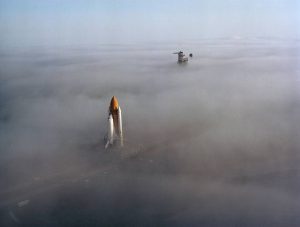
I approached my work as a Science Writer the same way I approached other reporting positions I had filled, which was to build in as much diversity and have as much fun with it as I could, all while doing a competent and credible job of reporting. I felt my specialty was taking highly complex scientific and technical details and issues and translating them in a way that just about any reader could understand, without dumbing them down. In the course of my term, I managed to score a wonderful stint at Space Camp in Huntsville, Ala., got to visit the WET-F – the huge water tank where astronauts practice doing EVAs in simulated weightlessness – in Houston, launched my own weather rocket, the Yacenda-1, from Cape Canaveral, flew aboard a NOAA hurricane tracker plane through a tropical storm, rode on the huge transporter that carried the Shuttle to the launch pad, and sat at desks of scientists with actual moon rocks on them. I came up with the term “astroworker” – a word my editors hated and took out at every chance they could, which is why you’ve never seen it – to encapsulate the kind of manual activity many astronauts and mission specialists engage in while in space.

More than anything was the thrill of meeting, interviewing, and in some cases spending time with people who had helped establish America’s place in space, people that had just been names bordering on mythological to me, and now I had the opportunity to be face-to-face with them. I got to interview and know half the men who had walked on the moon. It was said even then that Neil Armstrong rarely granted interviews. I had a telephone interview with him while he was a professor in Ohio, and he was indeed the humble, quiet, non-self-aggrandizing person I had been told he was. And I got to pal around for several days with Buzz Aldrin, who was and is every bit the character he was ascribed to being, though also knowledgeable and serious about America’s space pursuits. He told me of what was to be his next mission, setting up a space science program at the University of North Dakota. I love that the President featured Aldrin at the most recent State of the Union address.

I got to visit Edgar Mitchell and meet his family aboard Mitchell’s yacht when it was docked in Brevard County. I had the opportunity to interview Alan Bean about his art and Alan Shephard about his beer business. I had a number of encounters with Fred Haise, of Apollo 13 fame, both as a reporter and later as someone bidding for business from the company with which he became an executive, Grumman Aerospace. As then chief of the astronaut corps, John Young was someone I got to see and quote in numerous news conferences. I was able to meet Tom Stafford at an evening event. Though he wasn’t an astronaut, I got to interview Chuck Yeager, the first man to fly faster than the speed of sound and live to tell about it. And, a high point, I got to hang out with Walt Cunningham of Apollo 7 fame during some very entertaining days at Cape Canaveral when I had invited him to speak at a conference I helped organize, and then some time later have lunch with him at Brennan’s in Houston. I still remember the moment when we were waiting to board a tour bus at KSC and Cunningham was sitting on top of a waste basket, just as a place to rest. The bus driver informed us we needed to get tickets to take the tour, and then, realizing who the unassuming guy sitting on the trash can was, came bounding back off the bus, practically giddy and shaking, blurting out, “I’m sorry, Mr. Cunningham! I didn’t recognize you at first! Of course you don’t need a ticket! Anything you want, Mr. Cunningham!”

Along with all the other names and personalities, I got to interview Judy Resnik, one of my most memorable interviews. I still have the tape of that interview in which Resnik said she didn’t fear going up on the Shuttle since NASA took such care looking after the astronauts’ safety. When Challenger blew up on the bitterly cold morning of January 28, 1986, taking the lives of Resnik and her six crew mates with it, NASA wasn’t looking out for the astronauts’ safety, and neither was it when Columbia disintegrated on reentry on February 1, 2003. Both were avoidable disasters.

Looking Forward

I was no longer covering the space program at the time of the Challenger disaster — in fact, earlier the very morning it occurred I had looked toward the space center and said to myself, “One day that thing is going to blow up and I won’t be there when it does” — but I still was involved with space through my public relations firm, ITech International, which specialized in aerospace and high technology, among other areas. To me, the Challenger disaster was personal, both on account of the needless death of Judy Resnik and the other astronauts and specialists and the civilian school teacher, Christa McAuliffe, aboard, all of whom I had seen in news conferences and reported on, but because I helped bring Challenger into the world, covering its first launch, and the issues that had delayed that launch.

Following the Challenger disaster my old paper, TODAY, invited me to write an op-ed piece about the disaster and my views on where the country should go in its wake. In it I wrote how the Space Shuttle was equivalent to the early iterations of airliners that eventually led up to the DC-3, the first commercially successful airliner, and rather than expending money on another Shuttle orbiter, the nation should dedicate itself to new iterations of space transportation systems and go on to further space exploration. Obviously, Congress and NASA felt otherwise, and the space agency went on to build the orbiter Endeavour, which launched for the first time on May 7, 1992. And then, with the landing at KSC of the orbiter Atlantis on July 21, 2011, the Space Shuttle program came to an end.

And now, 50 years after the triumph of Apollo 11, we remain confined to low earth orbit. The International Space Station, development of which began when I was still involved with the space program, is the sole embodiment of humans in space. Since the end of the Shuttle program, the U.S. doesn’t even have the means of bringing our own astronauts to and from the ISS, depending on Russian rockets to do so. There are commercial rockets in the late development stage that are expected to be able to carry people to and from the ISS, but they’re not certified for this purpose yet. In fact, much of what holds promise for the future of space exploration rests with private companies, such as SpaceX and Boeing and several others.

I’m sure there is a lot of important work that goes on aboard the ISS, but I would venture that few people outside the program can name even one or two projects, specifically, that the ISS crews are working on. There is even credible argument that space is an expensive and not terribly great place for doing science. Regardless, whatever they are doing, it doesn’t provide the kind of excitement and global attention that deep-space exploration, most notably the Apollo lunar voyages, provided, and can provide. I am not denigrating the tremendously exciting and important and truly amazing unmanned space missions we’ve conducted. Our knowledge of the solar system and the universe beyond has been expanded enormously by these missions, and they should be continued. But somehow they lack the appeal and drama of manned missions of exploration to new destinations.

NASA and the space program reached its nadir in 2010 when its then-Adminstrator, Charles Bolden – himself a former astronaut – told Al Jazeera television that he had been charged by President Barack Obama with three primary tasks: Encourage children to learn about math and science, improve relations with foreign nations, and, Bolden said, “perhaps foremost, he wanted me to find a way to reach out to the Muslim world and engage much more with dominantly Muslim nations to help them feel good about their historic contribution to science … and math and engineering.”

Compare that with President Kennedy’s challenge, that the nation should commit itself to achieving the goal, before the decade was out, of landing a man on the moon and returning him safely to the earth. Not because it was easy, but because it was hard. In the intervening decades, it seems we have come down not just from the moon, but from rising to the kind of challenge the nation responded to in the 1960s.

Now there is talk of going to Mars. I’m happy to see that. While recognizing the costs and dangers involved in such missions, I think it is inevitable that the human spirit is always going to drive us on to bigger and more daring ventures, whether on earth or in space. I think it makes a lot of sense for us to go back first to the moon, and establish a base there. It takes a whole lot less energy to launch a rocket from a place where the gravity is one-sixth what it is on earth. There may be other justifications for a base on the moon, but that one alone provides justification if, in fact, we are intent on going to Mars and elsewhere in the solar system.

Most of my space interest these days is constrained to looking at the full moon, when it appears and the skies are clear, and watching for night launches from Cape Canaveral. I’m living 120 miles from the launch site, but in the dark of night I can get pretty clear views of the launches, which continue to excite me. Recently, during the latest SpaceX launch of its Falcon Heavy rocket from Pad 39A on June 25, the same launch pad from which Apollo 11 launched, I actually got to see the return to earth of the two first-stage boosters that came back to land at KSC. I think that was even more exciting than the launch, all the more so since I wasn’t expecting to be able to see that, just as watching the first Shuttle landing at KSC from the grandstand beside the runway was so exciting 35 years ago. I’m sure that one of these days I’m going to need to go back down to the space center and watch a launch from closer up.

And now, fifty years after that first footstep on the moon, I and the other 7.7-whatever billion people on this planet can only look up at the moon, and wonder: Will mankind ever again set foot on that celestial body? Will my children get to go there? Some might even wonder if they, themselves, will get a chance to go to the moon.

It is of such wonderment that giant leaps are born.

Watch the actual ignition and liftoff of Apollo 11 shot by a NASA camera at the launch pad

All images by NASA except the last image which is by SpaceX

This is a joint posting with my fiction site. It also appears on Medium.

That Time of Year Again: Thoughts on “the Longest Day in the World”

That Time of Year Again: Thoughts on “the Longest Day in the World”

This piece initially appeared two years ago, on June 21, 2017, the Summer Solstice. Today it is once more the Summer Solstice in the Northern Hemisphere, and the actual solstice officially occurs at 11:54 a.m. EDT/15:54 UTC this morning. The time and other references and weather comments in the piece are as they were two years ago, when the post first appeared. I’m no longer living on the boat, and it’s been a rainy year so far. And this year it’s been 50 years, half a century, since my father’s death. I think I will make re-posting this piece an annual event. I hope you enjoy it.

It’s June 21, the day of the summer solstice in the Northern Hemisphere, the winter solstice in the Southern Hemisphere. It’s a day that holds various meanings for different peoples, and its significance goes back millennia. The solstice, whether summer or winter, officially took place at 12:24 a.m. U.S. Eastern Daylight Time this morning, or 04:24 UTC.

Just to set the record straight and dispel any questions about my scientific knowledge, I know it’s not the longest day in the world. It’s the longest day of the year in the Northern Hemisphere, the shortest day in the Southern Hemisphere. But we’ll get to this a bit later.

It’s been a mixed bag today here on the West Coast of Florida. We’ve been having a lot of rain, something we didn’t have much of over the winter, and the rainy times are interspersed with sunny breaks. Right now, as I look out the window of my boat, the sun is mostly out but I’m looking at the light through rain-drop spattered glass. At least we’re not getting the effects of Tropical Storm Cindy, which is much further west and at this moment dumping lots of water on the upper Gulf Coast.

In this country, the summer solstice marks the official beginning of summer, though in other places and other cultures it marks the middle of summer, as indicated by the name Midsummer Night, which can occur anywhere from the 20th to the 24th of June. And really it is midsummer, since the days, which have been lengthening since the equinox three months ago, now will start to grow shorter, the nights longer.

The sun has reached its apogee in this hemisphere, as it stands today directly over the Tropic of Cancer. I feel summer ending, we already are on the downhill side, the side that will take us through the hot coming months but already on the slide back into winter, the cold time of year. Just as in the Southern Hemisphere the days will begin to grow longer as the seasons move back to summer.

A year ago on this day I was in Alaska, where there never really was a night. Where I was, well below the Arctic Circle, the sun went down sometime around midnight, but there was a kind of twilight that lasted until the sun rose again a few hours later. Above the Arctic Circle on this day, the sun never sets, and it truly is the Land of the Midnight Sun.

My thoughts turn to other things on this day. Someone asked me the other day, which was Father’s Day in the U.S., what thoughts I had of my father on that Sunday. But really, I think of Father’s Day as a commercial holiday. I also remember the last Father’s Day I had with my father, and how my mother did her unwitting best to create conflict between me and my father. While I may wish a happy day to the fathers I know on Father’s Day, it is today, the day of the solstice, that I think of my father. June 21 was his birthday, which in most years coincides with the solstice. I was told as a child that it was the longest day of the year, which I translated in my own way into it being the longest day in the world, and I would go around telling everyone who would listen that it was.

“It’s the longest day in the world!” I’d exclaim each year on his birthday, from morning until night.

I think today of my father on this day, the 21st of June. Gone now, for nearly 48 years. And I think back to the day of his birth, June 21, 1913. One hundred and four years ago. Even had he not died young as he did, just 56 years old, it is hard to imagine that he would still be alive today had he not died when he did. A prolongation of the inevitable.

A factoid I learned earlier is that today is not the longest day in the history of the world, as one might imagine it to be given that the earth’s rotation on its axis generally was slowing. Rather, the longest day in the history of the world is believed to be June 21, 1912, and things like the earth’s tides and recession of the glaciers have caused a slight increase in the rate of the planet’s rotation since then. My father was born a year later, which arguably could have been the second or third longest day in the history of the world, if not the actual longest day in the world.

I wonder what it was like on that June day, the day of the solstice, the longest day of the year, the day my father was born, in Jersey City, New Jersey. Did his father and mother, his Italian parents, my grandparents that I never knew, know it was the solstice? Did they even know of the solstice? Regardless, I’m inclined to think they did not think of it, if for no other reason than that they had something else on their mind that day. And then I think of the things people from then knew and were taught and how many of those things have been lost today, in these encroaching new Dark Ages in which we find ourselves, and I have to wonder. Perhaps they knew, better than most people today know. Or care to know. And they did note the auspicious day on which their son was born.

I’ll think of my father again on July 27, the anniversary of his death, and by then even our summer, the summer as we define it, will be half over.

The solstices, like the equinoxes, serve as a kind of punctuation for me. I watch the ebb and the flow of the days, the seasons, the years, and they mark the passage of time, time that increasingly slips by way too quickly. All of life is punctuation, I think. Slowing. Stopping. Breaking things, even waves on the water, into different parts, different pieces, different rhythms and fugues and movements and phrases and sentences. It is through such punctuation that we mark our lives, mark our transit through summer and back into winter, from day into night, from life into death. Watching, as a reader of a story does, while the time of our lives flows past. When we lose that punctuation, everything blends into one big mass, and we feel lost in the current, flailing and drowning as we’re pulled inexorably along. At least I do.

Enjoy this song, which I found today amid my files, and with which I end this post, and enjoy the time that nature and life give us.

Click here if song doesn’t play.

This piece also appears on Medium. Follow me there, and here.

Repeat Posting: Thoughts on “the Longest Day in the World”

Repeat Posting: Thoughts on “the Longest Day in the World”

This piece initially appeared a year ago, on June 21, 2017, the Summer Solstice. Today it is once more the Summer Solstice in the Northern Hemisphere, and the actual solstice officially took place at 6:07 a.m. EDT/10:07 UTC this morning. The time and other references and weather comments in the piece are as they were last year, when the post first appeared. I hope you enjoy it.

It’s June 21, the day of the summer solstice in the Northern Hemisphere, the winter solstice in the Southern Hemisphere. It’s a day that holds various meanings for different peoples, and its significance goes back millennia. The solstice, whether summer or winter, officially took place at 12:24 a.m. U.S. Eastern Daylight Time this morning, or 04:24 UTC.

Just to set the record straight and dispel any questions about my scientific knowledge, I know it’s not the longest day in the world. It’s the longest day of the year in the Northern Hemisphere, the shortest day in the Southern Hemisphere. But we’ll get to this a bit later.

It’s been a mixed bag today here on the West Coast of Florida. We’ve been having a lot of rain, something we didn’t have much of over the winter, and the rainy times are interspersed with sunny breaks. Right now, as I look out the window of my boat, the sun is mostly out but I’m looking at the light through rain-drop spattered glass. At least we’re not getting the effects of Tropical Storm Cindy, which is much further west and at this moment dumping lots of water on the upper Gulf Coast.

In this country, the summer solstice marks the official beginning of summer, though in other places and other cultures it marks the middle of summer, as indicated by the name Midsummer Night, which can occur anywhere from the 20th to the 24th of June. And really it is midsummer, since the days, which have been lengthening since the equinox three months ago, now will start to grow shorter, the nights longer.

The sun has reached its apogee in this hemisphere, as it stands today directly over the Tropic of Cancer. I feel summer ending, we already are on the downhill side, the side that will take us through the hot coming months but already on the slide back into winter, the cold time of year. Just as in the Southern Hemisphere the days will begin to grow longer as the seasons move back to summer.

A year ago on this day I was in Alaska, where there never really was a night. Where I was, well below the Arctic Circle, the sun went down sometime around midnight, but there was a kind of twilight that lasted until the sun rose again a few hours later. Above the Arctic Circle on this day, the sun never sets, and it truly is the Land of the Midnight Sun.

My thoughts turn to other things on this day. Someone asked me the other day, which was Father’s Day in the U.S., what thoughts I had of my father on that Sunday. But really, I think of Father’s Day as a commercial holiday. I also remember the last Father’s Day I had with my father, and how my mother did her unwitting best to create conflict between me and my father. While I may wish a happy day to the fathers I know on Father’s Day, it is today, the day of the solstice, that I think of my father. June 21 was his birthday, which in most years coincides with the solstice. I was told as a child that it was the longest day of the year, which I translated in my own way into it being the longest day in the world, and I would go around telling everyone who would listen that it was.

“It’s the longest day in the world!” I’d exclaim each year on his birthday, from morning until night.

I think today of my father on this day, the 21st of June. Gone now, for nearly 48 years. And I think back to the day of his birth, June 21, 1913. One hundred and four years ago. Even had he not died young as he did, just 56 years old, it is hard to imagine that he would still be alive today had he not died when he did. A prolongation of the inevitable.

A factoid I learned earlier is that today is not the longest day in the history of the world, as one might imagine it to be given that the earth’s rotation on its axis generally was slowing. Rather, the longest day in the history of the world is believed to be June 21, 1912, and things like the earth’s tides and recession of the glaciers have caused a slight increase in the rate of the planet’s rotation since then. My father was born a year later, which arguably could have been the second or third longest day in the history of the world, if not the actual longest day in the world.

I wonder what it was like on that June day, the day of the solstice, the longest day of the year, the day my father was born, in Jersey City, New Jersey. Did his father and mother, his Italian parents, my grandparents that I never knew, know it was the solstice? Did they even know of the solstice? Regardless, I’m inclined to think they did not think of it, if for no other reason than that they had something else on their mind that day. And then I think of the things people from then knew and were taught and how many of those things have been lost today, in these encroaching new Dark Ages in which we find ourselves, and I have to wonder. Perhaps they knew, better than most people today know. Or care to know. And they did note the auspicious day on which their son was born.

I’ll think of my father again on July 27, the anniversary of his death, and by then even our summer, the summer as we define it, will be half over.

The solstices, like the equinoxes, serve as a kind of punctuation for me. I watch the ebb and the flow of the days, the seasons, the years, and they mark the passage of time, time that increasingly slips by way too quickly. All of life is punctuation, I think. Slowing. Stopping. Breaking things, even waves on the water, into different parts, different pieces, different rhythms and fugues and movements and phrases and sentences. It is through such punctuation that we mark our lives, mark our transit through summer and back into winter, from day into night, from life into death. Watching, as a reader of a story does, while the time of our lives flows past. When we lose that punctuation, everything blends into one big mass, and we feel lost in the current, flailing and drowning as we’re pulled inexorably along. At least I do.

Enjoy this song, which I found today amid my files, and with which I end this post, and enjoy the time that nature and life give us.

This piece also appears on Medium. Follow me there, and here.